

ZILART Museum-Exhibition Centre. Exterior. Moscow, 2025. Photo by Dmitry Chuntul. Courtesy of ZILART Museum-Exhibition Centre
The Copper Gates: ZILART Museum Opens in Moscow
The Zilart Museum-Exhibition Centre has opened in the Russian capital, with installations by Grisha Bruskin and Alexander Brodsky, and exhibitions of African art and contemporary Russian sculpture and painting. The ambitious copper-clad building, designed by Sergei Tchoban, represents a transformation from its original Hermitage partnership concept into a private institution reflecting contemporary Russian cultural politics.

The long awaited Zilart Museum & Exhibition Centre has opened its doors in Moscow, captivating visitors with new installations by leading Russian contemporary artists Grisha Bruskin (b. 1945) and Alexander Brodsky (b. 1949), as well as displays of African art and contemporary Russian sculpture and painting. Its impressive state-of-the-art building was designed and constructed by SPEECH bureau under architect Sergei Tchoban. Behind the whole ambitious project are two art collectors Andrey and Elizaveta Molchanov.*

‘Dies Illa’, an installation by Grisha Bruskin is the hero display at Zilart. Since Bruskin was first catapaulted into the public eye in 1988 at Sotheby’s legendary auction in Moscow where his work ‘Fundamental Lexicon’ (1986) became the most expensive lot sold hammering down at an impressive $416,000, even now four decades on, this sale remains among the top auction results for works by a living Russian artist. Grisha Bruskin went on to become one of the best known and most sought-after Russian emigre artists (although after a long time living in New York, he has returned to his native Moscow) and his work is represented in dozens of major public and private collections around the world.

One recalls here the intrigue surrounding Bruskin’s previous solo exhibition ‘Change’ at the State Tretyakov Gallery in 2022 which was closed prematurely and information about it was also taken off the museum’s website, at the time widely seen as evidence for a hightened level of censorship in Russia. This new exhibition at Zilart, however, is a continuation from the previous one at the Tretyakov both part of a trilogy that opened with ‘Theatrum Orbis’ in the Russian pavilion at the 57th Venice Biennale of Contemporary Art in 2017. This was reworked by the artist for the State Tretyakov Gallery in 2022, and now, in a substantially updated form, is presented here at Zilart museum.

Here Bruskin’s characters are living in a post-apocalyptic world built on aggression and hierarchy. They are fantastical creatures – angels and human-scorpions, a woman on chicken legs and Samodelkin, a robot from a popular Soviet cartoon. In his multi-layered work, Bruskin quotes many visual sources from Russian icons to ‘The Burghers of Calais’ by Auguste Rodin (1840–1917). And in an animation that frames the project there are themes of bombing and destruction of buildings. The metaphorical nature in his work is often transparent, such as the figure of a double-headed eagle trampling over a faceless crowd of people who are carrying it, which migrates from one Bruskin exhibition to another. The symbolic significance of presenting this project in the new museum is hard to miss: quod licet Jovi, non licet bovi (“what is permitted to Jupiter is not permitted to the ox”).

It is forbidden to take photographs of Bruskin’s exhibition at Zilart revealing how what is possible to show on private territory is impossible to bring into the public media space. And so an interesting question arises about the boundaries of privacy where in this case the museum looks more like a scaled up institutional extension of the private sphere than a potlatch – a gratuitous gift from a patron to society. And thus the public significance of the museum is narrowed to the framework of representing private taste.

Brushkin’s monsters perhaps echo the African idols presented on the fourth floor of the museum. This tribal art collection was assembled over three decades by the artist Mikhail Zvyagin and his son Leonid and purchased by the owners of Zilart Museum. The more than 800 works are diverse – amongst them bronze heads and barn doors, masks of secret societies and thrones of tribal chiefs. In 2011, part of the Zvyagin collection was presented at a temporary exhibition in the Museum of Private Collections (part of the Pushkin State Museum of Fine Arts), and Irina Antonova, the renowned director of the Pushkin, had hoped that some of the works might be transferred into state custody. However, Antonova passed away in 2020, and the Museum of Private Collections has de facto not been operating since 2018. According to the collectors themselves, the collection contains exceptionally rare artefacts from the most ancient of cultures on the African continent. However, back in 2011 some museum experts were raising questions about the authenticity and provenance of some items from the Zvyagin collection. Unfortunately today there is no-one in Russia who can authenticate them now as the leading specialists in African art, Anatoly Gromyko and Vil Mirimanov, have passed away.


Expressiveness here replaces scholarship. What viewers encounter is essentially an installation by Yevgeny Ass, the exhibition’s architect, who has created a modular system of circular podiums in various colours, heights and sizes, which unites the objects created by diverse cultures across different epochs with clever lighting effects. He has made an elegant architectural-sculptural ensemble evocative of a forest, in places a gathering of spirits. Yevgeny Ass emphasises that he is an “anti-colonial architect” recalling fondly his first encounter with young Africans on Tverskaya Street in Moscow during the World Festival of Youth and Students in 1957.

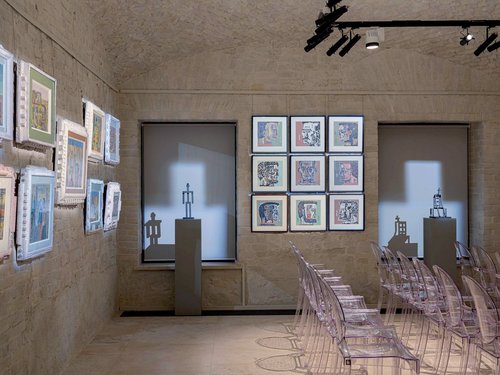
On the second and third floors of the museum, there are displays of Russian sculpture and painting. The museum building which was originally designed for large scale works by contemporary artists, now displays a lot of smaller works. To showcase the Molchanovs’ collection of paintings, architect Yury Avvakumov built boxes on the second and third floors which lower the ceiling height to a more human scale within which are exhibited paintings by Moscow artists Ilya Kabakov (1933–2023), Erik Bulatov (1933–2025), Oleg Vassiliev (1931–2013), and Semyon Faibisovich (b. 1949), ‘blue chip’ works of the Russian art market. Around the display cases there are sculptures by local St Petersburg sculptors Dmitry Kaminker (b. 1949), Robert Lotosh (b. 1953) and others. There is a sense that the work of the exhibition designer, although in part to conceal design miscalculations, draws attention to the absence of an overall concept for the exhibition.

Erik Bulatov. A Keepsake Photo, 1994-1995. Photo by Yuri Palmin. Courtesy of ZILART Museum-Exhibition Centre

Oleg Kudryashov. From left to right: Sample 1_1 sheet one, 2014; _1_1, 2014; Untitled, 2007. Exhibition view. Moscow, 2025. Photo by Yuri Palmin. Courtesy of ZILART Museum-Exhibition Centre

Eliy Belyutin. Untitled. Abstract Composition, 1991. Photo by Yuri Palmin. Courtesy of ZILART Museum-Exhibition Centre
There have been many challenges for ZILART to overcome during the past decade. Initially called ‘Hermitage – Moscow’, the museum project for a new residential district built on the site of a Soviet car factory was commissioned by the developers. The chosen architect was Hani Rashid, founder of New York's Asymptote Architecture and the museum was to show exhibitions of leading international artists as well as works from the Hermitage collection, under the leadership of Dimitry Ozerkov, then head of the contemporary art department at the State Hermitage Museum.
Things changed. The Hermitage withdrew from the project. Sergei Tchoban became the architect. Ozerkov left Russia in 2022. The Molchanovs took on Alexander Borovsky, head of the department of recent trends at the State Russian Museum, as a consultant.
As a result, there are no works from the Hermitage collection in the new museum. Exhibitions of world stars like Louise Bourgeois (1911–2010), Anish Kapoor (b. 1954) or Tony Cragg (b. 1949) in Russia are not on the cards in the near future. The architectural concept has remained similar with a total area of more than 13,000 square metres, a five-storey cube with a balcony, large windows and zigzags on the façade. But overall it is a completely different project.

Ilya Kabakov. New Accordion, 2011. Photo by Yuri Palmin. Courtesy of ZILART Museum-Exhibition Centre

Mikhail Roginsky. Call Me, 1994. Photo by Yuri Palmin. Courtesy of ZILART Museum-Exhibition Centre

Viktor Pivovarov. Blue Glasses of a Mad Policeman. Photo by Yuri Palmin. Courtesy of ZILART Museum-Exhibition Centre
To its first visitors the new museum evokes delight as well as a sense of bewilderment. People are excited by Sergei Tchoban’s architecture and the imagination of the exhibition designers. The architecture embodies the ideal of new Russian capitalism for its gigantism and its ambitiousness. The glazed façade, and the height of the entire building is intersected by copper coated shiny lines both straight and on the diagonal lines which resemble lightning.

Copper is the defining expressive element of Zilart’s building, both inside and out and it feels like high tech luxury. Copper panels generously cover the walls of the spaces on each of the exhibition floors like a solid wall, and when you pass into the exhibition spaces you have to overcome considerable resistance from the enormous doors which are completely covered with these copper panels reminiscent of gateways to an ancient Egyptian temple. On an awesome scale, dwarfing the visitors who pass through them, they set expectations high.

*ZILART is a private museum established by Andrey Molchanov, entrepreneur, art collector, founder and majority shareholder of LSR Group; and Elizaveta Molchanov, art collector, founder of charitable organization “Dobrotorium” helping children with special needs.
Grisha Bruskin. Dies Illa
ZILART Museum-Exhibition Centre
Moscow, Russia
2 December 2025 – 17 January 2027
Alexander Brodsky. Shelter of the Innocent
ZILART Museum-Exhibition Centre
Moscow, Russia
2 December 2025 – Ongoing
African Art: Gods, Ancestors, Life
ZILART Museum-Exhibition Centre
Moscow, Russia
2 December 2025 – 17 January 2027
A Step Off the Pedestal: Sculpture in Real Space
ZILART Museum-Exhibition Centre
Moscow, Russia
2 December 2025 – 5 July 2026