

The Art Newspaper Russia’s Annual Award Celebrates Private Cultural Initiatives

The winners of the XIV The Art Newspaper Russia Award with Olga Yarutina, Tatiana Sakhokia, Milena Orlova. Photo by Irina Polyarnaya/Natalia Polskaya/Anna Makarevich/Anna Temerina. Courtesy of The Art Newspaper Russia
At this year’s awards ceremony in Moscow, The Art Newspaper Russia offered more than a roll call of winners: it staged a revealing portrait of the country’s cultural establishment. From private museums and contested biographies to sanctioned patrons and Venice-bound performers, the evening exposed the ambitions, tensions, and carefully managed symbolism shaping Russian art today.
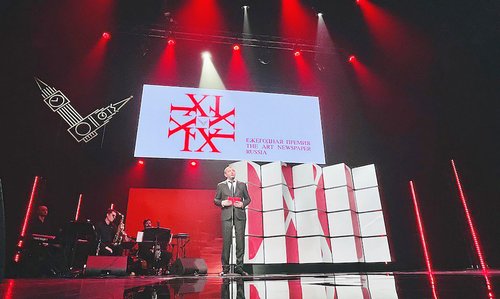
On the evening of 25th of March, the professional art crowd flocked to the Pyotr Fomenko Theatre in Moscow for the newspaper’s hotly awaited annual awards ceremony. The nominations mirror the sections in the paper, which is why the prizes recognise the achievements of institutions, writers, and art patrons rather than individual artists. Winners receive miniature sculptures designed by the Moscow artist Sergei Shekhovtsov, depicting Big Ben and a Kremlin tower joined like the hands of a clock. Both winners and runners-up are selected by the editorial team on the basis of the subjects covered in the newspaper over the previous year.
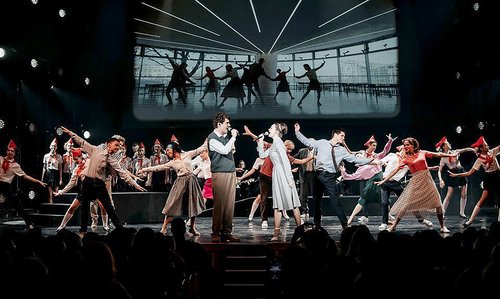
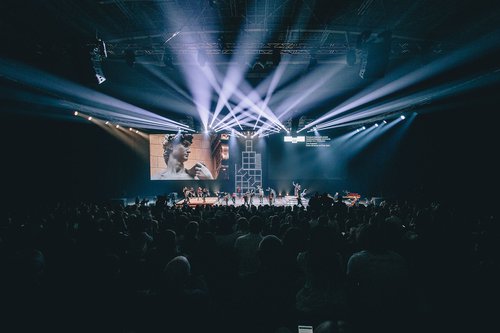
After brief opening remarks by publisher Olga Yarutina and editor-in-chief Milena Orlova, the ceremony began. Shekhovtsov’s sculptures changed hands amid theatrical and musical interludes, staged, as usual, by Alexey Agranovich and Kirill Preobrazhensky. This year, the most intriguing presence in the line-up was Toloka, the ethno-folk collective due to travel to Venice in May to perform at Russia’s national pavilion. During the preview days, they will share the stage with other musicians and DJs from various countries brought in especially for the occasion. Afterwards, video documentation of the performance will be shown on screens inside the locked pavilion, visible to visitors only through its open windows. It feels like a timely, if unintended, metaphor for Russian culture: separated from the West and operating in a closed circuit. Toloka performed two experimental compositions loosely inspired by traditional Russian folk songs, while dancers in black-and-white costumes moved through a ritual-like choreography by Olga Tsvetkova.

The final performance of the XIV The Art Newspaper Russia Award. Photo by Irina Polyarnaya/Natalia Polskaya/Anna Makarevich/Anna Temerina. Courtesy of The Art Newspaper Russia

Theatrical performance dedicated to the 'Book of the Year' winner. Photo by Irina Polyarnaya/Natalia Polskaya/Anna Makarevich/ Anna Temerina. Courtesy of The Art Newspaper Russia
The award in the Personal Contribution category went to the real estate developer Andrei Molchanov and his wife, Elizaveta, founders of Moscow’s Zilart Museum. The museum opened in December 2025 in an impressive building designed by the Russian-German architect Sergei Tchoban. In his acceptance speech, Molchanov noted that, as natives of Leningrad – now St Petersburg – he and his wife saw it as their mission to bring the art of their home city to Moscow. The collection indeed includes numerous sculptures by St Petersburg artists. He also thanked Alla Manilova, director of the State Russian Museum, for allowing him to borrow what he called the museum’s ‘most valuable asset’: the curator Aleksandr Borovsky, who oversees Zilart’s exhibition programme.

A few minutes later, Manilova herself took to the stage to accept the prize in the Museum of the Year category, awarded to her institution. There was good reason for this distinction: the State Russian Museum has entered the annual ranking of the world’s most visited museums compiled by The Art Newspaper’s international network of editors and journalists. In 2025, it rose to sixth place on the list, having welcomed 5.1 million visitors. In her speech, Manilova shared a striking statistic, noting that at the museum’s blockbuster Karl Bryullov exhibition the number of visitors from Moscow was the same as from St Petersburg. She also gave the audience a teaser with the promise of a ‘sensational’ exhibition in Moscow, to be produced in collaboration with Zilart. The Russian Museum turned out to be the only state institution among this year’s winners.
The award in the Restoration of the Year category went to the industrialist Anatoly Sedykh – under UK sanctions since 2024 – for the restoration of the 1898 water tower built by the engineer Vladimir Shukhov on the grounds of a metallurgical plant in the central Russian town of Vyksa, now owned by Sedykh. The structure was carefully dismantled and reassembled in the town centre.

Anatoly Sedykh accepts the award in the 'Restoration of the Year' nomination. Photo by Irina Polyarnaya/Natalia Polskaya/Anna Makarevich/Anna Temerina. Courtesy of The Art Newspaper Russia

Vasily Tsereteli, President of the Russian Academy of Arts and Director of the Moscow Museum of Modern Art, presented the 'Museum of the Year' award to Alla Manilova, Director of the State Russian Museum. Photo by Irina Polyarnaya/Natalia Polskaya/Anna Makarevich/Anna Temerina. Courtesy of The Art Newspaper Russia

Olga Vartseva, Director of the Voznesensky Center, and the curatorial team (Tatiana Sokhareva, Ivan Yarygin, and Dmitry Hvorostov) received the award in the 'Exhibition of the Year' nomination. Photo by Irina Polyarnaya/Natalia Polskaya/Anna Makarevich/Anna Temerina. Courtesy of The Art Newspaper Russia
The award in the Book of the Year category went to the Russian writer and journalist Lev Danilkin for his controversial biography of the late director of the State Pushkin Museum, ‘Madame’s Palazzo: The Imaginary Museum of Irina Antonova’. The book drew criticism from many museum professionals for presenting the legendary director in an unflattering light, despite the fact that Danilkin had never spoken to Antonova during her lifetime and has no academic or professional background in art history. In his acceptance speech, he referred to the attacks against him, noting that he had been denounced as an ‘impostor’, and expressed surprise that ‘good art historians’ — by which he meant the award jury — still existed, rather than only ‘censors and retrogrades’.
The organisers added a theatrical twist by inviting art historian Mikhail Kamensky, a former deputy director under Antonova, to present Danilkin with the prize. Kamensky is one of the book’s central figures, and many of its most caustic passages are drawn from Danilkin’s interviews with him. Before handing over the coveted statuette, he praised the writer for his ‘personal courage’, remarking that ‘while other winners receive the prize, Lev receives the trophy’, and adding that Antonova had ‘earned an honest book about herself’.

Competition in the Exhibition of the Year category was especially fierce: according to Orlova, the longlist comprised thirty shows. The award ultimately went to ‘Dark Thaw’, an ambitious project at the Voznesensky Centre in Moscow devoted to the rarely seen art of the largely Leningrad-based ‘metaphysical underground’ of the 1960s. The exhibition was curated by a young team — Tatiana Sokhareva, Dmitry Khvorostov, and Ivan Yarygin. As the Centre’s director, Olga Vartseva, explained, they spent an entire year tracking down loans from private collections.