

Swans, Saints and Spuntniks: Naïve Art on View in Moscow

Vasiliy Shevchenko. Widows, 1991. Courtesy of Tsaritsyno Museum-Reserve
Russian naïve art has long occupied the margins of art history, dismissed as charming amateurism or celebrated simply for its authenticity. ‘Not-So-Naïve: Art Beyond the Rules’, at Moscow’s Tsaritsyno Museum-Reserve, argues for a far richer understanding. Drawing together works from twelve museum collections, it reveals an artistic tradition that is at once deeply rooted in folk culture, profoundly shaped by Soviet life and astonishingly original in its vision.
If you want to understand the enigma of the Russian soul go to see the exhibition ‘Not-So-Naïve: Art Beyond the Rules’. Naïve art, or primitivism, has long been created primarily by self-taught artists – individuals of remarkable talent who work outside the academic conventions of composition and technique taught in art schools. While every culture has its own tradition of naïve art, these artists respond to the world with an unguarded immediacy, giving rise to visual languages and iconographies that are deeply rooted in the character and experience of their own communities.

Staged at the Tsaritsyno Museum, home since 1985 to one of Russia’s largest collections of naïve art, the exhibition traces the development of this tradition from the twentieth century to the present day through works drawn from twelve museums. Occupying eleven intimate rooms arranged to evoke the atmosphere of a traditional village izba, the exhibition unfolds across seven thematic sections, ranging from the origins of folk art and reinterpretations of the Old Masters to handcrafted icons and the unique tradition of the naïve artist’s book.
The exhibition’s title contains a deliberate paradox: naïve art is not always entirely naïve, yet it never conforms to the conventions of academic art. In one form or another, naïve art has always existed. For centuries, villagers with a natural gift for drawing decorated their homes with ornamental patterns, religious imagery and scenes from folklore. It was only in the late nineteenth and early twentieth centuries, however, that the professional art world began to recognise the artistic significance of these deeply rooted vernacular traditions.

The modernist avant-garde played a crucial role in this reassessment. Pablo Picasso, who sought the origins of artistic expression in the art of African cultures, famously declared that “every child is an artist.” The artists of the Bubnovy Valet (Jack of Diamonds) group embraced the expressive power of Russian peasant art; the Zdanevich brothers introduced the work of Niko Pirosmani to a wider audience; and the Surrealists, in turn, found profound creative inspiration in the art of psychiatric patients, seeing in it an unmediated expression of the unconscious.
And so naïve art became, as we might say today, a trend. In Russia, it had long been valued as an authentic expression of folk culture and was even harnessed for Soviet propaganda during the revolutionary years, much as the avant-garde initially was. Yet, like so many other forms of artistic experimentation, it eventually found itself pushed to the margins. Incapable – and indeed unwilling – to conform to the dictates of Socialist Realism, naïve art came to occupy its own place within the broader landscape of unofficial culture.

Naïve artists nevertheless continued to inhabit their own imaginative world, even as the society around them changed with extraordinary speed. Alongside idyllic landscapes, fairy tales and scenes drawn from folklore, they increasingly depicted the realities of everyday Soviet life: domestic interiors, family celebrations and village routines, but also the unmistakable symbols of the new social order – political slogans, demonstrations, Party meetings and portraits of Soviet leaders. Regrettably, this aspect of “the new life” is largely absent from the exhibition. Yet it is precisely this dimension that best reveals the duality of the world inhabited by naïve artists: for all their originality, imagination and apparent detachment from official artistic conventions, they remained ordinary Soviet citizens, living within and responding to the ideological realities of their time.
Pavel Leonov (1920–2011), the foremost figure of Soviet and Russian naïve art, is represented in the exhibition by only three works, though each is highly characteristic of his unique artistic vision. An artist who achieved widespread recognition in Russia and abroad only in the final decades of his life, Leonov created large, rhythmically structured compositions populated by dense crowds of diminutive figures. Rich in narrative and ornament, his paintings employ decorative borders not merely as framing devices but as a means of dividing the image into distinct thematic episodes – a process he himself described as “constructing.” ‘On a Stroll’ (1991) exemplifies Leonov’s elaborate pictorial language. The vertical composition unfolds across a series of stacked registers within a planar structure, “enriched by decoration,” as the artist himself put it. A border of birds and butterflies frames the image, while the composition is divided into successive zones: a cityscape at the top; below it, a road filled with cars; then a pond with ducks; beneath that, an open field populated by people, horses and an eagle, enclosed by bushes as though within its own ornamental frame; followed by a decorative frieze of birds and squirrels; and finally, at the very bottom, the scene that lends the work its title – a man strolling with an accordion accompanied by two women.

Even here, however, appearances are deceptive. Rather than depicting living figures directly, Leonov presents something closer to a photograph resting on a shelf: beside the figures stands a vase of flowers almost equal to them in height, subtly collapsing distinctions between representation and reality. His imagination invariably exceeded the physical limits of the canvas, and when he found himself unable to include everything he wished to say, he would sometimes attach handwritten notes on separate sheets, extending the work beyond its painted surface.
Leonov’s teacher at the Correspondence People’s University of Arts (ZNUI), the celebrated nonconformist artist Mikhail Roginsky (1931–2004), later captured the singularity of his pupil’s vision: “He always lived in an upside-down world, a mirror world, where everything exists according to its own laws, with its own sky and its own earth. He was, and remains, a Don Quixote of the Soviet era.”

Leonov himself was equally explicit about his artistic philosophy. “An artist must not draw simply for the sake of drawing,” he wrote. “He must be saved from the danger of naturalism.” Yet for all the fantastical richness of his imagination, he remained deeply rooted in Soviet reality. “I too am an artist of the Soviet land,” he declared, “and I apply its life and nature to canvas. My canvas, like a mirror, like a photograph, shows life… The Soviet land was and will remain a guiding star among the million lights of the heavenly firmament… The artist Leonov has depicted, and will continue to depict, its life, its everyday existence, its culture and its technology.”

This apparent contradiction lies at the heart of Leonov’s achievement. He rejected naturalism without abandoning reality, constructing instead an alternative world in which the everyday and the visionary, the Soviet and the universal, coexist in perfect harmony. It is precisely this tension that makes his work one of the most compelling expressions of Russian naïve art.
Russia’s vast landscape has always been fertile ground for extraordinary talent, and many naïve artists – including Leonov – passed through the Correspondence People’s University of Arts (ZNUI). During the 1960s and 1970s, the institution became an unlikely meeting point between self-taught artists and the Soviet nonconformist movement, employing a remarkable number of unofficial artists as tutors. Alongside Mikhail Roginsky, the faculty included Alexei Kamensky (1927–2014), Ivan Chuikov (1935–2020), Boris Turetsky (1928–1997), Andrei Grositsky (1934–2017), Nikolai Kasatkin (1932–2019), Yuri Kuper (b. 1940), Boris Otarov (1916–1991), and others. Their guidance enabled self-taught artists to develop their artistic language without sacrificing the originality and independence that defined their work. Rather than imposing academic conventions, these teachers recognised and nurtured the distinctive qualities that made naïve art so compelling.

In Russian, people of this kind are often described as ne ot mira sego – literally, “not of this world.” Yet it was precisely this capacity to remain apart from conventional ways of thinking that allowed many naïve artists to navigate the complexities of Soviet life while preserving the integrity of their own inner worlds.
Few embodied this more vividly than Alexander Lobanov (1924–2003), whose works appear in the exhibition’s portrait section. Having contracted meningitis in early childhood, he was left deaf and unable to speak. Unable to read or write beyond his own name and a handful of words, he nevertheless drew obsessively throughout his life, constructing around himself an astonishingly coherent – indeed, almost conceptual – personal mythology. His great obsession was firearms. Although he never handled a real weapon, he depicted rifles and pistols incessantly, transforming them through endless acts of invention into fantastical hybrid machines that existed only in his imagination.

One of Lobanov’s greatest pleasures in life was to leave the psychiatric institution where he lived and visit a local photographic studio. There, posing within elaborate decorative frames that he had designed and cut out himself the previous day, he staged a series of extraordinary self-portraits. Some of these photographs later became the basis for meticulously redrawn painted self-portraits; others survived as delicately hand-coloured photographs. Together they reveal an artist who transformed the conventions of portraiture into a lifelong performance of self-invention, using photography and drawing not simply to record his identity but to create it.
Even when responding to the realities of the world around them, naïve artists seem to exist outside time. The exhibition is filled with what might be called “eternal subjects.” A troika hurtles across the snow, pursued by a tiny dog (Vasily Grigoryev, 1914–1994); garish red roses bloom along the picture’s borders – a familiar motif of Russian folk decoration – as do scenes borrowed from the imagery of popular printed rugs: deer in a forest or swans gliding across a tranquil pond (Matriona Skovorodko, 1930–?, ‘Deer and Swans’ (1976); Olga Frantskevich, b. 1937, ‘The Garden of Eden’ (2015). Nearby hangs ‘Guardian Angel’, after a Biedermeier prototype, painted by Nikolai “Boroda” in the 1980s and early 1990s. Yet, unlike their printed or painted sources, these images – reinterpreted in a deliberately childlike manner and rendered in luminous, unmodulated colours – possess a sincerity and emotional warmth that make them unexpectedly moving.

An equally genuine delight awaits in the section entitled ‘As in a Museum’, where familiar masterpieces are reimagined through the lens of naïve art. Here is ‘Alyonushka’; here are Viktor Vasnetsov’s ‘Three Bogatyrs’ (a mid-twentieth-century workshop copy), once again “adorned” with red roses around the edges; two versions of Karl Brullov’s ‘Horsewoman’; and two interpretations of Konstantin Makovsky’s ‘Children Running from a Storm’. Even Sandro Botticelli’s ‘Birth of Venus’ finds its place in this remarkable gallery of reinventions.
Perhaps the most astonishing works, however, are those by Alexei Pichugin (1909–1999), who painstakingly translated canonical Russian paintings into carved wooden reliefs. Vasily Surikov’s ‘Morning of the Streltsy Execution’, Karl Brullov’s ‘The Last Day of Pompeii’, and Alexander Ivanov’s ‘The Appearance of Christ to the People’ were all transformed in 1981 into richly textured relief carvings, created not for a museum but for the cultural enrichment of the artist’s fellow villagers. Elsewhere, Vladimir Zaznobín (1900–1981) converts perhaps the most beloved subject among naïve artists – Vasily Perov’s ‘Hunters at Rest’ – into a fully three-dimensional sculpture that can be viewed from every angle (1981), while Vladimir Borisov (b. 1956) reduces Kuzma Petrov-Vodkin’s ‘Bathing the Red Horse’ to such an elemental schematic form that it comes to resemble a child’s handmade toy.

The artists’ choice of source material was hardly accidental. For decades, the hugely popular magazine Ogonyok, printed in millions of copies, regularly reproduced celebrated paintings across its centre spreads, and these reproductions often found their way onto the walls of homes throughout the Soviet Union. It was therefore only natural that creative individuals should wish to make their own “reimagined version of a masterpiece,” as the exhibition’s organisers aptly describe these works. Far from being mere copies, they are acts of reinterpretation, demonstrating how canonical images entered popular consciousness and acquired new meanings through the hands of self-taught artists.
A similar process unfolded in relation to icons and religious imagery. Despite decades of Soviet atheistic education, many people continued to seek spiritual solace. The images themselves were often based on re-photographed or copied reproductions of genuine icons, yet there was rarely any intention of creating faithful replicas. What mattered was not exactitude but the preservation of the sacred narrative. Particularly striking are the decorative embellishments. Deprived of the gilded splendour that traditionally surrounded Orthodox icons, self-taught artists turned to humble, readily available materials – foil, sweet wrappers and scraps of coloured paper – from which they fashioned improvised oklad covers, flowers and ornamental frames. In their resourcefulness, these modest substitutes possess a quiet poetry of their own.

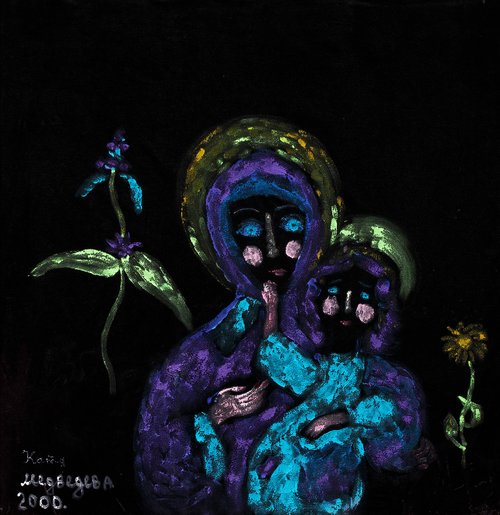
Religious consciousness in the second half of the twentieth century also assumed distinctive and often paradoxical forms. Earlier centuries had seen Christianity interwoven with pagan beliefs; under Soviet rule, new hybrids emerged, shaped by a regime that sought to occupy the role of creator and moral authority itself. A striking example is Katya Medvedeva’s (b. 1937) ‘The Awakening of Russia’ (1994), which depicts the Mother of God and Child accompanied by the unexpected inscription, “To the centenary of the birth of Nikita Sergeyevich Khrushchev.” The juxtaposition is startling, revealing how Soviet political mythology and traditional religious imagery could coexist within a single visual language, producing an iconography unique to the late Soviet and post-Soviet experience.
The exhibition also introduces artists driven by exceptional acts of devotion and perseverance. Among its most remarkable exhibits is a model church created over a period of twenty-five years by an anonymous craftsman from the village of Bolshiye Kamenshchiki in the Gorky (now Nizhny Novgorod) region. Standing approximately one metre high, the structure consists of around a thousand individually crafted elements. Beneath its large central dome and behind its glazed windows are miniature painted icons in tiny metal frames, banners, sacrificial altars, a bell tower, chandeliers and even painted “heavens,” as the exhibition label describes. More than a model, it is a work of quiet obsession – a private act of faith realised with astonishing patience and craftsmanship, embodying the enduring resilience of religious imagination under conditions in which public expressions of belief were so often discouraged.

Not-So-Naïve: Art Beyond the Rules. Exhibition view. Moscow, 2026. Courtesy of Tsaritsyno Museum-Reserve

Not-So-Naïve: Art Beyond the Rules. Exhibition view. Moscow, 2026. Courtesy of Tsaritsyno Museum-Reserve

Not-So-Naïve: Art Beyond the Rules. Exhibition view. Moscow, 2026. Courtesy of Tsaritsyno Museum-Reserve
The exhibition touches on a remarkable variety of themes, yet one that is seldom discussed in relation to naïve art is the artist’s book. Here, the close affinity between naïve art and literature becomes particularly apparent. Sometimes this relationship takes the form of visual interpretation, as in another of Alexei Pichugin’s carved wooden friezes (1987), illustrating scenes from Ivan Krylov’s fables with extraordinary delicacy and precision. Elsewhere, it develops into a fully fledged literary undertaking, as in Ivan Nikiforov’s (1897–1971) picaresque novel The Counterfeiters’, painstakingly handwritten into an album and lavishly illustrated by the author himself. Such works remind us that for many naïve artists, image and text were inseparable means of storytelling.
A more unusual – though no less fascinating – subject is the scientific and technological revolution. Rather than documenting scientific progress, naïve artists generally transformed it into the realm of fantasy. Gennady Ivanov (1940–2025), for example, produced elaborate engineering drawings of imaginary spacecraft engines for his series on space exploration, alongside visionary landscapes depicting a ‘Martian Scientific and Technical Base’ from his Colonisation of Mars’ cycle (all from the second half of the twentieth century). Mikhail Guryev’s work on paper ‘Are We on the Moon?’ (1990), meanwhile, mimics the visual language of a scientific journal while inhabiting a world where speculation and imagination triumph over empirical fact. Elsewhere, technological optimism assumes a more playful form in Vladimir Borisov’s brightly coloured wooden sculptures of Sputnik, Belka, Strelka and Yuri Gagarin (2024). Yet these utopian visions are counterbalanced by works of striking pessimism, most notably Mikhail Vasilyev’s ‘Nuclear Catastrophe’ (1978), inspired by Karl Brullov’s ‘The Last Day of Pompeii’. Here, against the backdrop of a modern city, human figures writhe in their final agony, transforming the classical catastrophe into a chilling warning for the nuclear age.

Incidentally, Vasilyev’s painting is the only work in the exhibition to openly depict the human nude. Another altogether more cheerful picture, ‘Adam and Eve’ (1981) by Valery Plastinin (1907–1983), has, for reasons that remain unclear, been concealed behind a screen pierced by a small viewing hole. The exhibition offers little further engagement with this subject, which is something of a missed opportunity. As the distinguished Russian art historian and scholar of naïve art Ksenia Bogemskaya once observed, the nude occupies a distinctive place within primitive art, revealing ideas of innocence, vulnerability and humanity that differ fundamentally from those found in academic painting. So, when you visit, do not forget to have a peek through the little hole.
Not-So-Naïve: Art Beyond the Rules
Moscow, Russia
2 June 2026 – 7 February 2027