

Shelter of the Innocents: Alexander Brodsky’s Defiant Refuge

Alexander Brodsky. Shelter of the Innocents. Installation view. Moscow, 2026. Courtesy of Zilart Museum
Sitting incongruously on the roof of the shiny new Zilart Museum of Contemporary Art in former car factory site in Moscow, Alexander Brodsky’s plywood-and-felt-paper shelter is both the most modest and most profound work on display.
‘Shelter of the Innocents’ – a structure of plywood clad in roofing felt and fastened with picket-fence battens – is arguably the most contemporary and most urgent of all the works displayed across the four floors of the new privately owned museum of contemporary art, Zilart, located in the former industrial site of a demolished car plant in Moscow. Artist and architect Alexander Brodsky (b. 1955), who shares his surname with poet Joseph Brodsky (a name which, in the contemporary cultural landscape, almost forces you to play with ambiguity of meaning and title), is well known for working with a local context within the broader history of world art. Using materials familiar and legible to any viewer born in the post-Soviet space, he fashions from them homages to masterpieces of global art. Brodsky, for instance, has his own Rotunda - built from picket fencing, placed in a bog, with a shrub at its centre.

His ‘Shelter of the Innocents’ appears on the roof of Zilart like an embarrassing oversight. The museum itself is built in the form of a cube, clad in gigantic sheets of raw copper. From the rooftop terrace, one has a panoramic view over the former factory quarter, which the Moscow authorities handed over for development to billionaire Andrei Molchanov.
The ZIL plant – founded before the Revolution by the Ryabushinsky brothers – became one of Russia’s first motor manufacturers, surviving modernisation and expansion under Soviet rule, before being declared bankrupt and shuttered after the collapse of the USSR. Now, in place of the factory workshops, there is a new district of streets named after artists and architects of the avant-garde.

Inconspicuous at first glance, pressed against the wall at the very top of the museum, stands a small structure that calls to mind either a three-deck ship from a child’s drawing or a shed of an abandoned dacha. Its slightly crooked façade and unprepossessing scale place it in open conflict with the copper-gleaming grandeur surrounding it – as though the migrant workers who built this luxury development had failed to clear away their rubbish or erase the traces of their temporary dwelling. In siting Brodsky’s object on the roof in this way, the museum's owner, billionaire Molchanov (who features in the global Forbes rankings), has shown an admirable sense of humour.

Alexander Brodsky’s ‘Shelter of the Innocents’ borrows its name from a masterpiece of the Florentine Renaissance by Filippo Brunelleschi (1377–1446). In the same spirit, city-dwellers on their modest allotment plots used to style themselves as landowners. That said, Brodsky with his felt-clad shack speaks not only as a chronicler of everyday life, but as philosopher and cultural anthropologist. Drawing on a mode of existence tested and proved throughout the Soviet era - one that permitted survival whilst preserving the self - he proposes inner emigration. In the case of ‘Shelter of the Innocents’, in the most literal sense: one walks inside it.
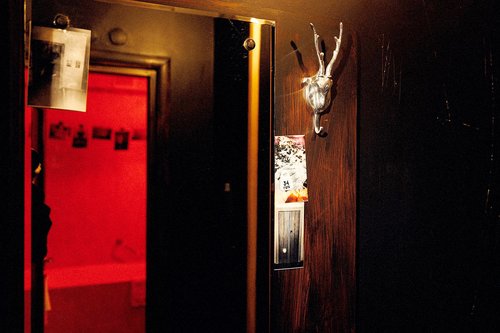
Within the little structure lies a labyrinth of tiny rooms and nooks. Like a bunker, it is equipped with everything required for survival: two lavatories, an electric hotplate with a coffee maker, a cast-iron stove, sleeping berths.

The nooks connect in the most spacious area, where there are many books, a small kitchen in the corner, and a portrait of Hemingway. And there is a thunderous sound: a recording of the surf of the Atlantic Ocean. Whether it is a symbol of the dashed hopes of would-be Columbuses, or a sign of environmental menace – an ocean out of ‘Solaris’ film by Andrei Tarkovsky – this is left to the visitor to decide. In Tarkovsky’s film, aboard his space station, the crew struggled to maintain their sanity by gazing at Bruegel’s ‘Hunters in the Snow’. In Brodsky’s shelter, the corresponding talisman is the portrait of Hemingway – an image from the Soviet past, the cult figure of the Khrushchev Thaw of the 1960s. That was a brief period of contradictory liberalisation in the USSR, which saw not only a relaxation of Soviet censorship, but also, for example, the persecution of Boris Pasternak – a poet who published his novel ‘Doctor Zhivago’ in the West without the approval of the authorities, received the Nobel Prize for it, and was then compelled to refuse the award. World fame cost him a swift cancer and his death. It was no accident that the previously cautious Pasternak had preferred to dig his kitchen garden in Peredelkino suburb of Moscow rather than embark on propaganda tours about the country. To Pasternak is attributed the aphorism that all the great construction sites of Communism were perfectly visible to him from the window of his Peredelkino dacha.

And yet the portrait of Hemingway – like the whole constellation of ideas and images associated with the generation of the 1960s – is as remote from today’s young exhibition-goers as the communal kitchen and the outdoor toilet in Ilya Kabakov’s (1933–2023) total installations. But whereas in Kabakov’s work the squalor of communal living is something from which one longs to escape at any cost, even if it means flying off into space, Brodsky's post-Soviet Biedermeier is merciless and dispassionate as a physician’s diagnosis. This is a shelter. A place where time has stopped.

Where its inhabitants, having severed ties with a heavy past, take temporary refuge from the misfortunes of the present, before stepping into a frightening future. A kind of play written according to the laws of Classicism, in which the entire drama of human life can be compressed into a single small patch of ground and thirty minutes. That is the duration for which the museum sells tickets to Alexander Brodsky’s installation. Within that time, there is a chance to find within one’s own consciousness – within one’s own system of images – something that will permit one to return alive from the ‘Solaris’ expedition, and to emerge from the Shelter of the Innocents intact.