

Russian Art Is Being Forced Offline

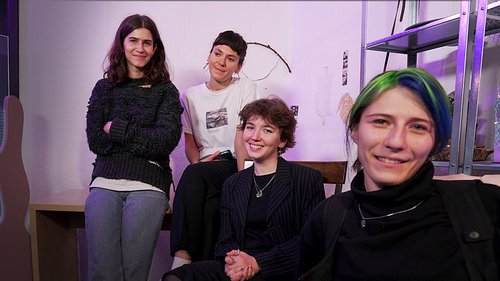
‘I’ in the Internet. Exhibition view. Moscow, 2026. Courtesy of madame artist-run space
Due to the blocking of major social media platforms and messaging apps, coupled with frequent mobile internet shutdowns – allegedly implemented for safety reasons – Russian artists who once integrated digital platforms into their practice have been forced to adapt to a profoundly altered reality.
In mid-March, the exhibition collective Madame aka Maria Anikina (b. 2001) and Daria Arbuzova (b. 2001) staged a show called “‘I’ in the Internet” at Korney Gallery in Moscow. The project, which explores the mutation of human identity under the influence of contemporary network practices, unfolded paradoxically at the height of mobile internet restrictions in the Russian capital.
Shutdowns have become increasingly frequent across the country since 2022, and their eventual impact on Moscow caused significant disruption to daily life throughout most of March. Many resources were simply unavailable, while apps and websites on the so-called “whitelist” – a government-approved set of services intended to remain accessible during outages – functioned erratically at best. Beyond this symbolic coincidence, the curators of Madame encountered a range of practical challenges. Out of habit, they initially attempted to send exhibition texts to a copy shop online for printing, only to find that impossible. Instead, they had to return home, transfer the files onto a USB flash drive, and deliver them in person – a method many had long since abandoned. As a result, both the texts and the exhibition layout plan appeared at the show with a delay.

While this anecdote is somewhat amusing, the broader reality is far more consequential. The systematic shutdown of mobile internet, along with the blocking and throttling of major digital resources – including widely used messaging apps and social networks – is having a tangible impact on artistic processes. Instagram, owned by Meta – a company designated as extremist in Russia – is still regarded by many artists as an effective portfolio platform and a key space for presenting their work. Other services blocked by the Russian government include Facebook and WhatsApp (also part of Meta), as well as X, LinkedIn, YouTube, and, more recently, Telegram. Together, these platforms have functioned as vital infrastructures for artistic visibility and communication. Artists use them to maintain a running chronicle of their practice: announcing upcoming projects, sharing documentation of newly opened exhibitions, and archiving their participation in various initiatives. Just as importantly, these platforms facilitate collaborations, often emerging from direct aesthetic affinities discovered across geographical distances. For many, especially those working far from major cultural centres, such connections are indispensable.

Institutions, too – particularly independent and self-organised spaces – have relied on Instagram as a primary exhibition interface. When access is restricted, a significant portion of their audience is effectively cut off. At the same time, those who manage to circumvent these barriers often coalesce into a more tightly knit, highly engaged community, forming a dedicated core of followers around a given artist, curator, or artist-run space.
That said, artists are not merely navigating prohibitions and restrictions – they are also attempting to make sense of a new reality that has, notably, taken on a global dimension. The internet is increasingly fragmenting into national segments, fenced off by the barbed wire of local regulations, with various forms of blocking now practiced in one way or another across much of the world. For instance, widely used American AI models such as ChatGPT, Gemini, Claude, and Grok do not provide their services to users in certain countries, including Russia.

Millennial artist and curator Arthur Golyakov (b. 1991), currently based in Kazan, the capital of Russia’s Republic of Tatarstan, initiated the project “Unfolding” in early 2024. Conceived for platforms such as Instagram and Telegram, the work can, in principle, be adapted to almost any format: embedded within a media article, displayed on a lightbox, printed, or otherwise integrated into an exhibition setting. At its core, the project consists of screenshots of posts that Golyakov identifies as both artistically resonant and emblematic of the contemporary Zeitgeist. These images are captured deliberately in a spontaneous, even careless manner: notifications intrude upon compositions, interface elements remain visible, and fragments of the phone’s visual ecology overlap with the source material. Importantly, Golyakov does not limit himself to conventionally “artistic” content. Everyday stories shared by artists, memes, status updates, and notes all become part of the archive.

As Golyakov explains, he continues to uphold the idea of a “big internet” – a borderless, unrestricted space – however utopian and distant that vision may now appear. Confronted with the growing difficulties of accessing online resources across different regions, he has nevertheless chosen to preserve, through this method, key moments in visual art and network culture. The selection remains subjective, shaped by his own sense of what is important, and largely centres on experimental and often underground practices, including those of his peers from Russia, the United States, Europe, Asia, Australia, and beyond. In this context, the screenshot becomes a fundamental archival tool: a direct and immediate means of preserving visual material from the internet onto a personal device, where it may persist even after the original content has vanished from the network.
Golyakov belongs to a generation that entered the art world in the 2010s. He was among the pioneers of the online aggregator movement – platforms such as Contemporary Art Daily, TZVETNIK, and OFluxo – which disseminated high-quality documentation of exhibitions from across the globe. The defining logic of these aggregators, whose heyday coincided with the transition from the 2010s to the 2020s, was continuous, near-uninterrupted publication: a steady stream of images from current projects that accelerated artistic circulation, encouraged production, and reinforced the imperative of constant renewal. It was, in many ways, the apotheosis of an optimistic vision of the internet – grounded in a belief in its unity, permanence, and openness.


Against this backdrop,“Unfolding” can be read as a wry, ironic postscript to the history of aggregation. Here, the emphasis shifts away from immediacy, rapid assimilation, or the qualitative leaps once associated with constant exposure to new work. Instead, Golyakov’s project introduces delay: an implicit deferral of engagement, where today’s images are set aside to be revisited tomorrow – or even later.
Golyakov has even considered creating a dedicated website to house these screenshots, a move that would, in principle, preserve key names and works for future artists and researchers. Yet such an archive – fragmentary, decontextualised, and partially distorted – would likely prove as disorienting as it is informative. It might confuse, or even mislead, its audience, prompting reflection on a broader question: how adequately do we ourselves interpret the incomplete and mediated remnants of the past that have come down to us?

At the same time, the issue extends beyond archiving. The gradual degradation of the network infrastructures that shaped artistic production over the past quarter-century is beginning to influence the very form of contemporary art. Not long ago – particularly during the COVID-19 pandemic – institutions and curators gravitated toward more “volatile” practices: works easily circulated online, such as video, digital drawing, and photography. This tendency was further reinforced by theoretical frameworks that sought to legitimise and stabilise it.
Today, however, a counter-movement is emerging. Art is, in a sense, becoming “re-grounded.” Large-scale paintings in heavy frames, monumental sculpture, and performative or event-based practices that demand physical presence are once again coming to the fore. Documentation remains significant, but it is no longer sufficient. The experience of direct encounter – of being physically present with an artwork or within a community – has regained a renewed and heightened importance.


Attention is gradually shifting toward large, iconic artefacts within exhibitions. Daria Arbuzova, mentioned earlier, was commissioned by Moscow’s GES-2 art centre to produce the two-metre sculpture ‘Ice Throne’ (2026), displayed inside an enormous transparent-walled refrigerator. Despite not occupying a central position – either spatially or conceptually – the work has become an informal symbol of the exhibition ‘Eternity Formulae’ (26 February – 19 July 2026).
A similar dynamic can be observed in ‘Undark Ages: Tales of Medievalism and Academia’ (13 November 2025 – 3 May 2026), presented in adjacent halls at GES-2. In the exhibition’s “antique” section stands Alexandra Paperno’s six-metre ‘Broken Column’ (2018). Though created several years ago, the work has gained renewed prominence in the present moment. Allegorically evoking the collapse of civilisation and the onset of a new dark age, it also lends itself – perhaps unexpectedly – to replication and circulation as merchandise. The institution has capitalised on this quality, producing T-shirts and stickers bearing its image. Its visual clarity and spatial dominance, visible from multiple vantage points, further reinforce its emblematic status.
Scale alone, however, does not account for the appeal of such works. They tend to be formally cohesive, avoiding abrupt material contrasts or compositional fragmentation. This coherence allows them to be easily distilled into a singular, recognisable image. In this sense, they function as three-dimensional counterparts – or even substitutes – for internet memes.
A comparable trajectory can be traced in Alexey Korsi’s ‘Grey Man’ (2022): a life-sized, photorealistic sculpture of a strained, faintly smiling traveller, ticket extended in hand, his complexion rendered in ashen tones. First shown during the artist’s solo exhibition along the central promenade of GES-2 in 2022–2023, the work lodged itself firmly in visitors’ memories. It was subsequently reproduced as a badge, acquired by the collector Anton Kozlov, and taken on tour across the country. Through this circulation and promotion, ‘Grey Man’ effectively assumed the status of a meme in three dimensions.

As for performative practices, the activities of the collective Kiosk – Slava Neistosno (b. 1996), Nastasya Nem (b. 1986), and Kolya Shpre (b. 1995) – stand out as particularly memorable. Between 2023 and 2025, they organised around a dozen events in everyday urban locations: a flower shop in the city centre, a busy metro underpass, the entrance to the Winzavod Centre for Contemporary Art, the courtyard of the Museum of Moscow, and other such sites. Their format was deliberately minimal and informal: a handful of works by friends (or, at times, forgeries of other artists’ pieces), casual conversation among a small group of attendees, and a loosely structured gathering that blurred the boundaries between exhibition and social encounter.

Documentation of these events was playful and random, and over time, invitations shifted from public announcements to private messages. While Kiosk’s projects became meaningful points of convergence for segments of the artistic community, they largely escaped incorporation into any broader institutional narrative. They left little enduring trace online – as if anticipating the very conditions that now prevail, and from the outset producing work for an internet already subject to fragmentation and restriction.