

Prokofiev Studio Revives the Legacy of Russia-born Artist in London

Bending Time. Exhibition view. London, 2026. Courtesy of Prokofiev Studio
In a first-floor studio above a Dalston solicitors’ office, three generations of abstract art collide: the rediscovered archive of Oleg Prokofiev, son of the composer, shown alongside two younger artists for whom material, touch, and time remain stubbornly unresolved.
Only someone sufficiently abstract could notice something abstract in Dalston. In fact, the place is intensely ‘concrete’ its Caribbean, Turkish and Vietnamese flows channeled through 18th and 19th century terraced houses and the glossy residue of gentrification. Hybrid identity here means a kebab shop and an art gallery sharing the same façade. Abstraction in this context is a synonym for luxury and the privilege of those who arrive with a concept or can afford to temporarily switch reality off. Such is the deliberately unstable, superimposed optics that the group exhibition ‘Bending Time’ by Oleg Prokofiev (1928–1998), Valentino Vannini (b. 1976) and Kirill Basalaev (b. 1988) proposes at the newly opened Prokofiev Studio.

“An active spatial framework that reveals the conditions of the artist’s thinking” is how the press release invites us to approach the second floor of an office building in a cul-de-sac by Dalston Junction, directly beneath Regnum Solicitors. The space is run by Oleg Prokofiev’s son, Gabriel, who, together with curator Anzhela Popova, is presenting his father’s complete archive to the public for the first time.
Already, the room feels composed in a way that suggests Gabriel, a neoclassical musician himself, inhabits these records as he might a score: tracing the fragile line between structure and its decay. There is something almost performative about it, heightened by the Meredith Monk avant-garde soundtrack playing at the opening. Gabriel is omnipresent: greeting visitors, pouring wine, and noting that “every son dreams of seeing his father’s artworks in museums”. He adds that another exhibition is planned in Paris later this year at Alina Pinsky Gallery in Le Marais.
On the terrace stretching along the studio, Vannini discusses with his friend Kate their upcoming residency in Sicily (“it will be scorching hot”), clearly pleased that his “Apparatus #2,” which resembles a giant ear, has been installed here outdoors, on the gritty roof ledge, because previously, when shown in a garden, it “blended too much with the environment.” It’s also Vannini who first articulates the exhibition’s key intuition: the works share a similar, almost tactile curiosity toward material, and everything begs to be touched.

Basalaev, arriving forty minutes late, picks up the motif of tactility while reflecting on the exhibition. With his characteristic bark, he responds to my attempt to discern a hovering angel in his dense, scarred relief ‘Inside Out’: “Thanks to abstraction for letting everyone see whatever they want.”
Abandoning a rather loose discussion of urban space, “corporality” and trauma, he offers a story that lands almost like an anecdote about how the city’s surfaces first became something to work against. When he moved to Moscow, Basalaev worked as a courier delivering documents to the industrial periphery. “All I saw beyond the ring roads were concrete walls, factories and their walls. So I decided to photograph them. I became fascinated by the communication between the ‘night ZhKH’ [municipal workers] who painted over graffiti and the invisible ‘someone’ who kept creating it.”
Before retreating to the terrace, he lets slip perhaps the most unguarded remark of all, almost as a reflex: “Some of the works here are called ‘Reflections’. Reflections of myself – constantly wrecked, growing decrepit.” Delivered almost in passing, the comment proves more diagnostic than anything else said. The works do seem to mirror their authors in striking ways. Vannini is another telling case for this homological reading: the same delicacy, viscosity and slow, enveloping stickiness found in his pieces.
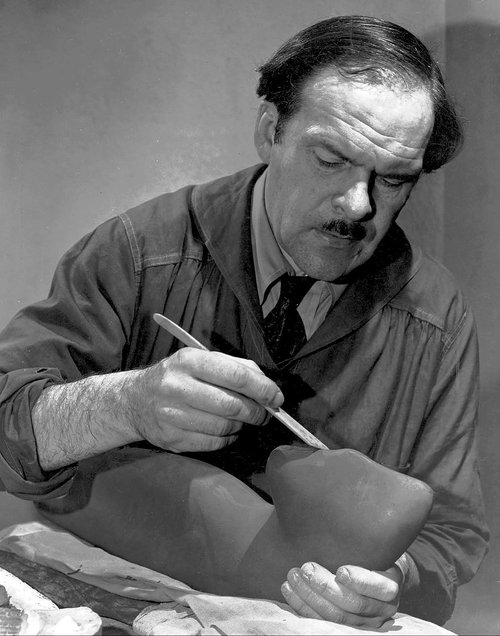
Suddenly, the image of Oleg Prokofiev rises: a kind of lanky Papa Carlo figure, the “good father, but older generation”, as Gabriel describes him, bending matter to his will.

The exhibition, as stated in the concept text, presents itself as a “living, generative system”. The press pack is so fixated on mobility that reading it induces mild vertigo, like a manual for an industrial centrifuge. Almost every phrase is “reactivated”, a “dynamic field of relations”, “reconstruction”, “actively produce”, “extends”, “enters”, “expands”, “exists outside”, “destabilises”, “shifts”, “resists stability”, “sags, stretches, or dissolves”, “collapses”, “never fixed”, “returning”, “cyclical, recursive, and continually redefined”, “open, contingent, and in motion” – as if someone were deliberately pumping into the British public, otherwise notoriously indifferent to art, a sense of FOMO.
Art, as usual, has not read the press release. ‘Bending Time’ bends instead towards an enthusiastic “game of three men at imitation”, though the game gives little clue as to what the imitation serves, or for whom. The most serious inquiry here comes from Oleg Prokofiev, precisely because it resists any immediate attempt to define what, exactly, it imitates. Basalaev and Vannini, by contrast, have already done the reading for you.

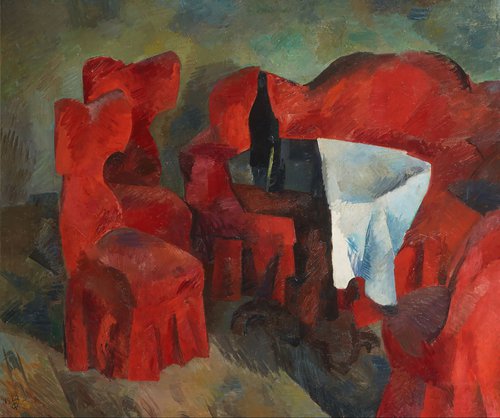
Son of the composer Sergei Prokofiev and a former student of Robert Falk (1886–1958), Oleg Prokofiev arrived in the UK in 1971 with a decade of suppressed abstraction behind him. He immediately received the Gregory Fellowship at the University of Leeds, which enabled him to work as a full-time artist for the first time.
He continued to paint simplified, barely symbolic fantasies in grey-white, blue and pink. Gradually, shadows and semi-transparent hovering figures began to appear, but this line of enquiry was interrupted by a trip to New York in 1977. “It was the scale of this city, which has nothing European about it, but got a kind of aggressive verticalism, which fascinated me tremendously,” Prokofiev wrote in ‘The Evolution of My Sculptures’, a text from the booklet for his first German solo exhibition, now on display in ‘Bending Time’.
“I actually painted a number of large works, gouaches and acrylics, simply consisting of vertical stripes […] One day, instead of painting a new stripe, I simply stuck to the surface a vertical painted wooden plank and it brought to the composition something totally different. In fact, my next work was not a painting but a relief, consisting of vertical planks, glued to the surface of the hardboard […] Thus, my first sculptures were born. Since each one reminded of a little toy sky-scrapper, in order to avoid being a mere copy of a building, I painted them all in blue and red colours […] And suddenly, for the first time in my life, my work (the colours) had something Russian in it.”

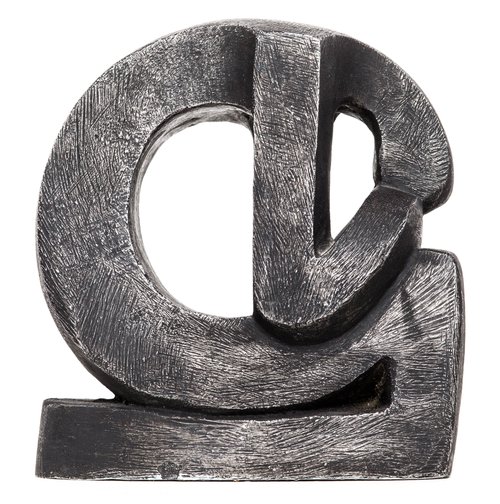
Prokofiev’s conceptual debts extended to Indian art – the subject of the dissertation he prepared while still living in the Soviet Union – as well as to contemporaries such as Henry Moore (1898–1986), particularly his incorporation of negative space into voluminous masses and his use of voids, and Alexander Calder (1898–1976), whose “exploration of space was most illuminating in my understanding of what twentieth-century sculpture is about.”
Later in his career, Prokofiev began arranging the growing number of objects accumulating in his studio into various groupings. “I was either piling my sculptures up,” he writes, “or putting them next to each other on the floor within a large square or circle, or hanging them up from the ceiling on different levels, building up a whole pillar or some other separate or interrelated huge three-dimensional shapes.” These sculptural compositions, known as “bundles”, were, according to Gabriel Prokofiev, “very popular. There is something about them that people loved. We only have two or three left – they were always sold. I need to check.”

From where I stand, Prokofiev’s sculptures inevitably evoke scaled-down works by the legendary Basque sculptor Eduardo Chillida (1924–2002) – not so much through visual resemblance, though there is certainly some of that, but through a shared ontological understanding of environment and place. One could take almost any of Chillida’s forms, where even the rusted textures of steel occasionally resemble wood, and sense a comparable conception of sculpture as something that structures space rather than merely occupies it.
To articulate this parallel more clearly, I found myself returning to the dialogue between Chillida and Martin Heidegger that produced the 1969 artist’s book ‘Die Kunst und der Raum’. “We would have to learn to recognise that things themselves are places and do not merely belong to a place,” Heidegger writes, suggesting that sculpture becomes “the embodiment of places.” These reflections imagine objects as bursting through their own skins, woven into a web of relations, while space itself emerges as a material medium through which contact occurs. Sculpture demonstrates, through its own example, how we ourselves are tethered to the world – even as technological modernity increasingly hollows out any stable sense of rootedness.
Chillida, speaking for himself, placed a border around the same intuition: “Limits are the real protagonists of space, just as the present, another limit, is the real protagonist of time.” Oleg Prokofiev, too, seemed to pursue this totality through the artistic formula inscribed on the frontispiece of his pocket sketchbook: “1. a line embracing a form; 2. a form embracing space; 3. space embracing everything.” His wooden spatial structures create centres from which their extremities protrude like outward-bent antennae, signalling readiness for defence yet without aggression. Power and motion seem to cancel one another out.

The meta-irony of this philosophical detour arrives when Gabriel Prokofiev, recounting how he persuaded his father as a teenager to rename a sculpture originally intended to be called ‘666’ as ‘The Beast’, suddenly veers into a broader reflection: “It’s something fascinating about abstract art and modern music: we don't need the words, we even don’t want the words. Modern philosophy is obsessed with words, but this is not the only way we can communicate.”
And yet the words spoken at the opening remained stubbornly grounded in materiality. A final, matter-of-fact contribution to the exhibition’s emphasis on physical presence comes from Popova: “Wood, glass and concrete are touchable things, so it’s a kind of relationship.” Then came the closing line of Basalaev’s speech, delivered after proclaiming himself “nobody” compared to Oleg Prokofiev and Valentino Vannini: “Thank you very much and welcome to drink a little bit vodka!” The audience – still in its natural state, notoriously indifferent towards art – greeted the invitation with cheerful laughter.