

‘Nostos’ without Nostalgia: Muromtseva’s exhibition in Paris

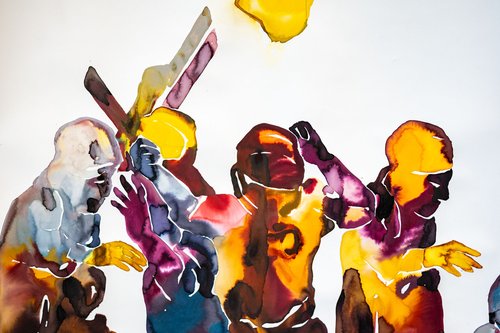
Katya Muromtseva. Death Certificate, 2026. Still from the video. Courtesy of the artist and NIKA Project Space
A new animated film by Russian artist Katya Muromtseva immerses the viewer into a kafkaesque labyrinth of red tape and absurdity. Now on view at NIKA Project Space, it revolves around topical notions of exile, bureaucracy, and the impossibility of return for this Moscow born, New York based artist.
Katya Muromtseva's exhibition at NIKA Project Space, an art venue on the outskirts of Paris, occupies two rooms immersed in twilight. One is a conventional gallery display of drawings and installations. The other is a darkened screening room where her animated film ‘Death Certificate’ plays on a continuous loop.
The first room introduces the method: an artistic technique sophisticated enough to become the subject of an exhibition in its own right. The second presents the result, and the result is remarkable.

In ‘Death Certificate,’ Muromtseva (b. 1990), born in Moscow and now based in New York, tells a story that is at once highly abstract and deeply personal. The film follows a woman identified only as K., who returns to her homeland after living abroad for nearly ten years. Back in her old room, she discovers her own death certificate. For her country, she is already dead. To return to life, she must exchange this official death certificate for an official certificate of existence. To do so, she must navigate a series of trials in a world that was once familiar but has since become bureaucratic, surreal, and hostile. Being born again proves more difficult than dying. The society that once produced her has no trouble interpreting her absence as a legitimate death. Yet it refuses to accept her presence as proof of life. The homeland no longer reveals itself as home.
This is the central premise of the film, and it would be unfair to dissect its episodes in detail. The looping projection serves as the culmination of everything the visitor has encountered in the first room.
Seven transparent cylinders covered with linear drawings stand on illuminated plinths. As they rotate around light sources, they project moving shadows onto the gallery's white walls. The exhibition’s curator, Christianna Bonin, quite naturally compares them to the shadows in Plato's cave. Muromtseva's images drift endlessly across the walls, appearing and disappearing, changing and distorting with the architecture of the space, creating a hypnotic movement of recurring motifs.

Yet this is more than an installation. It is also an explanation of how the film itself was made. «I wouldn't want anyone to think it was simply drawn on a computer, » Muromtseva explains. The film combines line drawings used as backgrounds with shadow-theatre figures that become its characters. “It’s an animation technique I invented myself,” she says. “I start with drawings and then reproduce them on transparent plastic. I roll the plastic into a cylinder, place it on a rotating platform, illuminate it from behind, and film the shadows cast onto a translucent screen. That's how I create movement.”
The process is laborious: ‘Death Certificate,’ according to the artist, required around forty-four such cylinders, each dedicated to a particular sequence. One wall of the gallery displays some of the preparatory drawings that later came to life in the film. “There are fifteen here,” she says, “out of perhaps one hundred and fifty or two hundred that I made.”

These small sketches reveal a confident hand, a vivid imagination, an instinctive sense of composition and, above all, an ability to dismantle and recombine visual worlds. There are echoes of Goya’s Caprichos, Rembrandt’s portraits, Diane Arbus’s unsettling photographs, Bosch’s invented creatures, Bruegel’s blind men, and perhaps even traces of Heinz Edelmann, whose imagery helped define the visual universe of the Beatles’ Yellow Submarine.
The exhibition's title, Nostos, evokes the ancient Greek notion of homecoming. Few subjects are more immediate or more painful for emigrants, whether voluntary or forced, external or internal, whether in Moscow, New York or Paris.
The idea of a return to normality has surfaced repeatedly throughout Muromtseva’s practice. During the pandemic, stranded in Zagreb, she attempted to reclaim a sense of normal life by staging exhibitions from her own balcony. Elsewhere, working with residents of Russian nursing homes, she used painting to reconnect elderly participants with a sense of agency and identity, returning them, in a sense, to life, and building unlikely bridges between artists of Moscow Conceptualism and the anonymous “little people” who suddenly found themselves in conversation with the gods of art.

The story of return, familiar from Odysseus wandering through the Greek islands and Leopold Bloom wandering through Dublin, is restaged here within a bureaucratic dystopia of the artist’s own invention. A trained philosopher long fascinated by the reality of myth, Muromtseva understands that action is often more important than resolution, that movement itself can become the destination. Her film ends not only without a happy ending but almost without an ending at all, even though it follows a clear narrative trajectory. Muromtseva is not only a visual artist but also a writer.
The film grew out of a story she wrote herself, something close to a fairy tale. That fairy tale emerged from conversations with real people. “I probably conducted around a hundred interviews over two years,” she recalls. “People spoke to me about migration in New York, London, and the United Arab Emirates. One man told me about his grandfather, a fisherman from Mexico who disappeared on an island and unexpectedly returned many years later. When he came back, he had to prove that he was alive. He went to a priest and obtained what was literally a certificate of life: an entry in the church register stating that a miracle had occurred and that he had returned from the dead.” As often happens, fantasy turns out to be rooted in reality.

Throughout the film, there are two major shifts. The first is colour, which determines the emotional register of each sequence. The afterlife, the Land of Bright Light, resembles an electric paradise inhabited by golden birds and flooded with intense radiance, ranging from ochre to zinc yellow. It stands in stark contrast to the monochrome world of return: a realm of shadows punctuated only by the red flare of burning documents and memories of war, and by the cold blue bureaucratic light of an unhappy childhood.
There is another contrast as well: language. At the moment the narrative becomes personal, with the line “Where I went, night never came,” the voice-over switches from English to Russian. For Muromtseva, this transition is essential. Many English-speaking viewers, she notes, would prefer the entire text to remain in Russian. Yet Russian-speaking audiences immediately understand the shift as evidence of a state of suspension between worlds, one of the film's central themes. The effect becomes even more intriguing in Paris, where a third language enters the work: French subtitles.
The result intensifies the film's psychedelic journey through languages, colours, and identities. Language itself becomes evidence in the case against the protagonist. The Russian narration is abruptly interrupted by a bureaucrat's command: “Speak English and give precise answers!”


For all its symbolic and dreamlike qualities, ‘Death Certificate’ evokes very concrete realities. It recalls airport immigration interview rooms, those liminal spaces where one must constantly prove identity, legitimacy, and the right to exist. It also echoes debates from postwar Germany about whether artists who had not shared the hardships of their compatriots could legitimately return, a question recently revisited in Paweł Pawlikowski’s Cannes-winning Fatherland.
K. never receives her Certificate of Life. Her quest remains unresolved, and the miracle never comes. Asked whether one should expect miracles, or whether one should return at all, Muromtseva’s answer is cautious: “Probably not.”

And yet the idea of return remains embedded in the very structure of the exhibition. It is designed for movement. The rolled sheets of transparent plastic and folders of drawings are inherently portable, capable of travelling even without their creator. The same is true of the film. Whatever cannot physically cross borders can still circulate online as a thirty-minute video, available everywhere: at home, and in places where one no longer has a home. This is not an optimistic work. It is a theatre of shadows viewed at dusk. But if shadows still exist, then so does light.