

Nostalgia for the Open World in Samara

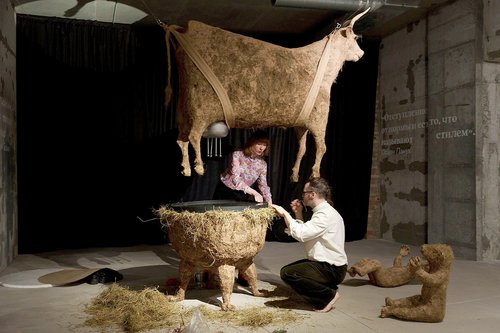
Most Beautiful Place I’ve Ever Been. Exhibition view. Samara, 2026. Photo by Andrey Bolhovetsky. Courtesy of Victoria Gallery
The Victoria Gallery, founded by Russian billionaire Leonid Mikhelson, has reopened in Samara after an extensive renovation. The gallery’s inaugural exhibition, which showcases works by local and international artists from private collections, offers visitors a journey back in time to a bygone era of transparent borders and boundless possibilities.
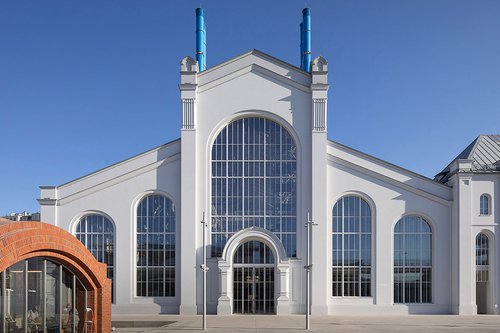
Samara, a city of one million residents sitting on the shore of the Volga River a thousand kilometres to the southeast of Moscow, used to be a picturesque and wealthy merchant town before the Bolshevik Revolution. Its historical centre, with its imposing Art Nouveau buildings – many of which are derelict and slowly falling apart – still bears traces of its former glamour. A brutalist structure facing the river in the city centre looks somewhat outlandish, like an alien spaceship that has landed on the banks of the river Volga. However, the new landmark was not actually built from scratch. An eclectic, three-storey building with stucco decorations on the facade has been completely refurbished inside and out. It used to house a bank and an office, as well as two gallery spaces on the first and third floors. During the extensive, almost three-year-long renovation, it was converted into a modern cultural hub complete with all the latest amenities: exhibition halls on all three floors, a coffee shop, a bookshop, a library, and three workshops for printmaking, ceramics, and other activities, as well as a rooftop space for site-specific installations. No expense appears to have been spared during construction, which is no surprise. The owner of the Victoria Gallery is currently the third richest man in Russia, according to Forbes magazine, and is known for his taste in contemporary architecture.

Leonid Michelson, a Russian gas and petrochemicals tycoon, has close ties with Samara. He studied at a local engineering institute and worked in the city during the 1980s and 1990s. Like many Russian businessmen of that era, he developed an interest in art and became a collector. In 2005, he founded his first art venue – a gallery in Samara named after his teenage daughter. This was followed in 2009 by the V-A-C Foundation in Moscow, which was also named after her (V-A-C stands for ‘Victoria – The Art of Being Contemporary’). Michelson's art initiatives have always looked to the West. The V-A-C Foundation's Venice venue opened years before the Moscow venue. The Moscow branch was designed by Italian architect Renzo Piano, who converted the former GES-2 power plant into an enormous cultural space, and overseen by V-A-C’s general director Teresa Mavica who resigned shortly after the opening at the end of 2021.

A sculpture by Swiss artist Urs Fischer (b. 1973) was placed in front of the entrance, and the inaugural exhibition was a large-scale performance piece by Icelandic artist Ragnar Kjartansson (b. 1976). In 2019, Teresa Mavica was appointed commissioner for the Russian pavilion at the Venice Biennale, and it was announced that Michelson would fund its operations and renovation. The Victoria Gallery in Samara was mounting exhibitions in partnership with private foundations from Sweden, the Netherlands, Italy, and France. However, it all ended when Russian troops entered Ukraine on 24 February 2022. Michelson found himself subject to sanctions imposed by Canada and the United Kingdom. Kjartansson finished his performance piece prematurely. V-A-C’s exhibition programme, which relied heavily on international artists, had to be completely overhauled. As exhibitions featuring European artists were no longer possible, the institution focused on Russian and South American artists instead. Russia stayed away from the Venice Biennale, even renting its pavilion in the Giardini to Bolivia in 2024. The Venetian branch of V-A-C, Palazzo delle Zattere, closed down, and anti-Russian protesters broke into the building at some point. The Victoria Gallery in Samara was also closed in 2023, but for different reasons. According to Sergei Balandin, the institution's recently appointed general director and long-standing curator, the space was too small and inconvenient for its operations. The staff therefore persuaded Michelson to start renovations, including converting the entire building into a gallery space.

Architects from two architectural studios in Samara joined forces to transform the clumsy structure: RBTY redesigned the façade and Link.Bureau revamped the interiors. Despite the frosty gloom of early March, the space felt welcoming, opening up to the snow-covered Volga embankment. “This is a space where local and global cultures will converge,” Balandin told journalists at the opening. “After all, we are located near the port.” Indeed, the building occupies the very spot where the city's first river station once stood. On the rooftop is an installation called ‘The Little Sun’ by Moscow-based artist Igor Samolet (b. 1984). It has a lamp on top and resembles a lighthouse – it even transmits messages in Morse code. The curators plan to change the rooftop artwork every year, following in the footsteps of the Metropolitan Museum of Art in New York. Such a concept would have seemed pretty commonplace ten years ago. However, in today’s Russia, it sounds almost utopian. Cultural exchanges with Europe and America are now a thing of the past. A recent law banning signage in foreign languages means that Victoria will probably have to change the spelling of its name on the façade from Latin to Cyrillic.

The inaugural exhibition is an intriguing blend of renowned international artists and local Samara natives. Curated by Balandin, it explores different approaches to landscape in contemporary art. The artworks on the lower level which are closer to the river are united by the theme of water. On the upper level, we move away from this treacherous element to explore solid ground; however, the connection between the pieces becomes less apparent. Soviet painter Gennady Filatov’s (1929–1979) idyllic view of the Volga hangs steps away from a photograph by Wolfgang Tillmans (b. 1968) called the ‘Most Beautiful Place I've Ever Been’, where, ironically, most of the image is shrouded in fog – a romantic metaphor for a fading memory. The gallery team has named the exhibition after this piece. Indeed, there is something vaguely nostalgic about this show. It features works by renowned international artists, including Peter Doig (b. 1959), Andreas Gursky (b. 1955) and Takashi Murakami (b. 1962), as well as leading Russian artists, many of whom emigrated years ago. Erik Bulatov (1933–2025) spent his final years in Paris, Valery Koshlyakov (b. 1962) have been living there since the 2000s, members of AES+F group work from New York and Berlin, Vladimir Dubossarsky (b. 1964) spends most of his time in Vilnius and even the young art fair mascot Evgeny Muzalevsky (b. 1995), a native of a village near Samara, is now honing his painting skills in Germany.

The large, impressive canvases that line the walls of the newly renovated halls evoke a strange sense of dislocation, as if you have been suddenly transported back in time or to an alternative reality where the tragic events of recent years never occurred. This mystery has a simple explanation: all the artworks come from private collections. The donors include the V-A-C Foundation, the AZ Museum, real estate developer Vladimir Semenikhin and his wife Ekaterina, the Terebenins, who are renowned for their passion for Indian art, and Anton Belov, the former director of the Garage Museum of Contemporary Art in Moscow, who left the country around two years ago. The most recent artwork is a photograph taken by Alexander Gronsky (b. 1980) in 2023. It depicts a nondescript residential block in Moscow sinking into the early evening gloom, with a construction crane bearing the Russian words ‘God with us!’ in the foreground. Most of the artworks in the exhibition explore the relationship between humans and their surroundings, whether man-made or natural. In some of the works of art, such as porcelain sculptures by AES+F depicting illegal migrants and wealthy tourists frolicking together in the Mediterranean Sea, the landscape is barely present. The subject matter of this series – the almost miraculous rescue of desperate refugees from drowning at sea – subtly rhymes with Samolet’s lighthouse sculpture on the rooftop. However, it is difficult to determine whether Victoria resembles a lighthouse showing the way to a safe haven or a ship trying to find its way through the turbulent waves of history.

The show’s nostalgic title suddenly makes more sense if we consider ‘the most beautiful place’ to be a point in time rather than a place. The exhibition appears to be an attempt to turn back the clock, tempting visitors to step into a better, saner and more normal world of the recent past, if only for a few minutes. However, the gallery’s staff appears to have understood that even billionaires cannot control time: the exhibition programme for the second half of 2026 shows no westernised delusions, focusing instead on Russian artists. Yet the same ‘backtracking’ vein of thought is evident not only in Samara. Palazzo delle Zattere re-opened in 2024 under a new name, Scuola Piccola Zattere, as an Italian non-profit which is a personal project of Victoria Michelson, having officially severed all ties with V-A-C. The pavilion in the Giardini is also making a comeback. Russia is taking part in the Venice Biennale again this year. Can you walk into the same Volga twice?
The author’s trip to Samara was organised by the Victoria Gallery and the Vesnaskoro Company.