

Modernism as an Adolescent Horror Story

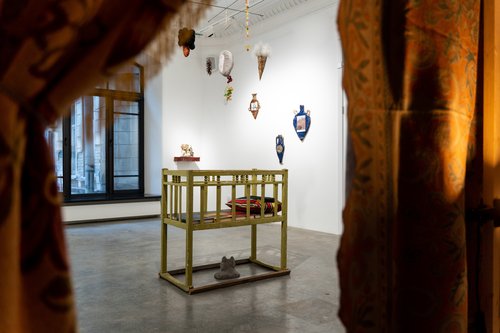
Grown-Ups Allowed. Exhibition view. St Petersburg, 2025. Photo by Evgeny Eliner. Courtesy of State Russian Museum
At the State Russian Museum, adults are invited to encounter a children’s version of the history of contemporary art. In ‘Grown-ups Allowed’, curators Anton Uspensky and Olga Alekseeva shape this narrative as a child-friendly psychedelic journey – seductive, disorienting, and far from innocent.
‘Grown-ups Allowed’, held at the Marble Palace of the Russian Museum, unfolds across two floors, adjoining the recently renovated—though slightly reduced – permanent display of Western and Russian twentieth-century art donated by the German collectors Irene and Peter Ludwig in the 1990s. To the curators’ credit, an exhibition devoted to childhood proves not only engaging but genuinely instructive. The more than 400 works on view, by leading Soviet and post-Soviet artists, cohere like the pieces of a vast puzzle. Gradually, a parallel history of Russian modernism comes into focus – one refracted through the lens of childhood: a children’s version of modernism, fully formed and unexpectedly compelling.

Let us be truthful: this version is neither endearing nor saccharine. It is frank, even brutal. Everything begins with the image of ‘Home’. The rotunda is devoted to this theme, bringing together a range of family scenes. Engravings by Aleksey Pakhomov (1900–1973) appear alongside works by artists of the Khrushchev Thaw and neo-naïve paintings from 2022 by Yulia Sopina (b. 1968). Yet this seemingly literal, ABC-book vision of childhood is quickly overturned once one moves beyond the rotunda. A section devoted to those who became outsiders is particularly affecting: the homeless, street children. Watercolours by the little-known artist Aleksandr Goffert (1899–1978), created in the 1920s, are dedicated to them. Children crouching in rags are disturbingly close to the figures of George Grosz (1893–1959), Käthe Kollwitz (1867–1945), and Karl Schmidt-Rottluff (1884–1976). In Russia, Aleksandr Deineka (1899–1969) and Aleksandr Samokhvalov (1894–1971) are traditionally associated with German Expressionism through their poster-like images of athletes and workers’ brigades. Yet these images of homeless childhood reveal a different set of parallels: a world convulsed by suffering, akin to the way Yury Pimenov (1903–1977) depicted war invalids – bodies and lives caught in a state of permanent rupture.
Another leitmotif at the beginning of the exhibition is formed by the ‘protocols’ of children’s everyday impressions from the 1930s by Boris Ermolaev (1903–1982). These witty, cheerful sketches could easily be mistaken for rehearsals of today’s zines, comics, or even social media reels. Another key theme emerges in works devoted to the world of childhood by pupils of Kuzma Petrov-Vodkin (1878–1939). These pieces function as commentaries on the great style of a great master. Thus, Petrov-Vodkin’s student Eleonora Kondiain (1899–1986) produced illustrations for picture books about Soviet pioneers. Her figures, in turn, convincingly rehearse the imagery of officially sanctioned childhood later deployed in the decoration of Soviet institutions – from so-called Houses of Culture to kindergartens and schools.

In principle, the culture of childhood adaptively absorbs the visual language of Soviet officialdom. Where state commissions – replete with over-achieving workers and collective-farm festivities – are frightening in their inevitable deadness, children’s series populated by young pioneers and games can appear, at times, unexpectedly welcoming, even charming. Park sculptures of pioneers blowing horns or girls holding oars found their way into the courtyards of residential blocks, becoming part of neighbourhood life – almost members of the family. They were loved. They were pitied, too, as paint crumbled and horns, oars, and eventually limbs fell away with time. At the exhibition, plaster figures of Soviet girls by Anna Kryzhanovskaya (1894–1970), dating from 1938, inevitably call to mind the glazed terracotta sculptures of the Della Robbia family of Renaissance masters – yet the comparison is as unsettling as it is seductive.
As one moves deeper into the exhibition, a growing sense emerges that this ‘childish’ commentary on the adult history of contemporary art is saturated with dark secrets and latent psychoses. For reasons that are never fully explained, the enfilade of halls is not divided into clearly defined sections. Instead, everything advances furtively, almost by default. Images slide into one another, exchanging ever more disturbing themes. The further one goes, the more Soviet childhood begins to resonate with object-oriented art and with that slow-burning horror articulated by the American philosopher Eugene Thacker.

Mechanical toys produced in Soviet factories chart the evolution of changing styles with particular clarity. One room contains an entire park of toy cars: the earliest echo the constructivism of the 1920s; others adopt the streamlined forms of 1930s Art Deco; still others point toward the second modernism and brutalism of the post-war era.
By contrast, paintings by artists, porcelain figurines, and sculptural objects largely resist this neat stylistic taxonomy, repeatedly breaking away from the expectations of any textbook narrative.
The section devoted to games opens with an extravagant gesture: ‘An Incident’ (1937) by Aleksey Zernov (1891–1942). Painted in the verist manner of the masters of Neue Sachlichkeit, it depicts a lorry that has run over a teddy bear with button eyes. The bear’s head has been torn off and lies abandoned on the parquet floor. One is inevitably reminded of the cruelly instructive horror stories for children found in the verses of the Soviet poet Agniya Barto. Yet given its date – 1937, the peak of Stalin’s purges – the “incident” swells with tears and associations that are anything but childish.

The well-known master Anatoly Belkin (b. 1947) presents a series of porcelain figurines in which Soviet young pioneers converse and do battle with oversized flies, worms, and other insects. The cosy cuteness of porcelain is here transmuted into something distinctly chthonic.
Nearby, Andrey Bartenev (b. 1965), together with a circle of followers and kindred spirits, assembles a miniature museum of kitschy, glitch-inflected sculpture populated by cyber-monsters. These figures seem to have leapt straight from the backstage of the internet, while simultaneously recalling motifs of Soviet modernism. Bartenev himself places in the hall a black-and-white, melted kikimora – a swamp witch – entirely covered in tiny eyes that stare back with the melancholy gaze of humanoids.

Opposite hangs a painting from 1997 by Viktor Pivovarov (b. 1937), in which small worms dance atop the cap of a boy peering out from behind a giant apple. In the adjacent hall, three rare paintings by the almost completely unknown artist Oskar Klever (1887–1975), dating from the 1930s, form part of his ‘Ghosts’ cycle. The curators remind us that throughout his long life Klever remained immersed in the magical shadow of his fantasies: ghosts and spirits appearing like mirages in the dusk of park alleys or emerging from the sway of curtains in a child’s room.
Exquisitely drawn, these apparitions had already manifested themselves in Klever’s works of the Russian Silver Age decadence of the 1890s–1920s. Here they return with an infernal, sorrowful beauty – unnervingly reminiscent of Frankenstein’s Creature as reimagined by Guillermo del Toro – at once tender, monstrous, and profoundly tragic.

The mutual transformations of the mundane and the dreamlike – hallucinatory realms born of frightening fairy tales and nightmares – draw the exhibition’s final halls close to the aesthetics of ‘The Faculty’ by Robert Rodriguez. In the film, alien monsters possess schoolteachers, only to be confronted by a group of fearless teenagers led by a hero played by Elijah Wood, who expose the creatures to the light of day.
In a similarly Rodriguez-like spirit, the blood-soaked children’s festivities of Irina Drozd (b. 1983) are placed alongside adolescents transformed into confused, five-metre-tall solitary giants in works by Dmitry Gretsky (b. 1970). From these monstrous embraces of childhood, perhaps only one form of salvation remains: the creation of one’s own worlds – fragile fortresses built from dreams and hope.