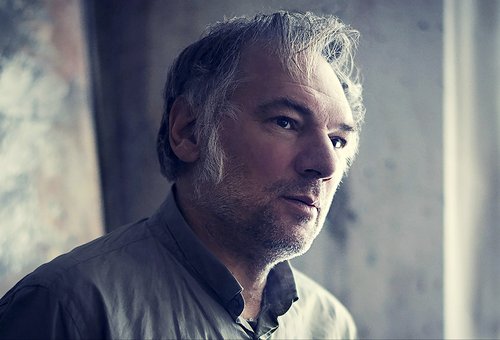


Mikhail Rozanov. Untitled 6, 2016. From the ‘Order’ series. Courtesy of Ruarts Foundation
Longing for Authenticity
‘The Triumph of Melancholy’ exhibition at Ruarts Foundation in Moscow approaches the intimate through the appropriation of the mass-produced. Art critic and curator Sergey Khachaturov reflects on this approach and its hidden pitfalls.
Ruarts Foundation is staging an exhibition about melancholy, ruins, and memory. Assembled by curator Nina Gomiashvili it brings together works by more than thirty contemporary Russian artists. Many of the pieces on display come from Ruarts Foundation’s own storage and reflect, to some degree, the taste of its owners that incline towards a neo-conservative art with affinities to the St Petersburg school and its tradition of engaging with the classical heritage in our own era, including artists like Georgy Guryanov (1961–2013), Mikhail Rozanov (b. 1973), Sergei Sonin (b. 1968) and Elena Samorodova (b. 1973), Valery Koshlyakov (b. 1962), Kirill Koteshov (b. 1983), Vitaly Pushnitsky (b. 1967) among others.

The Triumph of Melancholy. Exhibition view. Moscow, 2026. Courtesy of Ruarts Foundation

The Triumph of Melancholy. Exhibition view. Moscow, 2026. Courtesy of Ruarts Foundation

The Triumph of Melancholy. Exhibition view. Moscow, 2026. Courtesy of Ruarts Foundation

The Triumph of Melancholy. Exhibition view. Moscow, 2026. Courtesy of Ruarts Foundation
A procession of objects, paintings, and installations unfolds across three floors each only tangentially related to the theme. Several of the artists, with similar works, filled the rooms of a previous exhibition at the Ruarts on kitsch. This may be symptomatic. This new exhibition turns out to be about how the fragile subject of melancholy, ruins, and memory is absorbed by the memes and stereotypes of Russia’s mass consciousness. In that light, an exhibition about memory – and the works shown within it – can be read as a successful scan of the public mood and a form of social anthropology.
Melancholy is a state that is personally, painfully earned. It resists conversion into generic modes of presentation and resists alignment with any popular displays of feeling. The first well-known Melancholy of creative people was given to the world by Albrecht Dürer (1471–1528) in 1514. In his engraving, an angel-like winged woman sits in the company of a putto and a dog on the platform of a towering building – is it not the Tower of Babel, humanity’s supreme ruin? Scattered around her are drawing instruments, astrolabes, quadrants, a rhombohedron. The full horizon and the distant light of a comet stretches before her. A bat with a dragon’s tail carries the pennant MELENCOLIA I. In his depiction of Melancholy, Dürer combined the irreconcilable: order and despondency, creative impulse and anguish, the will to act (according to the alchemists, Melancholia I represents the first stage of genius – the creative yearning of artists) and apathy. Such polar states and emotions lead one to conclude that Dürer presented Melancholy as an anti-canonical theme. It cannot become a condition for universal feeling. Each viewer is obliged to plunge into the space of the masterpiece and reckon with their own chimeras, drives, phobias, and insights individually. Melancholy is a condition of strictly personal reflection upon oneself and the world.


What happens when this state of intimate contact with space and time is turned into an entertainment industry and a popular exhibition topic? Something not unlike what was done a quarter of a century ago to Russian Empress Catherine II’s suburban estate at Tsaritsyno. The unfinished Gothic Revival residence, having gradually declined into a melancholy ruin, was the embodiment of lost ideas and ideals concerning the revival of an ancient capital in the guise of an enlightened antiquity, radiant in its pointed-arch silhouettes. From the age of 19th century poet Alexander Pushkin until the 1990s, Tsaritsyno was a place of pilgrimage for solitary dreamers, who wandered among the ruins and gave themselves over to complex thoughts on the vanity of earthly glory, the value of individual emotion, and the inexorable passage of time.
Under Mayor Yuri Luzhkov, Tsaritsyno was overhauled and completed in the style of a Moscow Metro station and turned into a site for mass public events, with the palaces of architects Bazhenov and Kazakov populated by installations not unlike those now on display at Ruarts Foundation. The value of individual experience gave way to an attempt to manufacture a collective emotion from visiting a generalised antiquity. In her 2022 book ‘Fragments of Restoration’, cultural historian Irina Sandomirskaya offers an illuminating interpretation of the restoration of the western façade of Notre-Dame Cathedral in Paris, which in the 19th century architect Viollet-le-Duc designed in an approximate neo-Gothic style of the positivist era. She turns to the touristic memes suspended from the façades – melancholic chimeras, 19th-century pastiche: “…these chimeric creatures are composed of mutually incompatible elements. Universally recognised as symbols of Gothic medievalism, they essentially embody in stone the principle of the production of meaning that is universal to the modern era, which imagines itself as a reproduction of antiquity. Here we find different forms of reproduction: the reconstruction of historic urban spaces through their demolition; the restoration of historic buildings through their completion according to the restorer’s own imagination.”

This formulation – “the reconstruction of urban spaces through their demolition” – directs one’s thoughts not only to Tsaritsyno but also to the neo-Gothic architecture of Moscow’s now-defunct transformer equipment plant Elektrozavod built in 1915 to a design by Georgy Evlanov. Its formidable, Hogwarts-like architecture is slated for demolition, leaving only its towers standing, with the gaps between them to be filled by new blocks for offices and luxury housing.
Such forms of “production of meaning” are deeply traumatic in architecture. In exhibition spaces they become entertaining diversions, quest experiences. This is indeed the impression left by the show at Ruarts Foundation.

One recalls, for instance, an object made especially for the exhibition by Danya Pirogov (b. 1996). A concrete cocoon is encased in a roughly black-painted wooden shell. Light flickers from a crack within. This light renders visible the concrete structure and a burrow-like recess within it. Such a cocoon might perhaps be compared to the pastiche chimeras of Notre-Dame, only of the 21st century. Complex meanings are reduced to the presentation of an elaborate amusement.
Elena Samorodova and Sergei Sonin present the series ‘Northern Arcadia. A Projection of Paradise.’ In their neo-naïve manner of stylising the past as an alternative history, Samorodova and Sonin show carpets, fragments of sculpture, and a video. The shards of an estate civilisation are assembled – one that no longer belongs to any human being and no longer recalls one. Deer reign in the parks in place of people. The memory of life in the manor house is overgrown and forgotten. It is a highly interesting project, yet one that stands in polar opposition to the very idea of the melancholy of ruins. Melancholy is always oriented towards the value of a specific memory, intensely relived in thought and feeling. The amnesia depicted by the artistic duo is precisely the replacement of melancholy with utopia, with dystopia – with those absent places that can be assembled from scratch.


In a certain sense, the objects of other artists in the exhibition also present themselves as artefacts of reconstructed topoi – stylised, as in popular games, including computer games. The sculptural hands with birds by Igor Samolet (b. 1984), the blurred architectural landscapes of Valery Koshlyakov (b. 1962), and the taxidermy museum inspired by the world of the Soviet sci-fi novelists Strugatsky brothers by Katya Isaeva (b. 1980) are all stagings of imagined situations and places. In the logic of empire, utopia displaces melancholy. In my view, it would have been more fitting to show the paintings on rusted metal by Irina Zatulovskaya (b. 1954), the cracked doors and ventilation windows by Alexander Brodsky (b. 1955), or the old overcoats with biographies by Christian Boltanski (1944–2021). In these objects, the pinpoint melancholic contact with memory, with ruins, with lives lived, exerts a very powerful effect.


That said, the exhibition at Ruarts Foundation proves to be an honest diagnosis of a corroded space of memory in an age of high-tech and neo-conservative amnesia. In that capacity, the exhibition is interesting and teaches us something about our lives.