

Keepers of the Folding Homeland: Revisiting Paper Architecture

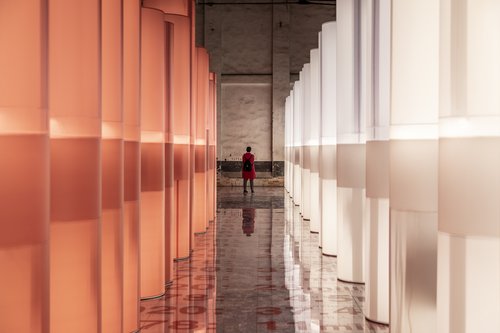
Paper Architecture. Long-Term Storage. Part I. Exhibition view. Moscow, 2026. Courtesy of Shchusev Museum of Architecture
The Moscow Museum of Architecture (MUAR) has opened a trilogy of exhibitions dedicated to the work of the late-Soviet movement of paper architecture. The first chapter is called ‘Paper Architecture. Long-Term Storage. Part I.’
Exhibitions of so-called ‘paper architecture’ have become something of a curatorial staple in Russia, thanks in no small part to its foremost chronicler, Yuri Avvakumov (b. 1957). Avvakumov, who published a critically acclaimed book on the phenomenon in 2019, has long curated exhibitions devoted to the movement both in Russia and abroad. Now the time has come to preserve these holdings for posterity and pass them on to future generations through the creation of a museum archive. This autumn, the Museum of Architecture presents the first instalment of a trilogy, ‘Paper Architecture: The Long-Term Storage’.

Avvakumov explains: “The Museum of Architecture should live under the guardianship of architects, a tradition laid down by its founder, Alexei Viktorovich Shchusev. The Museum holds extensive collections of Shchusev’s own projects, as well as those of Vasily Bazhenov, Nikolai Lvov, Matvei Kazakov, Osip Bove, Fyodor Shekhtel, Ivan Leonidov, Konstantin Melnikov, and many other members of the Russian architectural guild. To gift one’s own creative archive to a museum is a long-standing tradition. This generous gift from Moscow and Siberian architects, former ‘paper men’, is equal in scale to the combined collections of Paper Architecture works held by the Russian Museum, the Tretyakov Gallery, the Pushkin Museum, the Centre Pompidou in Paris and MoMA in New York.”


The very term ‘paper architecture’ has something of a poetic quality. Viewed across the centuries, it could be applied to any unrealised or fantastical architectural project. In its narrower sense, however, the phenomenon emerged in the 1970s and 1980s around an informal community of young architects, predominantly graduates of the Moscow Architectural Institute (MARKhI), as well as the V.V. Kuibyshev Novosibirsk Civil Engineering Institute. The movement encompassed more than ten creative groups and over fifty individual architects, many of whom would later become prominent figures in Russian architecture.
From the late 1970s, graduates of MARKhI and the Novosibirsk institute began entering - and frequently winning prizes in - international competitions for architectural ideas, many of them organised by magazines such as ´The Japan Architect´. Their desire to construct alternative universes, often infused with the surrealist language of psychogeography and metaphysical visions, was perceived as a demarche against the blandness of the design taught in Soviet architectural schools. In this respect, paper architecture had much in common with Moscow Conceptualism: a similarly subversive response to the greyness of the academic art establishment during the Stagnation era.

Vladimir Aristov, Andrey Ivanov, Timur Kuzembaev. The Dwelling of Tomorrow, 1984. Project for the International Union of Architects and UNESCO competition. Courtesy of Shchusev Museum of Architecture

Alexander Brodsky, Ilya Utkin. Information Centre, 1987. Courtesy of Shchusev Museum of Architecture

Andrey Ivanov, Timur Kuzembaev. 'Oikoumene' project for the 'Glass Monument 2001' competition, 1986/2026. Courtesy of Shchusev Museum of Architecture
Gradually, a generation of ‘paper architects’ emerged, among them Alexander Brodsky (b. 1955), Ilya Utkin (b. 1955), Yuri Avvakumov, Dmitry Bush (b. 1958), Dmitry Podyapolsky, Mikhail Labazov (b. 1961), Mikhail Filippov (b. 1954) and Totan Kuzembaev (b. 1953). Avvakumov dates the precise birth of ‘paper architecture’ to 1 August 1984, when the first exhibition to bear the name opened in the editorial offices of the magazine Yunost on Mayakovsky Square. The first exhibition abroad followed in 1986.
As Avvakumov recalls: “From the late 1980s, ‘paper architecture’ travelled from exhibition to exhibition, almost without being replenished by new works. In 1992 the last group exhibition, ‘Paper Architecture: Alma Mater’, was held at the Moscow Architectural Institute. In 1996, at the Venice Architecture Biennale, I presented my archive of Russian architectural utopias of the previous 200–250 years, which naturally included paper architecture too. In essence, the circle closed. Paper architecture became part of the history of Russian art.”

The story did not end there, however. Exhibitions devoted to paper architecture, featuring a roster of contemporary participants broadly similar to that of the present show, were held at the State Tretyakov Gallery in September 2009 and at the Pushkin State Museum of Fine Arts in early 2015.
Looking today at the work of the protagonists of paper-architecture, one recalls a definition that seems very apt: anti-genre. The boundaries of this movement are so open, so sociable with different systems of artistic languages, that it amounts to a formula for design thinking. And in this it is remarkably close to the ideas of architectons by Kazimir Malevich (1879-1935), Prouns by El Lissitzky (1890-1941), and Georgy Krutikov’s (1899-1958) flying cities – all those utopian projects of the Russian avant-garde that charged the air with colossal creative energy. In many ways Avvakumov, Labazov, Andrei Savin (b. 1961), Mikhail Belov (b. 1956), Kuzembaev, Alexandra Pavlova (1964–2013) are heirs to the avant-garde experiment. It is a particularly elegant touch that Yuri Avvakumov likened the architecture of the new exhibition, in the mediaeval hall of the Apothecary Chancery at MUAR, to two cylinders cut into one another, pierced with diamond-shaped windows. This is an obvious allusion to the iconic house in Krivoarbatsky Lane by Konstantin Melnikov (1890-1974), a branch of the Museum and one of the most ambitious monuments of the Russian avant-garde.

Perhaps the eighteenth-century Italian architect Giovanni Battista Piranesi (1720–1778) can be regarded as the great precursor of all imaginary, wilful and unconventional architecture. It is therefore fitting that his celebrated ´Prisons´ so often serve as a prologue to exhibitions devoted to the Soviet paper architects. Piranesi himself realised only one architectural project, the Church of Santa Maria del Priorato, belonging to the Order of Malta in Rome. His fame rests instead on his magnificent series of engravings and drawings, executed with a virtuosity comparable to the finest drawings of Rembrandt (1606–1669).
In architectural graphics, Piranesi was perhaps the first to make us fully believe that the conception of a grandiose building can sometimes be more compelling than its realisation, and that the play of the imagination—the capriccio—can be an artistic end in itself. His drawn and engraved world, little understood but highly prized by his contemporaries, asserted, categorically and powerfully, architecture’s right to live according to the laws of every art form at once: not only building, but also music, poetry and theatre. It is a world in which the cyclopean structures of unknown buildings, inspiring both awe and trepidation, become simultaneously the setting and the protagonists of a phantasmagorical spectacle staged by architecture itself.

Piranesi’s series ‘Grotesques’, and especially ‘The Prisons’, inspired the Romantics of the nineteenth century. They – Prince Vladimir Odoevsky, Thomas De Quincey – dedicated their own works to him. In Piranesi’s architecture, self-propagating in arches, vaults, corbels and cornices and disdainful of the laws of gravity, Sergei Eisenstein (1898-1948) saw the seeds of the film-montage principle of organizing space. In his architectural dreams and reveries, Piranesi wove forms, genres, epochs and styles into an ornament beyond the mind’s comprehension.
The prophet of a particular strand within the work of the Soviet paper architects of the 1980s was Vyacheslav Petrenko (1947–1982), who died at the age of just thirty-five. Many of the themes that would come to permeate the movement were already brilliantly articulated in his projects. Several of his etchings feature in the MUAR exhibition, where they serve as a kind of tuning fork for the works that follow. The leitmotif of Petrenko’s work was the creation of a space-universe in which different ways of ‘stringing architectural volume onto the force lines of the world’, as he put it in one of his notebooks, could be given visible form. Ancient Roman aqueducts and thermae, the skyscrapers of the Russian avant-garde, the flying lovers of Marc Chagall (1887–1985), and the creeping shadows of René Magritte (1898–1967) and Giorgio de Chirico (1888–1978) were among the rich array of images that fed Petrenko’s architectural imagination.

Petrenko conceived each spatial sector as a zone in which different artistic disciplines could converge, guided by certain ideal constants of human existence. Each work of art, in turn, strives towards the fullest possible realisation of a precisely conceived design solution. Petrenko’s work demonstrates that the creative energy which quite literally bursts from his world of forms marks not the end of the ‘paper era’, but rather the enduring relevance of the ideas developed within it. Today, these ideas have become fundamental to contemporary artistic practice and to a mode of thinking that is free and unconstrained by the boundaries of genre or medium.


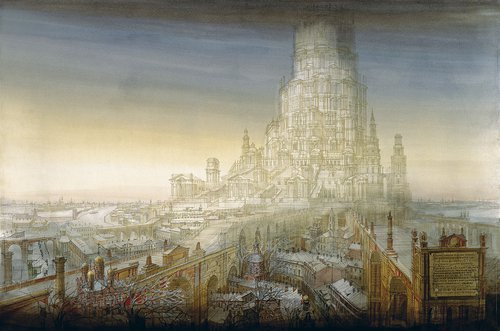
But it was not only the forces of universal gravity, the dynamic transformations of space and time, cosmic diagonals, planes and verticals that captivated the ‘paper men’. At the exhibition, visitors are mesmerized by the somnambulistic etchings of the duo Alexander Brodsky and Ilya Utkin. They created a kind of metaphor for the living environment of the small individual, frustrated by society, for whom architecture served as a consolation and a world of hidden hopes and reveries. They devised their own theatre of architecture, akin to a performance staged by way of pencil and paper. This theatre could conceivably be brought to life through animation and shown alongside the animation films of Soviet directors Khrzhanovsky, Khitruk and Norstein. Sometimes, to my mind, Alexander Brodsky and Ilya Utkin turn to the genre of dystopia: not of ‘other’ places, but of ‘wrong’ ones. Expressive in this context is the etching ‘Glass Tower’, on display at the MUAR exhibition. The duo recall the myth of the Tower of Babel. In their version it is made of glass and has scattered across a vast territory. Its shards, in which a vertical silhouette can be discerned, lie in a field, rest on a riverbed and, from above, resemble a gigantic shadow. In ordinary life this ruin is invisible. From the distance of Walter Benjamin’s Angel of History, we too can barely see the traces of the catastrophe. It is buried too deep in the cultural stratum. That is, even the distress signal goes unread, and leaves one indifferent. Time and Space are folded away. It is only logical that the sheet bears a quotation from Ecclesiastes (Eccles. 1:9): “That which hath been is that which shall be; and that which hath been done is that which shall be done: and there is no new thing under the sun.”

A further strand can be identified within the complex phenomenon of the ‘paper architects’: those whose work developed a conceptual critique of the socio-political realities of Soviet life. In 1990, Dmitry Bush, Alexander Khomyakov (b. 1957) and Dmitry Podyapolsky created, both as a graphic work and using a metal construction set, the image of a ‘folding homeland’. On the one hand, it represents housing alienated from the individual, designed for extreme conditions; on the other, it becomes an idealised metaphor for home and homeland as a realm of freedom and dreams, echoing the proverb, ‘All that I own I carry with me’. Wherever one finds oneself, one can unroll the carpet of one’s dreams and be happy upon it. This, perhaps, offers the best definition of the power at the heart of paper architecture itself: the ability to imagine another reality. Its architects as melancholy dreamers of their age.
Paper Architecture. Long-Term Storage. Part I.
Shchusev Museum of Architecture
Moscow, Russia
8 September – 18 October 2026