

Infante At Home Among Nuclear Physicists

Artefacts of Francisco Infante. Exhibition view. Dubna, Moscow Region, 2026. Courtesy of JINR Gallery
In Dubna, a small Russian town renowned for its nuclear research, the metaphysical semi-abstract photography and paintings of Francisco Infante-Arana enter into dialogue with snow-covered pine groves. Hosted in a former Soviet cafeteria turned gallery, the exhibition brings art and science together in unexpected harmony.
While major state museums in Russia are becoming increasingly wary of contemporary art, new venues that welcome it are appearing in the most unexpected of places. An impressive solo exhibition of works by Francisco Infante-Arana (b. 1943) is on display in Dubna, a small town one hundred kilometres from Moscow. This quaint town, which sprawls across the pine-covered banks of the Volga and Dubna rivers, is world-famous for its nuclear research institute. Ten elements of the periodic table were discovered here, one of which, dubnium, was named after the town. The whole life of the town revolves around the Joint Institute for Nuclear Research (JINR). Since the Soviet times, it has been run collaboratively by several countries and has functioned as a state within a state, serving as the Eastern Block’s counterpart to Switzerland’s CERN. Currently, despite EU nations having stopped or suspended their participation since 2022, it still has thirteen member countries, ranging from Cuba to Vietnam. During the Soviet era, the town was an oasis of liberalism, attracting visitors from Moscow to attend concerts featuring dissident poets or to enjoy disco parties with far more varied playlists than were permitted elsewhere by Soviet censorship. With its tree-lined streets, cosy single-family houses, expansive riverside promenades, and bike paths, Dubna has much more warmth and character than a typical Soviet town built after World War II. Nowadays, the Institute makes great efforts to attract leading intellectuals from Russia and beyond. The House of International Conferences, an impressive modernist building from the 1970s surrounded by a park, now has its own art gallery, replacing an outdated Soviet-era cafeteria. Architects from the Orchestra design studio in Saint Petersburg have installed high tech museum lighting and hanging equipment while preserving the style of the original interior, with its streamlined shapes, minimalist furniture, and abundance of metal and glass.


The inaugural exhibition is a collaboration between JINR and the Veretyevo Art Estate, a luxury resort hotel built on the site of a former Young Pioneer camp on the outskirts of Dubna by Moscow businessman Aleksey Gnatyuk, a native of Dubna. Veretyevo’s artistic director, Irina Gorlova, who co-curated the recent extensive retrospective of Infante’s work at the State Tretyakov Gallery in Moscow, suggested selecting one of the older non-conformist artists for the inaugural exhibition. Infante and his wife and collaborator, Nonna Goryunova (b. 1944), are renowned for their passion for experimentation and for creating artworks in collaboration with nature. Their approach aligns perfectly with the town’s ethos.

There is also a long tradition of these kinds of shows: during the Soviet era, when underground artists were banned from state-run exhibition venues, they would often hold small exhibitions at research institutes whose staff were interested in contemporary art. Since the work of scientists was considered crucial for the country’s defence capabilities, they were granted certain liberties. “Works of art were placed in the corridors or wherever the space permitted. The artists could not have their say on these matters,” – Infante told Art Focus Now on the opening night of the show. – “Of course, it is very different now.” However, he appreciates the genuine interest that scientists have shown in art even back then. “They are not like the general public visiting a museum. They are more intelligent and appreciate the value of labour, including that of the artist.” Indeed, nuclear physicists seem to view his art from a unique perspective. Dubna’s patriarch, Yuri Oganessian, who is now ninety-three and the only person to have an element in the periodic table named after him during his lifetime, told Infante that his art is “all about zero and eternity – issues that science would never solve. Do you hope to solve them with your art?”

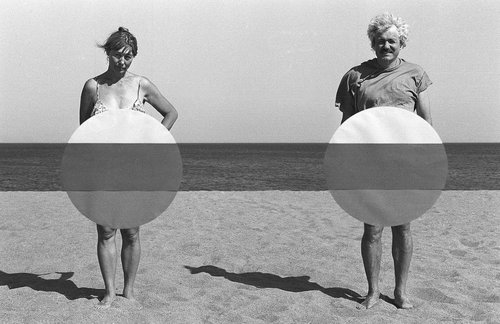
Infante’s style is a unique blend of Russian landscape photography, land art, and the avant-garde tradition of geometric abstraction. In a series called ‘Artefacts’, he creates striking optical illusions by strategically placing mirrors and other objects in a real landscape and photographing them, without using any photo collage techniques, either analogue or digital. Many of the ‘Artefacts’ were photographed on snow from the 1970s onwards. In Dubna, Infante’s art returns to its origins for the first time ever: the photographs are displayed against the backdrop of a snow-covered pine grove, which is visible through floor-to-ceiling windows. The effect is mind-blowing: in a silent dialogue between the works of art and the viewer, nature becomes an interlocutor in its own right. Curator Irina Gorlova employs the same display technique used for the Tretyakov exhibition: the artworks are suspended on metallic strings attached to the floor and ceiling, seeming to float in mid-air. However, in Dubna, the curator shunned the chronological principle. She placed works created fifty years apart in the same space, thereby highlighting the continuity and integrity of Infante’s body of work. The earliest work in the exhibition is a version of Infante’s iconic piece ‘The Birth of Vertical’ from the early 1960s, while the latest is a series of four abstract paintings on paper called Spiral Eidos Symbols created in 2025. “I wanted to show how he circles back to the same idea and becomes interested in it sixty years later,” Gorlova explains. The result is a kind of mini-retrospective: all of the important series are represented by at least two or four works, and sometimes even more. All of the works of art on display were loaned by the artist and his family.

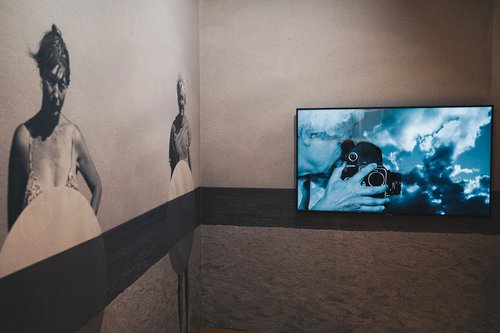
The exhibition occupies all three of the newly renovated spaces in the former cafeteria and surprises visitors with the dramatic contrast between light and darkness. Between the two brightly lit halls with large windows, which house Artefacts mostly photographed in daylight, there is a darkened passage where paintings dedicated to the eternal darkness of outer space are displayed. This includes Infante’s early ‘Cabbalist Cosmos. Projects of Reconstruction of Starry Sky’. The series of paintings from the 1960s shows stars aligned in symmetrical, orderly patterns. There are also abstract ‘Spirals’ from 2025 and a film created from rare footage shot by Infante and Goryunova in the late 1980s and early 1990s.

This film shows the artists working on Artefacts in different parts of the world. They install their complex suspended constructions in wild and unspoilt locations, literally bringing order to nature’s chaos. Fantasy becomes reality right infront of our eyes. In the corner of the same hall, an intricately designed kinetic object shines and rotates tirelessly. This rare surviving piece of Infante’s kinetic art (a reproduction of a 1960s piece made by the artist in 2005) serves as a reminder that Infante was a prominent figure in Kineticism in the USSR. Here in Dubna, this complex contraption, which serves no practical purpose, looks like a friendly nod from the artist to the scientists, whose work is often perceived as wasteful and remote from real life. However, some of the research projects developed in Dubna are of vital practical importance; for instance, the radiation-based method of fighting cancer. “Could art heal humanity’s ailments as well?” – you can’t help but wonder as you stroll through the halls, catching glimpses of trees clad in white standing solemnly like silent sentries.