

In Search of Harmony

Egor Ostrov. The Athenian school. Raphael Santi, 2011. From collection of Ekaterina and Vladimir Semenikhin. Courtesy of Ekaterina Cultural Foundation
An exhibition ‘Austerity and Aesthetics’ at the Ekaterina Cultural Foundation in Moscow has been sixteen years in the making. Conceived in 2010 by artist Olga Tobreluts, it brings together artists and architects who are united by their dedication to classical tradition and the ideal of beauty.
The exhibition ‘Austerity and Aesthetics’ currently on at the Ekaterina Cultural Foundation was first conceived back in 2010, the brains behind it one of Russia’s most established contemporary artists Olga Tobreluts (b. 1970) who originally envisioned it as a sort of hymn to the New Academy group of the 1980s-1990s. As her search for a venue and funding dragged on over years, the exhibition gathered additional participants even including artists with no immediate connection to the New Academy or to St Petersburg as cradle of the movement like Evgenia Buravleva (b. 1980), Oleg Dou (b. 1983) and Andrei Filippov (1959–2022). Even so, these fellow travellers were selected by Tobreluts for their formal and ideological affinity – besides striving for the austerity and aesthetic beauty named in the title, they had to have a deep respect for classical art and tradition in the broadest sense, and to acknowledge the canon of high culture.

One such figure is the architect and artist Maxim Atayants (b. 1966) whose work is displayed in the first room - a long frieze of sketches of the Pergamon Frieze from the Pergamon Museum in Berlin hangs along one wall, on the others views of Rome and Palmyra. The Gigantomachy sits alongside painterly ruins of ancient civilisation. The legacy of the Romans and Greeks has indeed survived in vast quantities to the present day, and it astonishes with its engineering ingenuity – which, combined with the philosophical and mystical thinking of the Pythagoreans and Platonists, gave rise to the notion of ideal forms. If one accepts these as such, then correspondence to them becomes a clear criterion of the beautiful. Yet it is obvious that this is a matter of choice and one need not necessarily choose the classical understanding of harmony. As a result, the whole construction of the exhibition ‘Austerity and Aesthetics’ feels somewhat pretentious from the outset.

Developing the theme, Atayants is followed by a substantial body of works by Anton Chumak (b. 1980) who looks simultaneously backwards and forwards: drawing inspiration from (Neo)classicism, the industrial style, Constructivism, and 19th century arcades. He translates the resulting whole into a compendium of architecture. His models and paintings whether ‘Pier’ (2022), ‘Pantheon’ (2026), ‘Grain Elevator’ (2021), ‘Lighthouse’ (2022), or ‘Order’ (2020) are pervaded by an unmistakable yearning for a supposedly lost clarity and severity. Yet if one looks carefully at international modernism, brutalism, deconstructivism, blob architecture, and parametricism in turn, it appears that nothing has been lost and if anything, the world has become far richer in forms and types of harmony.

On the second floor, where most of the works are on show, the struggle with modernity continues. One should begin with classical works by the New Academicians. On display, for instance, in the form of a large projection (the original having been lost) is the painting ‘The Triumph of Homer’ (1997) by Oleg Maslov (b. 1965) and Viktor Kuznetsov (b. 1960). The founder of the New Academy, Timur Novikov (1958–2002) – who also went blind towards the end of his life – is portrayed in the role of the great sightless ancient Greek poet. The artists, however, gave their leader a physique more in keeping with a Hollywood action film, which bears little resemblance either to the real Novikov or to the mythological image of Homer. It is rather amusing that neoclassicism quite often veers, in its pursuit of beauty, towards the most low-grade mass culture and kitsch – despite roundly condemning such things in its programmatic pronouncements.

In Maslov and Kuznetsov’s painting, the numerous figures depicted are members of the New Academy and their allies. The same roman-à-clef device recurs in the large-scale triptych ‘The Triumph of Apollo’ (2000) by the group Rossiya – a Moscow collective that shared views close to those of Novikov and his brethren. Here Georgy Guryanov (1961–2013) appears as Phoebus, Alexei Belyaev-Gintovt (b. 1965) as Perseus, and the severed head of Medusa in his hands is none other than Tobreluts herself. All of this is mildly entertaining – as it always is when one begins picking out familiar faces – but no more than that. It should also be said that the proclaimed return to traditional formal standards in art does not seem convincing in either work: both are executed rather clumsily and could easily be read as deliberate parody of the classics rather than their revival or celebration.

Far more interesting are the small masterpieces scattered about the room alongside these leviathans. First, there are paintings by Guryanov the diptych ‘Stern Youth’ (1987) and ‘Red October’ (1990s), which genuinely lay bare the ideal of the New Academicians - Soviet camp, uniting the strictness of post-revolutionary everyday life with the fault lines running through that official world: an everyday micro-decadence. Then there is Andrei Khlobystin’s (b. 1961) 'Academia Nova' (1999), in which black silhouettes of vases, urns, and candlesticks are arranged against a white ground. This is without question the funniest work in the exhibition. As the most radical and intellectually serious member of the group, Khlobystin has never stopped short and always pushed artistic gestures to the point of absurdity. In this he was, of course, very much a conceptualist though he would probably bristle at the label. Here, however, he subjects the entire logic of the New Academy to ironic commentary and self-subversion, reducing it to a set of textbook clichés.

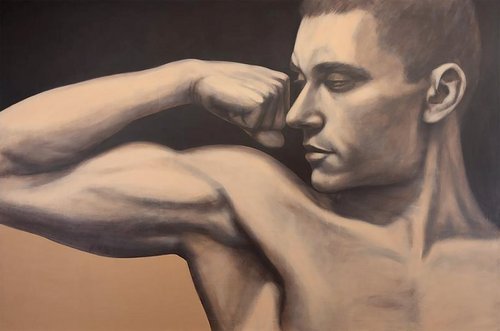
Austerity and Aesthetics. Exhibition view. Moscow, 2026. Photo by Mikhail Gurevich. Courtesy of Ekaterina Cultural Foundation

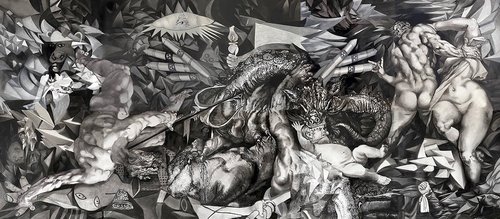
Austerity and Aesthetics. Exhibition view. Moscow, 2026. Photo by Mikhail Gurevich. Courtesy of Ekaterina Cultural Foundation

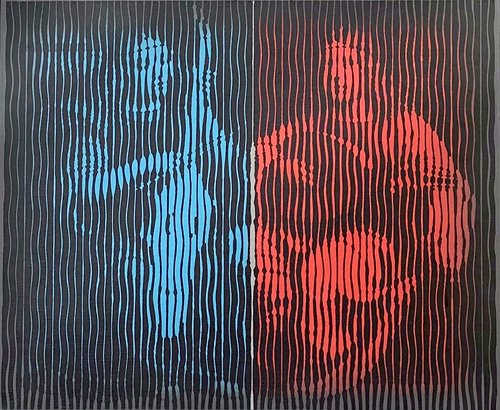
Austerity and Aesthetics. Exhibition view. Moscow, 2026. Photo by Mikhail Gurevich. Courtesy of Ekaterina Cultural Foundation
These three works cannot save the overall structure of the exhibition – just as, in the biblical myth, Lot and his family ultimately failed to save the two famous cities destroyed by God. The display is crammed with works; the density is truly remarkable, particularly given that the word ‘austerity’ features in the project’s title. There are some genuinely startling curatorial decisions. For example, a painting by Daniil Arkhipenko (b. 1985) from the series ‘Neo-reality’ (2025), which is clearly devoted to the image of Plato’s cave, has been hung between two large, gaping vents in the wall. This could be one of two things: either a conceptualist act of sabotage (which it certainly is not) or it betrays an absence of the very notion of beauty that is so central to the theme of the exhibition. And such a gap between what is proclaimed and what is achieved is dispiriting.