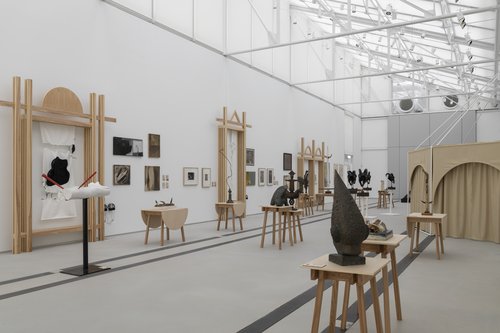
Still Life. Portrait. Landscape. After Genre. Exhibition view. Moscow, 2026. Photo by Daniel Annenkov. Courtesy of GES-2 House of Culture
In Search of Genre: New Exhibition at GES-2
At GES-2 House of Culture in Moscow, the exhibition ‘Still Life. Portrait. Landscape. After Genre’ traces three classical genres of painting from the Dutch Golden Age to the age of selfies and data centres. Ambitious in scope, if at times controversial in its approach, the exhibition runs until April 2027
This October a large-scale exhibition, ‘Still Life. Portrait. Landscape. After Genre’ has opened at GES-2 House of Culture in Moscow. It was a long time in preparation with an unusually large team of curators: five in-house - Dmitry Belkin, Andrei Vasilenko, Andrei Parshikov, Karen Sarkisov and Alexandra Tumarkina who were joined by Anna Kravchenko, Daria Kravtsova and Inna Kushnareva and works were found across dozens of private collections and four museums, in galleries and archives. Because of the scale and complexity, the opening was postponed several times and although the exhibition has turned out to be controversial for its juxtapositions, conceptualisation and the display, it is a must-see show for cultured Muscovites or anyone visiting the capital over the next six months.

The display opens with a section devoted to still life which you can see through a glass wall by the cloakroom even before you enter the exhibition space, inticing any visitors who may be at GES-2 for something else. So while you hand in your coat or dash to the washrooms, you cannot help noticing ‘The Vegetable Stall’ (second half of the 1640s – late 1650s) by Frans Ykens (1601–1693) and Jan Cossiers (1600–1671) and ‘Cook at a Table with Game’ (1630s) by Frans Snyders (1579–1657) and Jan Boeckhorst (1604–1668), both paintings from the Hermitage. These large canvases, filled with an almost physically palpable flesh and set against a dark background, are complemented by a long table on which lie (and partly hang above it) imitations of dishes and carcasses made of fabric, thread, beads and rhinestones. This is the installation ‘The Feast’, created specially for the exhibition by Dmitry Tsvetkov (b. 1961) and his students at the Higher School of Economics. And it too provokes a strange feeling, something like an unhealthy appetite.

Further on, down a narrow corridor cluttered with fragments of the textbook work ‘Décor: A Conquest’ (1974–75) by Belgian poet and conceptual artist Marcel Broodthaers (1924–1976), from the V–A–C Foundation collection, viewers emerge into open space: beyond, a tangled labyrinth of curatorial sections and subsections multiplies through the halls and branches off in all directions. Broodthaers’s multi-part installation, built as a mocking imitation of a classical European museum display of the 19th and 20th centuries, becomes the pivotal work of the ‘Still Life’ section. The work pushes to the point of absurdity the early bourgeois exuberance of the Dutch (only now in the form of loot seized in the colonies) and anticipates the pushing to absurdity of progressive values (the latter is shown uncritically in the subsection ‘Extraction’, in the part devoted to landscape, but more on that later).

Besides this, Broodthaers, with his cannons and pythons (achievements and trophies respectively), rhymes perfectly with, for example, popular ASMR videos and streams in which the authors juicily consume food or even something entirely inedible, such as plastic and metal electronic components. The subsection devoted to them, called ‘Mukbangs’ (a Korean genre of Rabelaisian, demonstrative gluttony), was put together by the film critic Inna Kushnareva. Taken from online hosting sites, these short films present the same subject of abundance and, above all, the enjoyment of it, as the Dutch do. At the same time, as with Broodthaers, the imagery used in these clips can characterise today’s world from its unattractive side. If the Belgian artist delicately showed in the 1970s how deeply the deceptively neutral museum sphere is permeated by imperialism, the semi-anonymous video bloggers of the 2010s–2020s display in full splendour today’s cult of consumption – and not so much as direct eating as watching a screen, the desire to see ever new images, static and moving. Instead of overseas territories, attention, desire and human consciousness in general are being captured.

The ‘Landscape’ section that follows ‘Still Life’ is equally dense. One of its most intriguing subsections, ‘From Point to Pixel’, brings together works by Russian artists from different generations, schools and artistic circles. Among them are several paintings by Stanislav Shuripa (b. 1971), whose penchant for schematism, primitivism and geometry brings his work close to abstraction. For several decades, Shuripa has also been a leading professor at the Institute of Contemporary Art in Moscow, where an influential circle of artists formed around him in the early 2010s. One of these was the Russian-Estonian painter Sergei Lotsmanov (b. 1983), whose large-scale canvas ‘Abstract Landscape 3’ (2014) is also on display. Here, the psychedelic-geometric approach is refined to an extraordinary degree of precision: variations in the elevation of a supposedly earthly terrain are rendered as a series of steps, while gradations of blue in the sky are reduced to sharply delineated, monochromatic zones, somewhat reminiscent of Minecraft. To transform the landscape entirely into a system of pure signs, Lotsmanov draws two horizontal stripes across it, recalling the visual language of Erik Bulatov (1933–2025).

Nearby are a monumental panel of ceramic tiles by Sergei Karev (b. 1989), ‘761 to Levitan in a Repetitive Technique’ (2025), and an equally large composition of canvases mounted on a circular metal stand by Anna Tagantseva-Kobzeva (b. 1990), ‘feōdum’, created especially for the exhibition at GES-2. Both artists studied at the Institute of Contemporary Art, although their practices evolved under quite different influences. Having moved well beyond the post-conceptualist tradition, both create works that, despite their scale and multiple components, remain unified and remarkably self-contained. In these compositions, landscape becomes less a recognisable subject than a problematic line of inquiry, pushing abstraction even further than in the works of Shuripa and Lotsmanov.
The subsection ‘Extraction’ seems almost inevitable after years in which postcolonial, decolonial and ecological theories have been fashionable among curators and artists. Like so many forms of activism that have entered the art world, this wave rapidly and unthinkingly became radicalised, turning its criticism on everything and everyone, including its own foundations, before ultimately dissolving ingloriously into the bureaucratised routines of biennials and museums. At GES-2, viewers have their ‘eyes opened’, in a distinctly didactic fashion, to the exploitative nature of landscape as a genre: it turns out that behind those pleasing images of nature lie the seizure of territories and the plundering of the earth’s resources! Yet such exploitation was hardly ever a secret and was often discussed quite openly. The supposedly revelatory tone of today’s exhibition texts makes it sound as though their authors have only just discovered these truths themselves. At times, they resemble a dazibao — a form of aggressive political propaganda that seems to agitate its author more than those at whom the message is directed.

Yet the section itself brings together an impressive variety of exceptional works. Among them is Claude Monet’s (1840–1926) ‘Waterloo Bridge, Effect of Fog’ (1903), on loan from the Hermitage, which is intended to demonstrate the influence of industrialisation on art. And indeed, that influence is unmistakable: the entire scene is enveloped in London’s industrial smog, shaping the painting’s palette and, by extension, contributing to the emergence of new approaches to painting. Another Hermitage loan, ‘View of the Tatras’ (1934) by the Polish hyperrealist Rafał Malczewski (1892–1965), depicts a train emerging from a mountain tunnel, surrounded by a landscape visibly transformed by human intervention.
The section also features works commissioned specifically for the exhibition from contemporary Russian artists. Among them is the monumental canvas ‘The Creation of the World’ by the collective Deus ExCavator, comprising Kerim Ragimov (b. 1970) and Pyotr Shvetsov (b. 1970). Evoking Dante’s vision of the structure of Hell, it depicts Mir, the world’s largest kimberlite pipe, an enormous funnel-shaped diamond mine in Yakutia. Another contribution comes from Alina Brovina (b. 1987), who employs her characteristic technique of stitching together large pieces of fabric and filling the resulting quilted structures with padding. Her textile panel ‘Ploughed Lands’ is, in essence, a reinterpretation of a satellite image of the Earth. Together, these works reveal how the horrors of resource extraction, once translated into an aesthetic language, become simply beautiful pictures or equally accomplished objects - creating an obvious tension with the curators’ explanatory framework.

The most delightful aspect of the exhibition, in the best sense of the word, is its final section. Devoted to portraiture, it occupies a small hall, almost miniature compared with the expansive spaces given over to still life and landscape. Just six works are on display here: five self-portraits by Kazimir Malevich (1879–1935), spanning different periods of his career, and a seminal work that is also a participatory action, ‘Finger’ (1977–78) by Andrei Monastyrsky (b. 1949). Visitors are invited to place a hand inside a box, extend a finger through a hole and point it back at themselves. The curators’ message - in this case, that of Karen Sarkisov and Andrei Vasilenko - is that today we are preoccupied above all with capturing ourselves, even when we attempt to photograph, film or depict someone else, or indeed something inanimate. This idea is conveyed through a handful of works that bring the artistic developments of the 20th century full circle: a laconic, witty and remarkably effective conclusion to the exhibition. It is worth noting that self-portraiture tends to flourish not only during periods of revolutionary change in art, but also in times of decline - although the two often exist side by side. This raises an intriguing question: are we witnessing an artistic renaissance or a precipitous descent, and what might our obsession with selfies reveal about where we stand?

For all the criticisms that can be levelled at the exhibition - and it is usually the bland, unremarkable projects that leave little room for debate - it offers tremendous scope for the viewer’s imagination, provided one can look beyond the curators’ often dogmatic assertions. Ultimately, this openness to interpretation is one of the exhibition’s greatest strengths.