

Homes for the Future

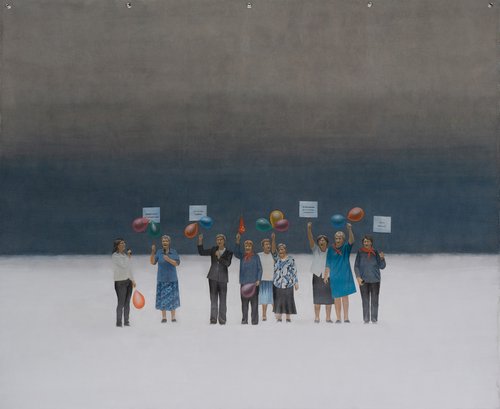
Pavel Otdelnov. Dishwashing, 2026. Courtesy of the artist
Pavel Otdelnov’s ‘Estates: Fragile Utopia’ turns Britain’s postwar housing estates into sites of memory, longing, and ideological collapse, tracing the faded afterlife of collective promises once built into concrete. In this essay, Il Gurn situates the series between Soviet and British histories of social housing, showing how Otdelnov uses architecture to reflect on utopia, alienation, and the failure of the future to arrive as imagined.
Over the past three years London based Russian artist Pavel Otdelnov (b. 1979) has mounted three solo exhibitions in London – 'Acting Out' (2023), ‘Hometown’ (2024) and ‘Child in Time’ (2025) - sustaining a painterly elegy to the industrial landscape of his native Dzerzhinsk. The modulation into British social memory, the same utopian leaven, yet on a more localized scale, appears thematically seamless, though for the artist it has required four years to situate himself in it.
On New Year’s Day in 2026, standing on what locals call the ‘Bridge to Nowhere’ in South London’s Burgess Park, Pavel Otdelnov sang ‘Likho’ by Alexander Bashlachev the Soviet rock poet dead at 27: “Forgetting where we’re from, we gallop every way. We wagered on a miracle – misfortune was the pay”. Behind him loomed the brooding bulk of the Aylesbury Estate, council housing that melancholically echoes the industrial giants of Otdelnov’s Soviet childhood crowned, at that angle and distance, by the tip of the iconic Shard.

This same building has now become one of the protagonists in his new series ‘Estates: Fragile Utopia’. On canvas, the housing complex emerges as a solitary social ark launched into a future, the Future that had forgotten what it was for. Across the rooftop of this once-residential block Otdelnov inscribes an epitaph in monumental lettering: ‘Homes for the Future’. Companion ghost slogans also appear across other works in the series like ‘Better Life for All’, ‘Glory’ - Soviet in genetic code, they fuse two distinct socialist traditions at a point of historical entropy that perhaps lies beyond Britain and Russia, somewhere else, in a different, more reflexive time.
Within Britain’s culture of constitutive individualism, estates like Aylesbury were systematically marginalized, widely seen as sites for petty crime. The architectural indictment of utopia itself had become official policy under Margaret Thatcher in the 1980s. Her “greatly admired” geographer Alice Coleman, who audited council estates and was granted a private audience at 10 Downing Street, meticulously counted graffiti on their walls, measured corridor lengths, then compiled tables documenting the correlation between the volume of excrement and the number of storeys. For science of this kind Aylesbury became the perfect laboratory. The outcome of this surveillance was the controversial ‘Utopia on Trial’, a book whose very first illustration shows the demolition of a housing block in Birkenhead, captioned: failed utopia.

“In Russia too this social utopia failed to take root,” Otdelnov remarked during our Q&A prior to the exhibition opening. “But while the Soviet version was total, the same urban planning template repeated from Vladivostok to Kaliningrad – here, within a single city, dozens of different utopias coexist for slightly different people, classes, families, for different professional groups. It’s interesting that even utopia here is more individualised.”.
I remember the evening Otdelnov first mentioned the idea of an exhibition on British social housing. We’d met by chance at a Gagosian opening in autumn 2025; in his hands was a freshly signed catalogue by David Hepher, inscribed simply: with my best wishes. David. Leafing through it, I recognised the recurring motifs so characteristic of Otdelnov’s own practice – solitary panel blocks, grids, neglected and despised – only transposed into British concrete. I also suspect Otdelnov had been aware of this aesthetic complicity long before he needed to be told.


Otdelnov excavates Britain’s own half-forgotten utopian blueprints: Geoffrey Jellicoe’s ‘Motopia’, where cars raced along rooftop motorways out-Corbusiering Corbusier; Ebenezer Howard’s garden cities, realised in part at Letchworth; Patrick Abercrombie’s grand plan for the capital redevelopment with dozens of ‘ideal’ satellite towns of 30,000 residents each to decompress London. The visionary audacity of these projects deserves special note, for in a country where history constantly weighs upon everything, it’s extremely difficult to create anything new: Britain’s spiritual climate is defined by an axiomatic anti‑collectivism – try remaining an innovator when you face a united front of “everything” arrayed against you (conservatism, liberalism, skepticism, popular ignorance and popular knowledge alike).

“Utopias thrive in an environment of political stability,” Otdelnov observes. “When a single party rules, it slides into dystopia, as in the USSR. In Britain certain sublime ideas were never realized, but at least no autocrat came to seize the country. In that sense, perhaps the worst evil was avoided”.
Another artist whose work resonates at a certain remove with Otdelnov’s projects, including earlier series such as ‘Inner Degunino’ and even ‘Russian Nowhere’, is the photographer Peter Mitchell (b.1943), who spent his entire career chronicling the street life of Leeds, its slow-motion metamorphoses, its resistance to modernization. In 2015 Mitchell published the anthology ‘SOME THING means EVERYTHING to SOMEBODY’, in which one photograph – a stack of multicolored books against a white ground – strangely rhymes, in my eyes, with Otdelnov’s object ‘Robin Hood Gardens as a Ruin’: a vertical ledger of lives that once meant everything to somebody.

In ‘Pointing the Hill’ Otdelnov paints the hand of Peter Smithson, co‑architect of Robin Hood Gardens – the complex Zaha Hadid once called “her favorite structure in London.” The hand holds a pointer directed at the artificial mound lying between the blocks. The estate itself has been liquidated (two severed walls of brutalist concrete are now on display at the V&A Storehouse, achieving something closer to accusation than preservation amid countless antique chairs and carved tables), yet the mound remains. “In fact, this mound is made of the buildings demolished to make way for Robin Hood Gardens. These are ruins of a previous utopia. The mound is a cemetery of earlier ideas,” Otdelnov reflects.

At the height of what is now called “the housing crisis” – when an entire generation cannot afford to buy a home at current prices – any serious interrogation of housing becomes an indictment. Otdelnov himself briefly entertained the possibility of entering the “affordable housing” scheme – a 25 percent stake with the rest rented but realized it was walled off by bureaucratic formalities that make the system almost impossible to navigate in practice. “It seems to me that the Labour Party in Britain is in crisis,” he says, “and has diverged from its earlier principles, no longer fully representing the working class.”
There is a certain fitness to the exhibition’s location in Lewisham, a South London borough whose own council-housing history is far from unblemished. After the war the “Excalibur” estate rose here – a cluster of single‑family prefabs for those bombed out by the Blitz. These modest houses still stand, resembling Soviet dachas. “Curiously, for us, people from the post‑Soviet space, suburban houses were associated with the possibility of private life, one’s own space,” Otdelnov notes. “Here they were, on the contrary, part of communal living – a chance to escape the terrace houses and build a shared existence.”


‘Estates: Fragile Utopia’ is a method of immersion before it’s an artistic project, an attempt to explain that immersion until it resonates and condenses into a form – with the important concession that such a new form will never reveal itself fully. This is partly why the project draws into a conversation not so much about the aesthetic solutions as about the world humanity has not matured enough to reach – the images themselves functioning as the mechanism that admits the viewer into the subject.

Estates: Fragile Utopia. Exhibition view. London, 2026. Courtesy of Lewisham Arthouse

Estates: Fragile Utopia. Exhibition view. London, 2026. Courtesy of Lewisham Arthouse

Pavel Otdelnov. Homes for the People, 2025. Courtesy of the artist

Estates: Fragile Utopia. Exhibition view. London, 2026. Courtesy of Lewisham Arthouse
Looking across Otdelnov’s body of work, the thesis is not that utopia stagnated – the world stagnated and dragged everything down with it. How could utopia withstand a collision with the spirit of today’s practical expediency that is alien to any communal form of life? Rem Koolhaas in one of the margins of “S, M, L, XL” muses that the most interesting places in the modern city are often those where no one ever tried to build anything. It seemed almost unfair to use Koolhaas against Otdelnov, so I also added: “Had you located the ‘British nowhere’?”
“Right now I’m living in it,” the artist replied. “I’m in the ‘British nowhere’.”