

Guryanov Memorial Museum-Apartment Opens in St Petersburg

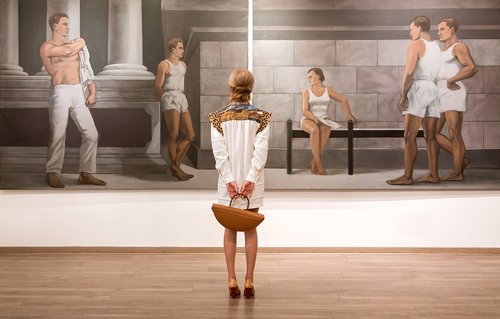
Guryanov Museum-Apartment. Exhibition view. St Petersburg, 2026. Courtesy of Guryanov Museum-Apartment
A memorial museum-apartment dedicated to artist and musician Georgy Guryanov – drummer of the legendary Soviet rock band Kino and one of Russia’s most significant visual artists – has opened in St Petersburg to mark the 65th anniversary of his birth.
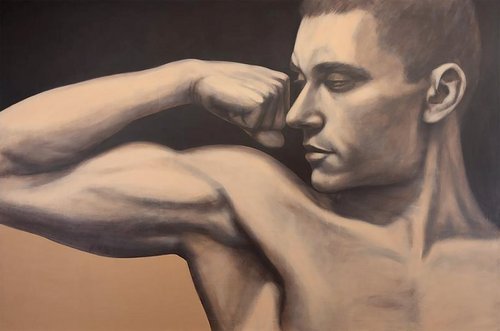
A memorial museum-apartment dedicated to Georgy Guryanov (1961–2013) is set to open in St Petersburg, timed to mark what would have been the 65th anniversary of the musician and artist’s birth. More than a decade after his death, Guryanov remains one of the most influential figures in contemporary Russian culture. Born in Leningrad, Guryanov completed secondary art school and briefly studied at an art college before turning decisively toward the underground cultural scene of the late Soviet period. From the late 1970s, he performed in rock bands that occupied a semi-official space within the ideological constraints of Soviet culture. In 1984, he joined the group Kino as drummer – a band that would go on to become one of the most significant acts in Russian rock history. Kino and its frontman, Viktor Tsoi (1962–1990), who tragically died in a car accident in 1990, drew inspiration from Western groups such as The Smiths, Duran Duran, and The Cure. The band’s distinctive New Wave aesthetic was shaped in large part by Guryanov, who once described Kino as “a romantic band rooted in the punk school.” In 1979, Guryanov met Timur Novikov (1958–2002) and became associated with the New Artists movement. A decade later, in 1989, he joined Novikov’s New Academy of All the Arts (later renamed the New Academy of Fine Arts), a circle dedicated to reviving classical ideals of beauty while operating as a distinctly postmodern cultural phenomenon. As a visual artist, Guryanov consistently explored what he described as a “totalitarian aesthetic,” drawing on the monumental visual language of Leni Riefenstahl’s film ‘Olympia’ and Mikhail Room’s ‘A Stern Young Man’. He frequently transposed stills from these films onto canvas, recontextualising their imagery within his own painterly practice.

The idea of establishing the museum emerged during preparations for the exhibition ‘Georgy Guryanov. Whither Shall We Sail?’, held at St Petersburg’s K-Gallery in 2022. The exhibition was curated by the distinguished art historian and close friend of the artist, Arkady Ippolitov (1958–2023), author of the monograph ‘Georgy Guryanov. The Last Dandy of St Petersburg’. It was during this process of research and reflection that the concept of a permanent memorial space began to take shape. The museum’s director, Akim Nearonov – son of New Academy artist Olga Tobreluts (b. 1970) and DJ Andrei Haas – underscores the exceptional immediacy of the project: “The museum has been lovingly realised very shortly after Guryanov’s death, and therein lies its uniqueness: his friends, the witnesses to events, are still alive, and we are able to gather facts undistorted by time or retelling.” The funds required to establish the museum within such a compressed timeframe were raised with the support of Moscow’s Vladey auction house, which organised the charity sale ‘The Guryanov Collection’ on 26 October 2024. Thirty-three works from the artist’s estate were sold for a total of €294,000, exceeding the preliminary estimate of €171,700–224,200 by approximately one and a half times. As Ekaterina Andreeva, a leading scholar of late and post-Soviet Russian art and a direct witness to the cultural transformations of the 1990s, has observed: “Guryanov is the most coveted – and therefore the most frequently forged – artist of the 1980s–2010s, which means that auction participants were afforded a rare opportunity to acquire his works with impeccable provenance.”

The world auction record for Guryanov’s work was set on 25 November 2013 at Sotheby’s ‘Contemporary East’ sale, where the painting ‘Rower Sergey’ (1999) achieved £188,500 (hammer price). In the years immediately following the artist’s death, his works commanded consistently high prices, prompting the publication ‘InArt’ to recognise Guryanov as the most expensive and fastest-appreciating Russian artist of the first decade of the twenty-first century. Guryanov’s first solo exhibition at the State Russian Museum took place in 1993. In 2024, his ‘Self-Portrait’ was accorded a prominent place in the Russian Museum’s exhibition ‘Novikov’s Wedge’, further confirming his enduring institutional significance. Today, his mature works attract sustained and intensified interest on the secondary art market. In a 2003 interview, Guryanov named several collectors of his work: “Westbam; the painting ´Baltic Fleet´ was chosen for his collection by Laurent Boutonnat; the Florentine photographs – by Mylène Farmer; the portrait of the pilot – by von Bismarck.” ‘Baltic Fleet’, together with the painting ‘Oarsmen’, remains among Guryanov’s most recognisable works. Both are based on the subject and composition of a 1950s press photograph depicting sailors at the oars. An unfinished version of this motif greets visitors in the first room of the museum-apartment. As Nearonov recounts: “One might think that Georgy had served in the navy – but no. We present a photo session of the group Kino aboard the training sailing ship ‘Tovarishch’ in Chersonesus after a concert in Crimea in 1990 – one of Viktor Tsoi’s last performances. When Kino came aboard the vessel, the sailors were so delighted that they tore off their cap ribbons, removed their belts, and presented the musicians with two signal flags, which are now on display in the exhibition.”

The owner of the flat and its contents is Georgy’s sister, Olga. “She curated the exhibition with meticulous attention to every detail – the guiding principle was one of non-interference. Moreover, she made available a second flat, which now houses the museum’s archive and collections. The exhibition presents only a small portion of what exists, and a partial rotation is planned annually,” says Nearonov. The domestic atmosphere has been preserved with remarkable fidelity: the houseplants still stand on the windowsills, and even the empty Chianti bottles that Guryanov used to water them remain in place. The four-room flat on the fourth floor at 38 Liteiny Prospekt, Flat 5, was acquired by the artist only in 2000. The museum archive contains a promissory note from Guryanov to Princess Ekaterina Golitsyna – whom he addressed as “my patron” and “my friend” – who assisted with the purchase while he repaid her over time.


During the 1990s, Guryanov lived in a series of squatted studios. One of them, at 51–5 Sadovaya Ulitsa, was photographed by the Russian magazine ‘Interior+Design’ as an exemplar of bohemian St Petersburg living. From the balcony of another studio on Vasilyevsky Island, Guryanov took photographs with his Pentax camera – now itself part of the exhibition – and these images are currently on display in the museum. The second large room, with windows overlooking Liteiny Prospekt, serves as both a sitting room and a studio. Particularly striking are the DJ console with two vinyl turntables and a drum kit, alongside a Rococo furniture suite. A driving force behind and participant in the first rave parties, Guryanov was an enthusiastic collector of antique furniture. As Nearonov recounts, the suite was bought for next to nothing, restored, and gilded with gold leaf. A second Rococo table was found nearby by the artist and a friend – missing a leg and painted bright pink – and was gilded in its entirety by the same craftsman who had worked on the Samson statue at Peterhof.

This same room served as the artist’s principal workspace. Guryanov stretched and primed his own canvases, worked primarily in acrylic, and nailed the canvas directly to the wall – the nail holes and the paint traces left along the edges still visible today. In one video recording of the artist in his studio, he dances to techno music among four unfinished paintings, moving rhythmically from one to the next.
“I travelled a great deal, socialised constantly, was, one might say, a party animal. In any city. And I spent a great deal of time in that fashion. But lately I have been devoting more attention to painting and prefer the solitude of the studio,” Guryanov remarked in a 2003 interview with Ekaterina Andreeva.

The adjoining room – the artist’s bedroom – displays a small portion of his collection of ties, belts, cufflinks, and shoes from his preferred brands, Jean-Baptiste Rautureau and Comme des Garçons. As Nearonov observes, many of the pairs were never worn. A prominent figure within St Petersburg’s dandy milieu, Guryanov was capable of spending the entire proceeds from the sale of a painting in the Corneliani boutique. The room also contains the bed in which the artist died, after spending his final years battling cancer. The museum’s organisers note a poignant symbolism in the fact that Guryanov’s funeral fell on 27 July – Russia’s national Navy Day – particularly given that one of his final exhibitions during his lifetime, in 2004, was titled ‘Sailors and Skies’.

Unlike other private museum-apartments established in St Petersburg in recent years – such as the “Room and a Half” dedicated to Joseph Brodsky or the OBERIU museum in the former flat of the poet Alexander Vvedensky – Guryanov’s memorial museum adheres to a more traditional, even conservative model, preserving the entire material environment intact. Because the museum occupies a flat within a residential building, it will admit only three guided groups per day, each limited to ten visitors. The general tour lasts approximately ninety minutes, with tickets priced at 800 roubles (around 10 US dollars). The organisers anticipate interest not only from devoted fans of Kino but also from a broader public. According to Nearonov, the next major undertaking will be the preparation of a catalogue raisonné of the artist’s work. “For twenty years,” he concludes, “Georgy Guryanov was working towards the completion of his artistic project – and that is what this flat may be called.”