

Georgy Litichevsky and a Room Beyond Time

Georgy Litichevsky. Sans Quitter La Chambre (Without Leaving the Room). Exhibition view. Paris, 2026. Courtesy of the Iragui Gallery
Iragui Gallery presents ‘Without Leaving the Room’, a solo exhibition by Georgy Litichevsky exploring the fluid boundaries of time and space. Bringing together recent paintings with works dating back to the 1990s, the exhibition reveals the remarkable continuity of ideas that have preoccupied the artist for decades.
The title of Georgy Litichevsky’s (b. 1956) solo exhibition, ‘Without Leaving the Room’, at Iragui Gallery in Paris, refers to a well-known, if somewhat overused, line by Joseph Brodsky: “Don’t leave the room; don’t commit that fateful mistake.” Yet the room Litichevsky creates on the northern outskirts of Paris is less a physical interior than a mental space shaped by the power of thought. “Wandering amongst imaginary walls [...] I come face to face with interlocutors such as characters from fairy tales or stories from my childhood, animals from the Palaeolithic era, stones, ancient heroes and even ordinary houseplants,” he explains. Indeed, Litichevsky’s world is not bound by linear time: Palaeolithic cave paintings coexist with figures from antiquity, the age of Blaise Pascal, the avant-garde and Soviet nonconformism.
The French philosopher and mathematician Blaise Pascal, who famously wrote that “All of humanity’s problems stem from man’s inability to sit quietly in a room alone”, emerges as one of the exhibition’s central figures. In a small gallery space, Litichevsky presents his own version of Pascal’s room across five canvases (2026), depicting the houseplants that surround him, a chair, and a bust of his favourite philosopher. Born in Dnepropetrovsk (now Dnipro, Ukraine), Litichevsky is currently based in Nuremberg. As he himself admits, this German city – which many might regard as provincial – suits him perfectly: “You can live in Nuremberg precisely because you can always leave it.”

From Piranesi to Giorgio Morandi (1890–1964), artists have reflected, each in their own way, on the possibility of travelling between worlds and across time without physically leaving their surroundings. Moscow Conceptualists continued this line of thought: Ilya Kabakov’s (1933–2023) ‘The Man Who Flew into Space from His Apartment’ (1985) has long since become a canonical work. The absence of formal artistic training appears to have played a liberating role for Litichevsky. For him, there are few barriers, restrictions or unfashionable genres. Over the course of five decades, he has worked not only in painting and graphic art, but also in installation, comics and performance. He stands somewhat apart from his contemporaries, not least because his mode of thinking differs markedly from that of many of his fellow artists. At the same time, however, his work retains a strong connection to both conceptualism and nonconformism, as though he occupies a position simultaneously within and outside these traditions.
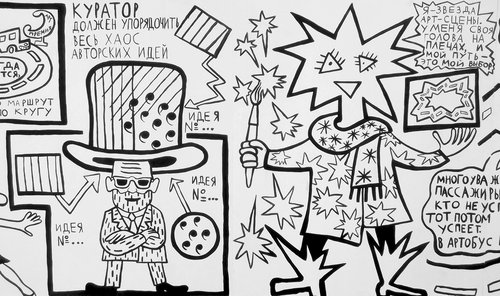
Despite the range of media in which Litichevsky has worked, this exhibition is devoted almost entirely to painting. The principal exception is a wall drawing created specifically for the show, depicting a fragment from Plutarch’s ‘Life of Sulla’. To its left hang two small canvases depicting a Palaeolithic rhinoceros and a Palaeolithic elephant.

Litichevsky’s interest in the ancient world is neither casual nor amateur, but grounded in professional expertise. Trained as a historian, he worked as a junior research fellow at the Institute of Archaeology of the Soviet Academy of Sciences, taught Latin, and later served as an editor at INION RAN, one of Moscow’s largest academic libraries. He is particularly fascinated by the figure of Sulla, the Roman general and dictator, whom he depicts with characteristic irony in harsh, stark colours: his nose appears to have slipped from his face, while a tiny mouse perches upon it.
With his deep knowledge of history, Litichevsky also reminds us, in ‘The Amber Room’ (2026), that a space can sometimes disappear physically while remaining extraordinarily present in the imagination. He transforms the legendary room, lost from the Catherine Palace near Saint Petersburg during the Second World War, into a symbol of an interspatial and timeless realm: a place that may have vanished materially, yet continues to occupy collective memory. Into his own ‘Amber Room’, Litichevsky introduces the houseplants and the bust of Pascal from his Nuremberg apartment, already familiar from other works in the exhibition. In the lower left-hand corner, he adds another fragment of amber containing an ancient insect — an object that in itself embodies both the passage of time and a kind of resistance to it.
Yet these are not the only elements Litichevsky shuffles together in constructing his metaphysical, transcendent space. His works are populated not only by historical figures but also by characters from fairy tales and folklore, collapsing the boundaries between reality and imagination. In two small canvases from 1994, Pinocchio and Thumbelina appear less like familiar children’s characters than strange, almost archaic creatures. Surrounded by turbulent nature, they pursue their own concerns, seemingly detached from both ordinary reality and chronological time.

The most monumental work in the exhibition, ‘Cave Painting’ (2025), is executed in a deliberately naïve idiom. On closer inspection, however, it becomes clear that the scene is not simply a pastiche of prehistoric animal imagery. Litichevsky introduces another reversal: the animals themselves are shown depicting human figures and a scarlet handprint, reminding us that the world has not always been understood in anthropocentric terms. Here, the animal world occupies the space entirely and determines its own order. Like the figures from fairy tales elsewhere in the exhibition, Litichevsky’s animals may appear simple at first glance, but they are far from naïve in meaning. His use of bright, vivid colour against heavy, contrasting outlines further destabilises the viewer’s expectations.
Although Litichevsky has been known for comics and graphic narratives since the 1970s, this exhibition reveals a resolutely non-linear and non-narrative mode of thinking. Viewed as a whole, the works appear as the product of a sustained intellectual and philosophical enquiry. The idea of an existence capable of transcending time and space has preoccupied him for decades, but today it feels particularly resonant. Looking from the works of the 1990s to the most recent canvases of 2026, there is little sense of rupture; instead, the exhibition underscores the remarkable consistency of Litichevsky’s concerns.


Georgy Litichevsky. Without Leaving the Room
Paris, France
13 September – 31 October 2026