

First Balkan Textinnale: Festival of Drifting Sensitivity

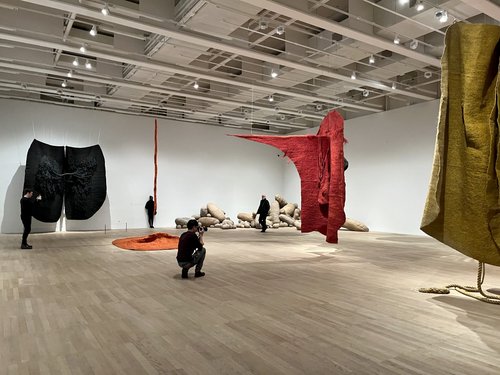
Balkan Textinnale. Exhibition view. Distrikt Atelje 61. Novi Sad, 2026. Photo by Pola Laamanen. Courtesy of Balkan Textinnale
The inaugural Balkan Textinnale, staged this March across Belgrade and Novi Sad, shows how textile art can speak powerfully about emigration, memory, ecology and freedom. Across three venues, fabric becomes a medium for mapping displacement, resilience and contemporary life.
The Balkan Textinnale is the initiative of two art curators: Sasha Kremenets and Ekaterina Ablamskaya. “Rather than focusing on traditional weaving, the Textinnale shows how fabric can speak about the contemporary world – about emigration, ecology, memory and personal freedom,” they state on the event’s website. Both women belong to the new wave of Russian emigration - Serbia has attracted many Russian-speaking emigrants over the past few years: the country requires no visa for entry, offers relatively straightforward ways to regularise one’s stay, and has shown itself welcoming to those who contribute to the local cultural environment.
Indeed, it is the experience of emigration that forms the conceptual foundation of the Textinnale. Its theme, ‘Drifting Lands’, evokes fragments of land drifting either in search of safe harbour, in the hope of encountering others like themselves, or simply without direction, when indeterminacy itself has become the basis of existence. Emigration is a path shaped by unpredictable scenarios, and all who embark upon it drift through very different waters.


The Textinnale takes place across three venues: the Belgrade galleries Nordistica and Woonder, and the district space Atelje 61 in the neighbouring city of Novi Sad. Each exhibition is united by an overarching theme. The first exhibition within the festival opened at Nordistica, whose founder, Sasha Kremenets, is also one of the Textinnale’s curators. The gallery presents works by nine artists, gathered under the theme of imaginary worlds. Here, past and future are woven from industrial raffia and corn fibres in Alina Gombats’s ‘Tower’; militancy rhymes with vulnerability in Yuliya Parfenova’s ‘Salt Water’; fragile sanctuary is imbued with new poetic meanings in Marta Krasicka’s ‘Naos’; and anthropogenic inevitability sprouts threads reminiscent of the fauna of an enchanted forest in Ekaterina Ablamskaya’s (b. 1992) ‘Symbiont no. 48’. As curator of the Textinnale, Ablamskaya remains at the same time a practising textile artist.
A richly coloured, multifaceted world opens before the viewer, guarded by the mythological figures by artist Teodora Nešković (b. 2001). Painted on large pieces of transparent organza, they tower over the visitor like demigods who seem to have absorbed the wisdom of several folk traditions at once. Only the fragile, almost toy-like shoes the artist leaves for one of her heroines hint that these majestic beings might at any moment break free from the confines of their semi-transparent world and step towards the viewer.


At the centre of the room stand Irene Musina’s (b. 1991) multicoloured, volumetric ‘Rhizoforms’, seen in this configuration for the first and last time. With each new exhibition, the installation changes shape, reflecting one of the work’s essential qualities: the absence of any domination by one or several elements over the others.
At the exit, the viewer is greeted by a panel by Sasha Look (b. 1982), inspired by rock art and shamanic practices. Experimenting with archaic forms, the artist works in a one-line drawing technique. The graphic line of the thread thus moves continuously across the panel, until it breaks off just as unexpectedly as it began.

Nordistica is the only one of the three venues whose exhibition also extends into the outdoor space. There, a diptych by Sveta Sher (b. 1986) unfurls in the Balkan wind, while Olga Posukh’s (b. 1984) rag tentacles occupy the gallery staircase.
This section of the Textinnale seems conceived in the spirit of a total installation. The viewer drifts through the exhibition, moving from one artist’s myth-making to another’s fantastical world. Ultimately, it is through their coming together that these worlds form a shared narrative: there is no better defence against a frightening present than the creation of its alternative. That alternative can even transform rubbish into a picturesque surface, as in Sveta Sher’s ‘Living Matter, Dying Matter’.


The second is in the Belgrade gallery Woonder. Airy and monochrome, it is united by the theme of corporeality, personal experience, and individual movement. The exhibition brings together works by ten women artists. Right at the entrance, the viewer comes face to face with Ira Brana’s (b. 1990) ‘Megalodicopia’. The work takes its name from a creature of the ocean depths that drifts through the water in search of a home – and, once it finds one, attaches itself in a single place and begins to lose its brain. It simply becomes superfluous. The artist’s humour sets the tone for the entire space, although the viewer soon encounters works of very different emotional registers.
Here we see the path of glacier A23a, neatly embroidered by Liza Perelman; Natasha Kosovets’s (b. 1976) mountain-clouds suspended in weightlessness; Irina Kliuchnikova’s emotional reliefs; and the life-affirming routes of cellular movement in Katarina Ivanović’s ‘Connection’. These strikingly different narratives respond with precision to the exhibition’s central theme. The body of a glacier is no less corporeal than what a person sees in the reflection of a panic attack; the body can be heavy, or weightless; the body can even be deconstructed.

Deconstruction is precisely Lidiya Baranik’s (b. 1983) method in ‘Drift Within’. She created a collage from photographs of her own body, printed it using paper lithography, and assembled it into an appliqué on a vast canvas that has undoubtedly become one of the exhibition’s semantic centres. The resulting image conveys several poses of the photographed heroine at once. Yet because the fragments on the canvas exist separately, any movement of air makes them drift while remaining in place. Another powerful visual accent is Anastasia Ivanenkova’s (b. 1998) hospital diptych. Onto bedsheets are embroidered both a radiologist’s report and the X-ray image to which it refers. This is the story of the artist herself. The work is ironic and therapeutic, but also, of course, deeply marked by pain.
Behind ‘Lingering in the Light’ by Maria Motyleva and Diana Smykova lies an extensive study of women’s memories in Saudi Arabia. Women’s memory, and the memory of women in that region, is often not fixed on paper but passed on orally, from one voice to another. The artists immersed themselves in the stories and everyday lives of women across the country, and their work became a collection of non-verbal memories of each encounter and each conversation.

Olga Klimovitskaia (b. 1981) presents a collection of her own memories. Her artist’s book is a poignant tribute to the first year of a new life unexpectedly imposed upon her – a life she did not choose, but which forced her to “freeze” in February 2022. Each page marks a month, from February to February: thirteen pages in total. The viewer is thoughtfully provided with gloves to leaf carefully through this black-and-white embroidered book, which conveys not a single word, yet communicates infinitely many experiences through a variety of stitches, dots, and knots.
And by the window, basking in the spring sun of Belgrade, are the shadows – Yulia Perfiletova’s (b. 1998) ‘Out of Context’. These fragile, deeply touching figures are suspended between presence and disappearance, on an eternal journey – neither here nor there. It is a greeting to all nomads drifting between worlds. The uniqueness of the artist’s technique lies in the fact that these almost weightless, frameless figures possess an extraordinary strength. Seated on wooden children’s sledges, they also lead us towards the theme of the final exhibition space, in Novi Sad.

The district space Atelje 61 in Novi Sad is the largest of all the Textinnale venues. Across two floors, it presents works by nineteen artists. The large hall beneath the roof is occupied by Lyuda Kalinichenko’s (b. 1985) ‘Loop Poetry’, a series of digital collages based on archival materials found in a London park and on the artist’s own nearly lost family archive. Both sources are fragmentary, and it is precisely the joining of these fragments that makes the encounter between private and anonymous memory so affecting. On the ground floor, the exhibition architecture is built around Anya Grositskaya’s (b. 1985) ‘Pavilion of Tears’ – large coloured canvases evoking evenings at a Young Pioneer camp. The contrast between patterned fabrics and tears that have been cut out or burned through functions as a tribute to childhood memory. Yet that memory holds not only superficially joyful recollections, but deep scars as well.
The exhibition also includes some of the most formally unexpected works: the BLAU group’s net made of socks, which unexpectedly draws attention to ecological concerns; Anna Fischer’s textile abstract sculpture; and Lisa Mur’s (b. 1991) poignant toy-like figure. Bright appliqués by Natasha Bayduzha, Lera Nerybka, Dasha Sz, and Sari Szanto are particularly memorable. The slanting snow in Julia Levykina’s work instantly transports any northerner to a winter morning before school. And Yulia Lukyanchenko’s (b. 1983) ‘Floating Islands’, greeting the viewer at the entrance, is a work one feels compelled to contemplate at length.

At the centre of the hall is a hopscotch game: Milica Dukić’s (b. 1989) tufted recreation of a children’s pastime, evoking a cultural code familiar to post-Soviet and, evidently, post-Yugoslav childhood alike.
Beside Inna Grishechkina’s (b. 1985) large-scale installation dedicated to the first months of motherhood stands Pola Laamanen’s (b. 1989) remarkable diptych. These are small embroideries on canvas featuring abstract, cartographic or floral compositions, along with national patterns – Karelian on one canvas and Serbian on the other. It is striking how strongly they echo one another when placed side by side.

For the Balkans as a whole, the theme of textiles feels organic. There is a living tradition here, with its own visual language and patterns. More than 120 applications were submitted to take part in the inaugural Textinnale and after the selection process, thirty-eight artists were included in the exhibition. This is a large-scale and vividly realised undertaking, represented predominantly by female artists, which is characteristic of the textile medium. Alongside the exhibitions, the Textinnale hosts workshops, public talks, and artist meet-ups; the festival has become a platform for dialogue and co-creation, attracting both art professionals and the wider public.

Balkan Textinnale
Nordistica Gallery
Belgrade, Serbia
5–20 March 2026
Woonder Studio
Belgrade, Serbia
7–15 March 2026
Distrikt Atelje 61
Novi Sad, Serbia
12–22 March 2026