

Farewell to Fabrika: A Transient Oasis of Freedom

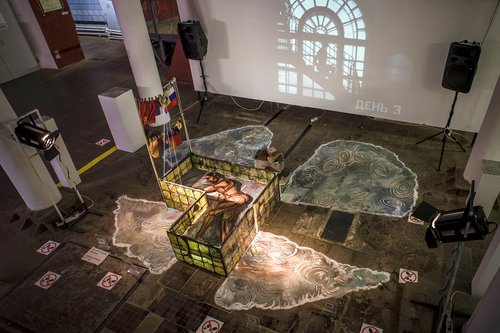
The Violent End. Exhibition view. Moscow, 2026. Photo by Alexander Nedorez. Courtesy of Fabrika Centre for Creative Industries
In a former Moscow factory slated for demolition, the final exhibition pushes into spaces that were previously unused. Curator Mikhail Sidlin has deliberately placed works in the building’s darkest corners, underscoring a simple proposition: art can take root anywhere, even against the odds.
The Fabrika Centre for Creative Industries is a former paper factory that was transformed into a cultural hub. Remarkably, it managed to escape the trappings of flashy gentrification. Its defiant unglamour is one of its biggest charms. The corridors are dimly lit, the stairways are narrow and steep, there are only basic amenities, and the overall layout is mind-bogglingly confusing. There are no barber shops, trendy bars or hipster restaurants, and no boutiques selling bohemian-style clothes. There are not even any art galleries (a few tiny venues are called galleries but are self-organised, artist-run spaces that show the work of young artists with no gallery representation).

Financial transactions hardly ever take place behind their doors, which other than on opening nights mostly stay closed. Fabrika’s business model is simple: once the owner moved the paper production to a more modern and convenient facility, the spaces were leased to small businesses such as design studios and independent publishers. The revenue generated was then spent on exhibition programming and initiatives to support artists. Exhibitions here are always free to visit. Mid-career artists, chosen via an annual open call, can use the studios free of charge and receive a modest production budget to stage an exhibition. Or so it used to be.

According to its director Asya Filippova, the art centre is now on life support, living out its last months after twenty-one years of operation. Filippova was recently given France’s prestigious award of the Chevalier des Arts et des Lettres in recognition of her support for the arts. However, the Moscow city authorities have decided that the land occupied by this cluster of nondescript buildings is being used 'ineffectively' and have announced a plan to demolish it to make way for residential blocks.

Appeals to preserve a venue that hosted many memorable exhibitions and performances by Russian artists the likes of Andrey Kuzkin (b. 1979), Valery Chtak (1981–2024), Haim Sokol (b. 1973), and over seventy other international artists were disregarded. On 30th of January, one day before Fabrika’s 21st anniversary, news of its impending demolition was published on the official website of the Moscow City Government. Low-budget art hubs in dilapidated, neglected factories that are barely functioning usually have a short life in Moscow – they typically survive for just a few years before the buildings are sold to real estate developers, who then tear them down. For many years, Fabrika seemed to be the exception. Now it appears, its reprieve is ending.
However, to misquote T. S. Eliot, Fabrika ends with a bang, not a whimper. As usual on the day of its anniversary several exhibitions opened in different parts of the building. The largest is called ‘The Violent End’. Curator, art critic and regular Art Focus Now contributor, Mikhail Sidlin, alluded to a famous line from Shakespeare’s Romeo and Juliet when choosing the title: “These violent delights have violent ends”. However, there is nothing ‘violent’ or ‘riotous’ about the exhibition itself. Rather, it is a bitter commentary on the absurdity that pervades life in Russia, of which Fabrika has fallen victim. The main part of the exhibition takes place in Fabrika’s largest exhibition hall, formerly a Finishing Workshop.

A garland of barbed wire and pink construction foam by Danil Danot (b. 1993) hangs from the ceiling. A slightly reworked bronze model of the Museum of Space in Moscow, with a rocket heading off to faraway galaxies, has grown roots like a houseplant – this witty sculpture by Sergei Chernov (b. 1962) is called ‘Stairway to Heaven’. A swimming-pool ladder by Eldar Ganeev (b. 1977) has been ingeniously twisted to resemble an indecisive bather gathering up their courage before a plunge. Dmitri Kawarga (b. 1972) has transformed pieces of the factory’s unused research lab equipment into five sculptures called ‘Creative Machines’. With all their tubes and gauges intact, they appear to be emitting strange white matter, transforming before the viewer’s eyes. “When I touch them, I feel the non-linearity of the passage of time,” the artist says of the machines. “The violent end turns into the beginning and finds itself in the very core of the present.” Olya Bozhko’s (b. 1974) knitted flowers, which appear innocent yet vaguely ominous, seem to grow out of Fabrika’s concrete floor. They bloom with letters forming the phrase ‘Happy Ending’.

The exhibition continues into areas of Fabrika that are usually off-limits to visitors, where tenants roam alone like ghosts through narrow corridors. This area is only accessible on a curator’s tour. It is dedicated to the fragility of existence, whether of buildings, institutions or people. There are portraits of the late poet and conceptual artist Lev Rubinstein (1947–2024) made from his own words – works by Ilya Evdokimov (b. 1973), who has ingeniously transformed lettering into images. Embroideries by Maria Arendt (b. 1968) depicting Vladimir Shukhov’s towers hang on the walls of a staircase. These light and airy Constructivist structures from the 1920s fell out of use and were once sentenced to demolition, like Fabrika itself, yet they survived due to their sheer beauty. Deep in the maze of corridors is the former studio of the late Valery Chtak, complete with murals, a drum machine and a motorcycle that mysteriously found its way into this grim, windowless, two-storey space high above the ground. The studio has remained locked since the artist’s death, but Sidlin has included it in his exhibition route as a memento mori for visitors, offering them a glimpse of a solemn, mournful space that will soon share the fate of its former tenant.

However, the exhibition does not feel tragic. For Sidlin, transience is an inherent part of the nature of this space. He told Art Focus Now that his view was influenced by Hakim Bey’s book ‘The Temporary Autonomous Zone’. The American anarchist’s theory was based on his analysis of pirate utopias, yet Sidlin also finds it applicable to the Russian art scene. “In the 1990s, there were two main theories about how the art world would develop,” he said. “One theory said that the newly-founded, renewed Russian state would support contemporary art. This was Leonid Bazhanov’s theory. Well, we know how that ended. The second theory was that the new capitalists, the new bourgeoisie, would support contemporary art. This was Olga Sviblova’s theory. Well, we also know where that led.” Leonid Bazhanov, who has since passed away, was the founder of Russia’s first independent Contemporary Art Centre. He managed to develop this into a nationwide network of state-funded National Centres for Contemporary Art.

After a turbulent period of several administrative reorganizations, only two branches have survived and are now operating under the umbrella of the State Pushkin Museum of Fine Arts. Olga Sviblova is the director of the city-funded Multimedia Art Museum in Moscow. Sidlin says that, having read Hakim Bey, he disagreed with both of them from the outset. “I believed that art is only possible in these conditional temporary autonomous zones, independent institutions that are temporary by nature and exist until they are destroyed.” For him, temporality is a key feature of these zones. “It is a space of freedom, and there are always stronger institutional players around it seeking to destroy it because no one benefits from the existence of a zone of freedom, just as no one benefits from those who seek freedom.” For Sidlin, Fabrika is one such space, containing many autonomous ‘sub-zones’. Even the exhibition itself becomes an autonomous zone. Sidlin highlights the transient nature of this phenomenon by displaying artworks in areas of the building that have never previously been used for exhibitions, such as stairways, corridors and a loft.

The highlight of the exhibition is located under the roof in a dark, cold loft space that was previously empty and used as a hiding place by pigeons. It now houses a textile installation by Elena Sharganova (b. 1981) called ‘Palace of Culture’. The installation is dedicated to a cultural centre in her hometown of Nelidovo, a small mining town in the Tver region of central Russia. After the mines closed in the 1990s, the town declined and its population dwindled. Now, this fragile, lightweight memorial to its former glory haunts the loft like an elegant ghost. Indistinct sounds of Nelidovo’s streets, recorded earlier, float from the loudspeakers, adding to the eerie atmosphere. Although this artwork can appear melancholic and nostalgic, there is still a message of hope in it. Creativity and freedom can flourish in the most unlikely of places, even in a dark, unwelcoming loft. However, it would be sad to think that there are no better places for them in Moscow today.

The Violent End
Fabrika Centre for Creative Industries
Moscow, Russia
31 January – closing date to be announced