

Exploring Alice through the Looking-Glass of Interpretations

Tatyana Yanovskaya. Alice as a White Pawn. Courtsey of State Museum of Russian Literary History named after V.I.Dahl
A new exhibition at the Literary Museum in Moscow celebrates ‘Alice in Wonderland’s’ 160th anniversary. Illustrations, neon conceptual twists, and translation rebuses by Russian artists transform Victorian nonsense into a playful quest – blending Gothic dolls, Futurist poetry, and Alice syndrome for an absurd, immersive adventure.
Paradoxically, the key to interpreting the ‘Alice, Wake Up!’ exhibition at the Literary Museum marking the 160th anniversary of the first edition of ‘Alice’s Adventures in Wonderland’ is, for me, Lewis Carroll’s travel diary recently published in Russia – his real name being Charles Lutwidge Dodgson. In the summer of 1867, at the invitation of his friend Henry Liddon, they undertook a trip to Russia. The purpose was not merely touristic. It was rather diplomatic: establishing close contacts between the Anglican and Russian Orthodox Churches. After all, both Liddon and Dodgson were scholars at Christ Church college in Oxford where they were also priests. So, Lewis Carroll was not only a storyteller and mathematician, but also a deacon of the Anglican Church. It was as a deacon that he arrived in Russia on a mission.

Why might Dodgson-Carroll’s diary be the key to the new exhibition? Because the display talentedly and effortlessly, in the spirit of a youth studio-workshop or laboratory, allows one to see the book (and more broadly, Victorian English culture) in the mirror of its Russian interpretations. To think of the ‘foreign’ in terms of the ‘one’s own’. This in itself promises no small number of amusing, absurdist moments. Some fragments from Dodgson’s 1867 diary could excellently adorn chapters of the book about Alice, particularly where descriptions of various unusual objects and wondrous trinkets appear. Here is a quote from Carroll’s diary about the Armoury Chamber of the Moscow Kremlin: “Then we went to the Armoury, where we examined thrones, crowns and jewels until our eyes were dazzled by them, as if by blackberries. Some thrones and suchlike were literally strewn with pearls, like raindrops.”
And so, in the Literary Museum, we are invited to play the protagonist of the book, Alice, and at the same time to read the English fairy tale in a Russian context. The exhibition is the work of a group of curators led by the leading research associate of the Literary Museum, Natalia Rebrova. Items were sourced from the museum’s holdings, private collections, state collections including the Russian State Library, the Museum of Architecture, the Polytechnic Museum and the exhibition partner is Moscow gallery GROSart.

Occupying two enfilades, one like a quest, it leads us through different locations in the narrative of the fairy-tale, from the rabbit hole to the episode in the royal court at the end. We get to know Alice, and through her girls from Victorian England. What did they look like, how were they educated, how were they raised? These themes are reflected in historical essays accompanying the exhibition. Most of them consist of illustrations to the fairy tales by Russian artists such as Gennady Kalinovsky (1929–2006), Mai Miturich (1925–2008), Lydia Shulgina (1957–2000), Viktor Chizhikov (1935–2020), Pavel Pepperstein (b. 1966), Vladimir Clavijo-Telepnev (b. 1962), Yuri Vashchenko (b. 1941), Yulia Gukova (b. 1961), Andrei Martynov (b. 1945) and Pyotr Perevezentsev (b. 1962).


Dollhouses with toys in the spirit of dark Gothic fairy tales are displayed alongside stylised Pre-Raphaelite photographs by Vladimir Clavijo-Telepnev. The surreal dreams of Pepperstein’s illustrations vie for the viewer's attention with images from Soviet cartoons in Chizhikov’s illustrations. Perevezentsev’s calligraphic writings complement the magical geometry of space in the numerous drawings by Kalinovsky... Taken as a whole, it resembles a playroom strewn with toy blocks with which visitors can assemble their own miniature houses. Vintage 19th-century clocks from the Literary Museum collection set the stage for Carroll’s era, as well as everyday items from the Dickensian epoch. Interesting and atypical for fashionable Russian exhibitions today, the viewer is not overwhelmed with a parade of attractions or spoon-fed the theme at the level of elementary Wikipedia. Without shame at the absence of some mind-blowing Hollywood fairy-tale effects, the curators provide anchor themes via certain exhibit-emblems that stir the imagination and engage the viewer as a collaborator, a partner in the game about Alice and her adventures.

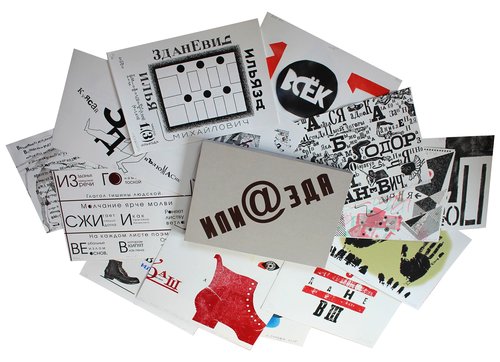
Some vignettes have turned out to be simply magnificent, like the convergence of Carroll's fairy-tale texts with Futurist poetry. Back in the 1920s, avant-garde artists who taught at famous Russian VKhUTEMAS art school talked about this convergence. Carroll’s verses seem to live in Alexei Kruchenykh’s translations. The Russian absurdist poets from OBERIU movement continued the relay. Their portraits hang here on the walls alongside poems. Daniil Kharms mentions Carroll among the poets most important to him, alongside another guru of the English illogical tradition of nonsense, Edward Lear. Today, this synthesis of OBERIU word-creation and English nonsense thrives excellently in Lyudmila Petrushevskaya's verses. An autograph copy of her short nonsense tale ‘Puski Byatye’ is on display.
In one corridor in the first enfilade there are neon installations with short texts from the fairy tale. And above them hover the collected works of Immanuel Kant. The corridor itself resembles a Joseph Kosuth (b. 1945) exhibition. The curators have visualised a bold idea: ‘Alice’ inspired the post-war generation of conceptualists to perform surgical work on logic and language. Following Carroll, they dissected speech to uncover in the habitual ‘word order’ meaningless and even repressive truisms and dogmas.

Violence and repression are stitched into the narrative of the Alice fairy tale. It is very apposite that the exhibition’s organisers placed in the hall of the royal trial of Alice materials about child-rearing in Victorian England, where hypocrisy and double standards reigned, and children were often subjected to beatings. A portrait of Queen Victoria is encoded in the character of the Queen in Wonderland (her photographic portraits hang next to illustrations to Alice books).
Absurdity, which encodes important scholarly studies and adapts them to children’s perception, is one of the leitmotifs of the clever exhibition assembly. In particular, alongside Yuri Vashchenko’s pictures on the theme of how Alice’s body transforms in the process of sudden growth or diminution, there is an explanation of ‘Alice syndrome’ in psychiatry. A disorder in which a person’s perception of body and space size changes, linked to problems of adaptation to a constantly evolving surrounding world. A brilliant conclusion is voiced by the Black Queen: “now, here, you see, it takes all the running you can do, to keep in the same place.”

The second enfilade is dedicated to the difficulties and joys of translating Alice into Russian. Comparative tables hang everywhere, in which the same fragment of the original text is written in different versions, from Vladimir Nabokov to Boris Zakhoder and Nina Demurova. The halls with such textual rebuses essentially allow one to experience a linguistic adventure based on ‘Alice’s Adventures in Wonderland’ and ‘Through the Looking-Glass’. With the exception of the OBERIU and Futurists, pre-revolutionary and early Soviet Russia russified Alice. The humour of nonsense remained incomprehensible. Only in the late 1960s, in the general linguistic atmosphere of semiotic games and postmodernism, came Nina Demurova’s brilliant translations. The famous Soviet storyteller Korney Chukovsky was delighted by her translations precisely because they were not russified, not literal, but punning, mischievous, capricious, and wild, just like the original language. Nina Demurova became the chief specialist on Carroll. The academic edition of ‘Alice’ in the ‘Literary Monuments’ series was her translation.

Books translated by Nina Demurova, as well as the 1976 record with Vladimir Vysotsky’s songs and the Soviet cartoon, round up the exhibition, at the end of which is an epilogue: an account of Dodgson's life, his passion for photography, and the fate of the prototype of Alice – Alice Liddell, daughter of the warden in an Oxford college. This double defamiliarisation is the key to the curation of the exhibition helping us to understand the complex land of alogisms, to love this land, and to become a co-conspirator in an intriguing linguistic and visual journey.
Alice, Wake Up!
State Museum of Russian Literary History named after V.I.Dahl
Moscow, Russia
16 December 2025 – 29 March 2026