

Erik Bulatov’s Diary of Painting

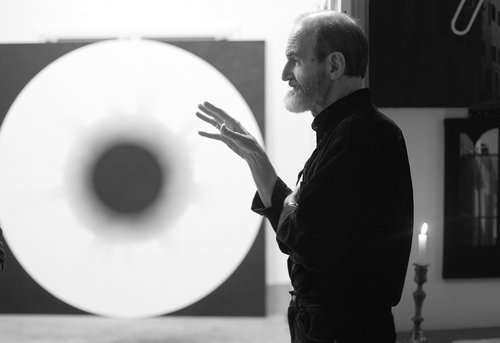
Erik Bulatov. Selected Pages. Exhibition view. Moscow, 2026. Courtesy of ROSIZO
An intimate exhibition called ‘Selected Pages’ at ROSIZO in Moscow presents Erik Bulatov not through the grandeur of a conventional retrospective, but through the more revealing form of an artist’s notebook: sketches, fragments, quotations and painted works that trace the evolution of his thinking.
Thanks to the combined efforts of some of Russia’s top state and private institutions including the Tretyakov Gallery, the Pushkin State Museum of Fine Arts, the Ekaterina Foundation and with the participation of Erik Bulatov’s widow, Natalia Godzina, ROSIZO’s intimate mansion in central Moscow is hosting a rich and compelling exhibition dedicated to Erik Bulatov (1933–2025), one of the defining figures of unofficial Soviet art.

A journey through the exhibition feels rather like leafing through the artist’s diary. It brings together the principal milestones and stages of Bulatov’s creative path, but not in the manner of a monumental retrospective, with an enfilade of vast halls filled with large-scale paintings. Instead, the visit has the intimacy of turning the pages of a notebook, filled with sketches, fragments and markers of different moments in the artist’s life and work.
This diary-like quality is reinforced in each room by printed sheets bearing quotations from Erik Bulatov himself. These notes touch on many of the themes that preoccupied him: the phenomenon of painting, the role of light in the spatial dramaturgy of the image, the incorporation of words, and the presence of poetry – particularly that of Bulatov’s friend the poet Vsevolod Nekrasov (1934–2009) – within the structure of pictorial narrative.

Visitors are invited to take these white sheets of typewritten text and place them in a folder provided at the entrance. This simple gesture turns the exhibition into a process of gathering, ordering and remembering, further strengthening the sense that one is assembling a notebook – or perhaps even a diary – of Bulatov’s artistic biography.
Sketches on paper, interspersed with individual painted canvases, reveal the laboratory of Erik Bulatov’s creative method. Supplemented by the artist’s own texts, the works become an unusually direct and passionate reflection on the nature of painting. For Bulatov, the painting was not simply an image, but a philosophical problem: a way of exploring the human capacity to accept an illusory model of the world and to interpret it. Seen in relation to more recent ideas about the expanded boundaries of art, one might say that Bulatov was concerned not only with artistic questions, but also with anthropological ones - with the possibilities and limits of perception, and with the ways in which perception is reflected back to us.

The exhibition opens with early works from the 1960s, in which the pictorial plane is interrupted by a streak of colour. Sketches in coloured pencil anticipate the creation of a large canvas on the same theme, displayed at the end of the enfilade. These “coloured cuts” of 1964 evoke several strands of post-war modernism: first, Abstract Expressionism; and second, Spatialism, associated above all with the Italian artist Lucio Fontana (1899–1968). Like the radical innovators of the post-war generation, Bulatov breaks with the traditional conventions of pictorial illusion. He opens a gaping wound in the surface of the image, staging a conflict between two states of painting: painting as object and painting as space. Space cuts through the material skin of the image, drawing the eye into black slits from which darkness seems to seep.
Bulatov soon came to find his experiments with abstraction insufficient. They allowed him to work in a mode of improvisation and immediate response, but not within a philosophically grounded method of his own. At this point, guidance came from his teacher, Vladimir Favorsky (1886–1964), an artist deeply concerned with the metaphysical essence of graphic imagery, as well as a theorist and founding figure of the Soviet school of book illustration.

Favorsky helped Bulatov to conceive of the painting as a kind of portal, through which an illusory model of the world communicates with, and penetrates, our everyday space. He insisted that the essential quality of pictorial form lay not in crude illusionism, but in the surface itself – the plane of the image. It is on this plane that the encounter between the illusory world and the viewer’s real world takes place. If the surface is ignored, the painting becomes perforated, full of holes.
In order to engage fully with the nature of plastic and spatial illusion, Bulatov therefore had to move beyond abstraction. From 1971 onwards, he turned instead to the traditional mimetic school, entering into dialogue with Russian critical realism and the art of the Peredvizhniki, or Itinerants, of the second half of the nineteenth century.

Particularly important among the works presented in the exhibition is the sketch for the painting Do Not Lean. Set against a Levitanesque landscape, it bears the words familiar from the closed doors of the Moscow metro: “Do not lean.” Despite its apparent simplicity, and its almost elementary trompe-l’œil effect, this pictorial device carries considerable metaphorical force. The warning is projected onto the very illusion that becomes the subject of the painting.

A true artist, Bulatov suggests, never attempts to merge entirely with the illusory world he creates. He remains conscious that he is constructing a conditional space, projected onto the surface of paper or canvas. The properties of that surface inevitably shape and distort the scene as it might be perceived “with the naked eye” through a window. Texture, the pressure of the pencil, the density of the paint, the abstract treatment of details and distant planes - all are absorbed into the image. They define the working surface of the painting: the very surface against which one must not lean.
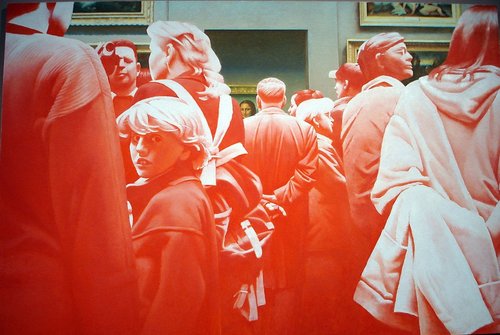
Moving through the artist’s “diary”, one observes how, in the landscapes with Parisian cafés, the image begins to stratify. Bulatov himself described this effect as a “displaced image”. He captures a kind of spectral shift in nature and in optical illusion: as light moves around objects, it separates into cooler and warmer parts of the spectrum. The painting appears slightly out of focus; blue and red tones dominate, as though one had removed a pair of 3D glasses in a stereoscopic cinema. This spectral displacement of a familiar street scene allows Bulatov to bring to the fore the conflict that takes place on the surface of the image, where the real world and the pictorial world meet. The illusion resists its passage through the portal of the surface. “Our worlds do not coincide,” Bulatov insists. Their encounter is always a drama.

This drama becomes especially acute when the world beyond the plane of the painting attempts to materialise in the viewer’s reality. The retaliating surface acts like a blade: it cuts away those elements that have slipped out from the depth of the image. They are covered over with red paint, like severed, bleeding flesh. This radical, almost cinematic version of rupture stands in polemical opposition to Pop Art, where objects insist on materialising in the viewer’s world – the world of the potential consumer of advertised goods.
To create a kind of therapeutic mediation between these two mutually wounding worlds, Bulatov introduces the Word into the painting. He is perhaps one of the few contemporary artists capable of truly “holding the Word” with such virtuosity. He does not turn it into a poster, attach it as a slogan, or imitate the tags and graffiti of street art. Instead, he places the word within space – between illusion and the external world. Projected onto the surface, it becomes a portal through which the viewer’s outward gaze and the painting’s inward gaze pass in transit.

The exhibition includes numerous sketches for paintings based on the words of Bulatov’s friend, the poet Vsevolod Nekrasov. Bulatov emphasised that Nekrasov’s word does not wish to be glued to the paper; it wants to live in space. The artist sees the poet’s word, holds it, and erects it within his paintings. The apotheosis of the final hall, devoted to the dialogue between Bulatov and Nekrasov, is formed by sketches and compositional variants of ‘I Live – I See’. Simple letters create a tunnel, thrusting like a wedge into a cloudy landscape. Bulatov sends his voice into space, discovering himself in the perspective of movement into depth: ‘I live’. The blue of the sky returns an answer to both artist and viewer – a tuning fork of the painter’s honest mission: “I see”.