

Descent into the Middle Ages: between Darkness and Light at GES-2

Daria Surovtseva. ALLUZ Numero No0 Zero, or Hymn to the Circle: How to Measure Spaces?, 2025. From the series 'Thesaurus Terrestos'. Undark Ages: Tales of Medievalism and Academia. Moscow, 2025. Photo by Anya Todich. Courtesy of the artist and GES-2
A top-down perspective on the exhibition ‘Undark Ages: Tales of Medievalism and Academia’ at GES-2 in Moscow reveals the indirect consequences of current geopolitics and their influence on the exhibition policies in Russia’s art institutions, believes writer and critic Dmitry Bavilsky.
The exhibition ‘Undark Ages: Tales of Medievalism and Academia’ has an unusually theatrical entrance for this venue: visitors move from top to bottom via what appears to be a grand staircase. Typically, the curators of GES-2 – a former power plant converted into a private exhibition and performance space – usher visitors directly from the entrance area and cloakroom in the basement into their main blockbuster exhibitions, which are also located on the lower level.

This curatorial decision symbolically enacts the viewer’s own descent “into the depths of past epochs” – into centuries of distant history and into the dense layers of art history that continually interact with contemporary practice. Contemporary art, after all, delights in borrowing classical subjects and compositional solutions, yet, as cultural philosophy reminds us, creativity always opens a two-way path: it leads not only towards the future, but also back into the past.

‘Undark Ages’, co-curated by Dmitry Belkin, Anna Ilchenko, and Andrei Parshikov, is devoted to the echoes and correspondences between contemporary art and medieval and academic genres and styles. Practitioners of contemporary art often like to “weight” their works, replicas, and gestures with easily recognisable references, thereby reinforcing and enriching what they do.
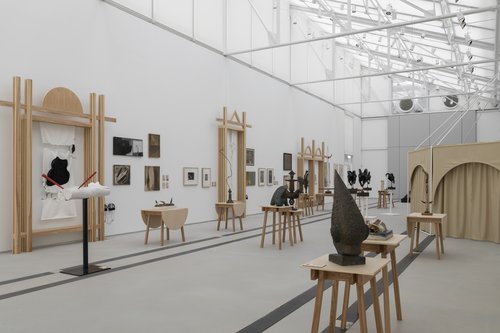
In the White Hall, the GES-2 curators have gathered numerous homages to antiquity. Alongside pastiches and artefacts by members of the ironic, postmodernist art group the New Academy – an underground artistic community from Soviet Leningrad (now St Petersburg) – the display also includes original works that are iconic within Russian cultural history.

Drawn from major museums across Russia, these works create not so much a sense of continuity as of proximity and unexpected neighbourliness. Among them are Alexander Benois’s (1870–1960) highly emblematic “Versailles” landscapes; ‘Apollo, Hyacinth and Cypris ‘by Alexander Ivanov (1806–1858); yet another large-scale orgy by Henryk Siemiradzki (1843–1902), the leading academic painter of tsarist Russia; and ‘Ancient Terror’, the largest and best-known painting by Léon Bakst (1866–1924). The State Russian Museum in St Petersburg last lent this work to Moscow eleven years ago, for a landmark retrospective of the artist at the State Pushkin Museum.
However, the most iconic work in this section of the exhibition is submerged in an inconspicuous side display case and is barely visible – these are illustrations by Fyodor Tolstoy (1783–1873) for the poem ‘Dushenka’ by Fyodor Bogdanovich, which heralded the arrival of classicism (read: academicism) in Russia. Moreover, not only in art, but also in literature.

Near Bakst’s Ancient Terror and Icarus by Boris Orlov (b. 1941), the viewer crosses into the darker section of the exhibition, devoted to an equally stylised vision of the Middle Ages. It begins with a wall of icons and graphic works by Dmitry Prigov (1940–2007) from his ‘Bestiary’ series, which has long since assumed the status of an enduring classic.
However, the principal classical and authentic work in the “dark room” is a large sketch by Viktor Vasnetsov (1848–1926) depicting the Horsemen of the Apocalypse. This is fitting, since the key themes and leitmotifs of this section of the “Middle Ages” are fears and phobias, dreams and visions, ecstasies (not only religious), and unruly passions.

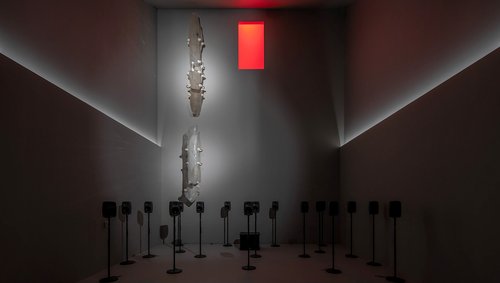
The most compelling works in this section of ‘Undark Ages’ are the entirely new installations by young and mid-career artists, several of them commissioned by GES-2 specifically for this exhibition. Particularly striking are ‘Bee Zone’ by Anton Kuznetsov (b. 1973) and Maria Safronova (b. 1979) – five human-scale sculptures that play with the techniques and styles of a fantastical, never-existent Gothic – as well as ‘Hunt for the Unicorn’, or ‘New Fabric of Time’ and ‘Ivory Tower: No Re-entry’ by Alexei Gromov (b. 1988). Finally, in ‘Tunnel’by Danya Pirogov (b. 1996), curling, swirling images of distilled fears seem to burst through the wall, invading the exhibition space from a kind of otherworldly non-being.
All of these are very recent works. Monumental, apprehensive, depressive or, at the very least, melancholic, they are all generalised by the suggestively saturated, gloomy video ‘Despair’ by the famous artist duo Promvyza from Nizhny Novgorod.

One has the sense that GES-2’s UHNWI owner, Leonid Mikhelson, grants his curators far greater freedom than cash-strapped state institutions, allowing them to devise unusual projects – from a show on archaeological excavations in Central Asian Khwarazm to an exhibition tracing the impact of ‘Black Square’ on Russian and global art – without the pressure to turn a profit. They are able to realise labour-intensive installations, sophisticated scenography, and secure the loan of masterpieces from the country’s leading museums.
Nevertheless, ‘Undark Ages’ is the first exhibition at GES-2 for which an admission fee is charged. Since the venue opened, free entry – as a declaration of the universal accessibility of art – has been the conceptual foundation of its cultural programme. Now, access to the power-station building itself, brilliantly renovated by Italian architect Renzo Piano, remains free, while tickets are required for exhibitions on the underground floor. A visit to ‘Undark Ages’ cost me 600 roubles (just under 7 euros).

The geopolitical situation, which changed drastically in February 2022, triggered multiple waves of sanctions and “cancel culture” that struck first and foremost at Russia’s cultural infrastructure. The rich festival life that had become not merely customary but essential for residents and visitors to Moscow and St Petersburg was abruptly curtailed, as were tours by foreign theatres and international performers, and the arrival of major foreign exhibitions.
It became clear that foreign museums – European ones above all – had long been responsible for a significant share of projects involving classical art. This is a field of singular, non-replaceable works where no “import substitution” is possible. Firstly, Russian collections do not hold an abundance of classical Western art, with the notable exception of the State Hermitage in St Petersburg. Secondly, the classical canon is not only prestigious but costly to handle: insurance alone, and the requirements of proper climatic conditions for exhibition, demand substantial resources.

Tours by Italian masters from Raphael (1483–1520) to Titian (1488/1490–1576) and Caravaggio (1571–1610) – as well as exhibitions of English Pre-Raphaelites, German Romantics, and Scandinavian Decadents – had long been a routine feature of the capital’s art scene. This was all the more important given how few works by these artists are held in Russian collections, and how many entire layers of Western and global art are effectively absent: from genuine Abstract Expressionism and Pop Art to proto-Renaissance frescoes and panel paintings.
Major projects featuring international stars of contemporary art also used to generate great excitement in Moscow, and their exhibitions helped educate more than one generation of local aesthetes. Their absence is now felt less acutely than the shortage of classical art, however, because a vigorous crop of “young” and contemporary work has emerged – not always truly strong and at times decidedly uneven – yet still capable of substituting for global trends and fashionable artistic languages.

Geopolitics has completely altered the tone and content of the exhibition scene in Russia’s capitals. For several years now, the most talked-about shows in Moscow and St Petersburg have been successive reconfigurations of the same figures: geniuses of the first (and now also the second) avant-garde, icons, and various shades of realism and figurativism. The same ideas and directions are reshuffled in repeated passes over a sharply narrowed cultural repertoire. Curatorial thinking circles endlessly around Constructivism and architectural works on paper – subjects that are safely “voiceless” and ideologically neutral. I can see gallerists and museum professionals increasingly falling in love with abstraction and metaphysics.

Let us fellow Russian art lovers and professionals, then, make use of the possibilities of this moment, which has deprived us of everything imported from abroad, and immerse ourselves in the history of Russian culture – in the particularities of icon painting and the iconography of the avant-garde, now displayed from every angle, each institution doing what it can. For the discerning viewer, this is no catastrophe: a developed intellect can always find advantages, even in disadvantages. Perhaps we will not have another opportunity to study so closely the specific evolution of Constructivism and canonical Socialist Realism.
Let us look, for example, at advertising fonts to see just how far the current avant-garde boom has penetrated the wider public. Culture is a self-regulating and unpredictable mechanism, no less so than the exhibition programme of GES-2. Do you know what has triggered the present fashion for “Victorian” detective novels? You’d never guess – although the answer is obvious once you think about it. The development of mobile communications, smartphones, and the internet has robbed crime writers of their usual devices for structuring investigations and constructing alibis: today, almost everything can be checked.
Having lost modernity, detective writers have rushed into past centuries. The other day I acquired a detective novel telling the mystery of the murder of Pontormo (1494–1557). The great Mannerist, it turns out, was not killed by problems with the gastrointestinal tract, about which he writes in detail in his diaries, recently published in Russian.

What I mean is that cultural self-regulation will inevitably find an outlet somewhere, having already survived both the Middle Ages and every variety of suffocating academicism. It is easy to imagine that the next geopolitical thaw will be heralded by some spectacular exhibition. One would like to think it might be devoted to a painter of Cy Twombly’s (1918–2011) calibre. For now, however, even despite the much-vaunted friendship with Hungary, we are unlikely to see shows of Mihály Munkácsy (1844–1900) or Victor Vasarely (1906–1997), the country’s most famous artists. And yet what marvellous queues in snow and rain might once again form outside the museums!
All that, however, is for another day; for now, our horizon narrows to ‘Ancient Terror’ and the ‘Horsemen of the Apocalypse’ – Armageddon in a strictly domestic edition.