

Chemiakin on Himself: A Soviet Dissident’s Memoir Excavates a Lost World

Mihail Chemiakin. My Life: Before Exile. Book illustration. Courtesy of the artist and Apollon Books
The English translation of Russian-born, France-based artist Mihail Chemiakin’s autobiography, ‘My Life: Before Exile’, has recently been published. Soon after the release of its original Russian edition in 2024, it was awarded second prize in the Big Book Award, Russia’s leading national literary prize – a remarkable achievement for a memoir in a competition dominated by fiction, and one that is thoroughly deserved.
The new English language edition of Mihail Chemiakin’s (b. 1943) autobiography, 'My Life: Before Exile,’ brilliantly translated by his wife Sarah H. de Kay, is far from a standard chronological memoir or a recollection of facts, but rather a monumental, 630-page archaeological excavation of a lost world, tracking a creative and a spiritual journey through the rigid structures of a Soviet military upbringing, institutional art education, forced psychiatric treatment, the vulnerable early years of raising a family, and a Leningrad artistic underground filled with danger, anxiety and romanticised hope. This book, covering the first twenty eight years of Chemiakin’s life is a story of a human destiny shaped by brilliant, tragic, and unyielding figures who inhabited the margins of mid-century Soviet life.

Mihail Chemiakin. My Life: Before Exile. Book illustration. Courtesy of the artist and Apollon Books
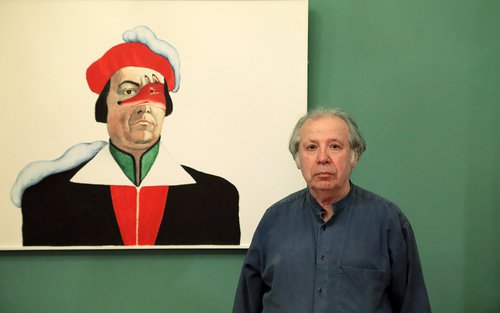
Mihail Chemiakin, a prominent artist, sculptor, draftsman, art historian, and theatrical designer, was born in Moscow in 1943. His father was a Kabardinian and decorated Red Army officer and his mother a film and stage actress who had volunteered to serve in the cavalry. Following a transient childhood in East Germany where his father was stationed, the family returned to Russia in 1956, settling in Leningrad. There, Chemiakin was admitted to the Special High School of the Repin Academy of Art (SHSA). However, his refusal to conform to the state-mandated doctrines of Socialist Realism resulted in his abrupt expulsion after three years. This institutional rejection was merely the prologue to systematic state persecution. In 1967, together with philosopher Vladimir Ivanov, Chemiakin developed the philosophy of Metaphysical Synthesism, dedicated to the creation of a new form of icon painting based on the study of religious art across all ages and cultures. In 1971, following a decade of constant harassment, interrogations, and arrests by the KGB, the authorities forced him out of the USSR. He settled first in Paris with his wife Rebekka Modlen (1934–2014) and their young daughter Dorothée Chemiakin (1964–2018), before moving to New York City in 1981, and later to Claverack, New York. Since 2007, he has lived and worked in Villedieu-sur-Indre, France.

Mihail Chemiakin. My Life: Before Exile. Book illustration. Courtesy of the artist and Apollon Books
Chemiakin constructs his literary universe on extreme dualities. His writing style is cinematic and theatrical, utilizing a grotesque aesthetic that sometimes mirrors his visual art. He builds mythic narratives through a breathless, cumulative syntax, piling clause upon clause to create a momentum that may violently juxtapose institutional honours with raw domestic chaos. Chemiakin drops the reader directly into a turbulence of memory, listing life milestones and traumatic outbursts in such rapid succession that his lived reality is physically felt in the pacing of the words.
Capturing this complex, raw, and dramatic voice requires extraordinary translational fidelity. Sarah H. de Kay, who has been Chemiakin’s English language voice for the past forty years, met the artist in 1983 while working for PBS on a documentary about Vladimir Vysotsky. They began living together in 1985 and were married in 2004. She has approached the text with surgical precision to maintain Chemiakin’s clinical, unvarnished psychological candour. The prose shifts instantly from grand, sweeping descriptions of historic trauma to blunt, piercing emotional truths. This stylistic choice prioritizes fidelity to reality over reader comfort, ensuring that the text retains its original, subversive edge.

Mihail Chemiakin. My Life: Before Exile. Book illustration. Courtesy of the artist and Apollon Books
An important feature of ‘My Life: Before Exile’ is its visual component. The text is intricately woven around a series of meticulous pencil-on-paper drawings created by Chemiakin specifically for this book (with rare historical exceptions, including his 1960s ‘Hoffmaniada’ works and ‘Svidrigailov’s Dreams’ collage). These 149 illustrations serve as an essential, parallel ‘text’ that represents his lifelong artistic methodology.
In his memoir, Chemiakin details his relentless pursuit of artistic mastery through ruthless discipline. Driven by the ideal of an eye surgeon’s precision, he trained his hand and eye through thousands of discarded sketches until he could flawlessly replicate the dense crosshatching and other methods. This exhausting academic rigor allowed Chemiakin to transcend his struggle with traditional proportions and gain control over his medium, helping him, decades later, to demonstrate his signature technique of drawing complex, large-scale metaphysical compositions with a single, uninterrupted line.

Mihail Chemiakin. My Life: Before Exile. Book illustration. Courtesy of the artist and Apollon Books
Chemiakin wrote: “All art begins with the drawing. To my mind, the drawing is the skeleton of every work of art: the basis of a painting’s composition is the drawing; the basis of the movement of figures and proportions – is the drawing; even the distribution of color is dictated by the drawing.”
His graphic approach translates his complex literary themes into a distinct phantasmagoric, neo-expressionist visual style. He rejects realistic proportions in favour of expressive, elongated anatomy and mask-like facial features, at times bordering on a chilling theatrics where military figures are rendered as decomposing skeletons in uniform. Reflecting his academic self-training, volume and shadow are achieved through the dense accumulation of precise, individual cross-hatching strokes rather than soft gradients, creating an intense, almost claustrophobic texture on wood grain, stone walls, and fractured surfaces. His compositions use a skewed, tilting perspective that mimics an unstable stage set, where sloped floors and warped horizons mirror psychological distress. Chemiakin uses a contrast within these compositions: children are depicted with simpler, smoother lines and wide, vulnerable eyes, formally isolating spiritual innocence and plunging it directly into a heavily hatched vortex of historic and domestic turmoil.

Mihail Chemiakin. My Life: Before Exile. Book illustration. Courtesy of the artist and Apollon Books
Chemiakin expresses a deep intensity in his memoir through the transformation of a dark wartime memory of rats into a theatrical origin story. His childhood vulnerability, surrealism, and future artistic triumph intersect for the artist who would later be called the King of the Rats. Using a high-angle perspective that turns floorboards into a stage lit by a cinematic moon, the accompanying drawing depicts a wide-eyed boy peeking from beneath his father’s army coat. The foreground illustrates the text’s fantastic, folkloric mechanics: a fat, supine rat balances a massive egg on its belly while being pulled along by a companion’s teeth. The drawing grounds this memory of organized, selective theft, which spared the boy's favorite mint gingerbread and rock sugar, and elevates it into a tangible reality.
The other drawings also reveal the physical resourcefulness demanded by his environment. When forcefully confined within the experimental Osipov Psychiatric Clinic (where Chemiakin met other nonconformist artists Alexander Ney (b. 1939) and Aleksandr Arefiev (1931–1978)) under the fabricated state diagnosis of “mild schizophrenia,” a bureaucratic label used to involuntarily institutionalize political dissidents who deviated from state-mandated banality, whether by listening to jazz (Miles Davis, Charlie Parker, and Thelonious Monk) or admiring Impressionist or Surrealist painters, Chemiakin was denied artist tools. He notes how he circumvented the strict ban on sharp objects by chewing away the wood of pencils with his teeth and sharpening the graphite leads directly on the rough iron radiators of the hospital corridor. Hidden beneath his mattress during evening doctor rounds, the resulting sketches of fellow patients and literary illustrations to Hoffmann, Andersen, and Charles de Coster served as a vehicle for processing psychological trauma.

Mihail Chemiakin. My Life: Before Exile. Book illustration. Courtesy of the artist and Apollon Books
Contextualizing Chemiakin’s early life trajectory shines a light on the Soviet Union’s Era of Stagnation, a period defined by the systemic suppression of exhibitions by nonconformist artists. Unofficial exhibitions were routinely shut down within minutes. Chemiakin’s own exhibition biography reads like a battleground: his 1964 group show, Exhibition of Artists-Workers in the Hermitage (held in conjunction with the Hermitage’s 200th anniversary and featuring Vladimir Ovchinnikov (1938–2026), Chemiakin, Valery Kravchenko (1945–2000), Vladimir Uflyand (1937–2007), and Oleg Liagachev (b. 1939)), was closed after just three days. After his first solo exhibition at the Picture Gallery of the Siberian Branch of the USSR Academy of Sciences in Akademgorodok, Novosibirsk, in 1967, the gallery itself was forced to close. Dependent on tight circles of trusted friends for an audience, some nonconformist artists realized that their creative survival necessitated a way out of the USSR, drawing improbable inspiration even from Oleg Sohanievich’s (1935–2017) daring nine-day escape to Turkey on an inflatable rubber boat.
The book is heavily packed with names and obscure cultural references, making it a thoughtful gift for the scholar or historian. It provides a level of detail that turns the memoir into a primary source document for the historical context of 1960s nonconformist art, adding another subjective artistic vision to the notion of horizontal art history of nonconformist art. For older readers who lived through or studied the complex cross-currents of the mid-century Soviet landscape, turning these pages will feel like a reminiscence of a specific atmosphere and the underground sanctuaries where creative souls gathered to safeguard human expression.


At the same time, ‘My Life: Before Exile’ will surely captivate a new generation of readers. In an era increasingly dominated by digitized and algorithm-driven aesthetics, young creatives will find Chemiakin’s obsession with the surface of the painting, his passionate defense of raw texture inspired by Michelangelo’s unfinished sculptures and Rembrandt’s heavy impasto, liberating. Navigating a vulnerable global landscape marked by rising ideological polarization and ongoing debates surrounding creative freedom, readers may find inspiration in Chemiakin's nonconformist communities. These circles illustrate the importance of building alternative spaces for collective survival, showing that art is a tool for psychological resistance. Chemiakin offers a reminder that even when an oppressive system strips an individual down to their underwear in a freezing room, the internal sanctuary of the mind and the freedom of the line cannot be compromised. It highlights a timeless truth bound to inspire creators across generations: the unyielding resilience of the artistic spirit will always outlive the empires that try to contain it.