

Tatiana Badanina. Guardians of Light. Courtesy of the artist
Boat Carrying Russian Artists to Take Part in Arctic Biennale Seized in Norway
The Arctic Biennale, a project launched by Russian artist Alexander Ponomarev, has taken an unexpected turn. When the ship carrying the event’s participants arrived in Spitzbergen, the local Norwegian authorities seized it following a lawsuit filed by the Ukrainian company Naftogaz. Nevertheless, the artists are continuing their work as planned.
The ‘Professor Molchanov,’ a Russian research and transport vessel, set sail from the port of Murmansk in the north-west of Russia on 29th of August. On board were twenty artists who are taking part in the Arctic Biennale, the brainchild of artist and former naval officer Alexander Ponomarev (b. 1957), as well as scientists and journalists. The artists were due to install site-specific installations in the Norwegian island of Svalbard – now Spitzbergen – and open a group exhibition at the local Barentsburg Pomor Museum. These installations and the exhibition will remain on Svalbard for some time. Later, some will be shipped back to the mainland and shown in Nizhny Novgorod’s Arsenal, a branch of the Pushkin State Museum of Fine Arts in Moscow, in December.

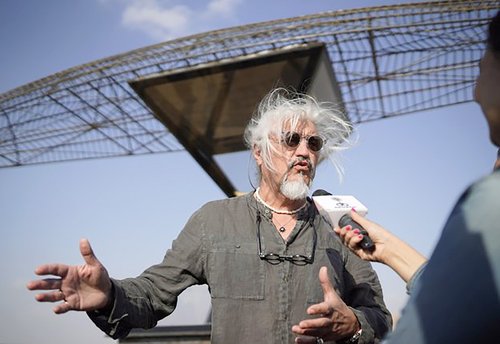
For Ponomarev, this is not the first event of this kind. Born in Dnepropetrovsk (now Dnipro, Ukraine), the artist has lived in Moscow for many years and has done several solo performances on ships while at sea. In 2017, he organized the first and only Antarctic Biennale, which took place on a boat travelling along the shores of the ice continent. The international roster of artists included world stars such as Tomás Saraceno (b. 1973) and Lara Favaretto (b. 1973). The results of that expedition, which was performed under the patronage of UNESCO, were exhibited at the Antarctic Pavilion in Venice during the 57th Venice Biennale. This current edition of the Arctic Biennale has unfolded in a very different political climate and includes only Russian artists. One of them, Katerina Kovaleva (b. 1966) participated in the first Antarctic Biennale. An exhibition about the Arctic region has been held at the State Tretyakov Gallery in Moscow ahead of the actual event. Ponomarev gathered around him a team of established artists, including Nikolay Polissky (b. 1957), Tatyana Badanina (b. 1955), Vladimir Nasedkin (b. 1954), Marina Belova (b. 1958), Alexey Politov (b. 1966), Sergei Katran (b. 1970), the art group ‘Ryskayushchie’, Marina Rin (b. 1990) and the architects Totan Kuzembaev (b. 1953) and Alexey Kozyr (b. 1967).

For the ‘Professor Molchanov,’ it was just another routine trip. The Russian Federal Hydrometeorological Service vessel regularly travels between Murmansk and the Norwegian island of Svalbard, carrying cargo and staff for the state-run Arcticugol (Arctic Coal) company. Its history goes back to the Soviet times. The 1920 Paris Agreement (Spitzbergen Treaty) secured Norway’s sovereignty over the archipelago, and all participating countries were granted equal rights to conduct commercial, scientific and economic activities there. The USSR officially acceded to the treaty in 1935 and established the Arcticugol trust for its operations in Spitzbergen.
Despite a storm that briefly delayed the departure of the ship from Murmansk, the journey got off to a good start. Everyone’s spirits were high as Marina Belova celebrated her birthday on board. What could possibly go wrong? Actually, quite a lot. What happened took everybody by surprise. After arriving in the town of Barentsburg on Svalbard, the unsuspecting artists got off the ship and checked into a hotel. In the evening, they were told the news that the ship had been seized.

In 2023, the International Court of Justice in The Hague ruled that Russia should pay the Ukrainian oil and gas company Naftogaz $4.22 billion for its property in Crimea, the disputed peninsula that until 2014 had been part of Ukraine. The Russian authorities did not agree with the decision, denying the Hague court’s jurisdiction over the case. Following the court’s ruling, Finland seized some Russian state property, primarily real estate located within its borders. Following the example of its neighbour, on 31st August, the Nord-Troms and Senja District Court in Norway ruled to seize the ‘Professor Molchanov’, as it belongs to the Russian Federation.
“At first, we were shocked. From the outside, the whole situation might seem rather alarming, but being here, we find ourselves more bemused than alarmed.”, one of the Biennale’s participants, Katerina Kovaleva, told Art Focus Now, speaking over Zoom from Barentsburg. The artists were supposed to return to Murmansk on ‘Professor Molchanov’ on 10th of September. Soon after the ship’s arrest, news came that the Russian authorities were sending a rescue vessel to bring the artists home. According to the Russian news outlet RBK, Russia’s Minister for the Development of the Far East and the Arctic, Alexey Chekunkov announced that the artists would be evacuated in two groups: those who finish their projects by mid-September will be taken back to Murmansk on another boat, while the Russian diplomats in Norway will arrange for the rest to fly home. “The exact details of the logistics of our departure have not been announced yet,” Kovaleva told Art Focus Now. She added that it is not yet clear how long the works of art will remain on Svalbard.

Despite the bizarre circumstances, the participants of the Biennale are continuing to work on their projects. Among the first works of art that has appeared on the island as a part of the Biennale are ‘Guardians of Light’ by Tatiana Badanina (b. 1955) – impressive white inflatable sculptures placed on Olof Mountain near Barentsburg. Ponomarev is working on his own installation as well. “We are artists. Our job is to create symbolic spaces. We do. We are confident that the problem will be solved. We have confidence in our shipowners and our government. We treat Norwegians well, and we are confident that everyone understands that art is a place of love and friendship. We are confident that we are protected,” he told Russia’s state news agency TASS.

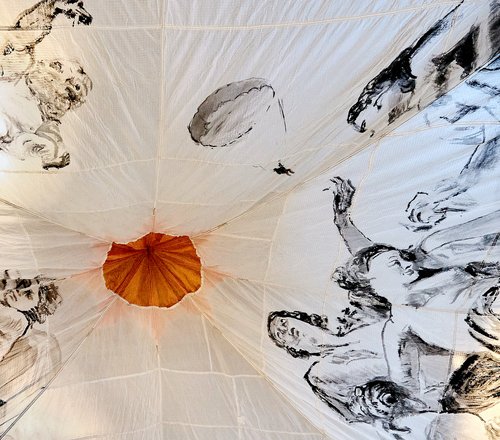
“We are full of energy, we are getting on with our work, and this setback does not affect our creative practice in the slightest” Kovaleva told Art Focus Now. She is currently working on two installations. One is at Pyramiden, a coal-mining settlement that has been abandoned for the last 30 years. Consisting of three painted parachutes (the artist’s signature technique) and a table set for an imaginary post-funeral meal, it is conceived as a memorial to explorers who have perished in the Arctic region. Pyramiden is a remote place six hours away by boat from Svalbard. The vessel with the Biennale team was supposed to moor there before returning to Murmansk. Now this plan has been changed. “I will go there independently. The work will be photographed, and tourists passing through Pyramiden will be able to see it,” Kovaleva said. Her other installation ‘The Imaginary Museum’ is in the abandoned house of a Soviet consul in Barentsburg. It is dedicated to the legendary Soviet prima ballerina Maia Plisetskaya who spent two years on Svalbard as a child. Her father Mikhail Plisetsky was the first director of Arcticugol and a Soviet consul on the island. He was arrested during Stalin’s purges in 1937 and subsequently shot. Plisetskaya’s mother, actress Rakhil Plisetskaya was sent to a labour camp with her baby son Azary. “The work of art is about Plisetskaya’s childhood, her bond with her father, the pain that never fully subsided, and her character – it all becomes clear why she turned out the way she did. She was a straightforward, uncompromising, even harsh person. She really loved the Arctic winds; as a girl she loved to dance about in them,” Kovaleva explains.