

Black Dogs in Europe: Past and Present

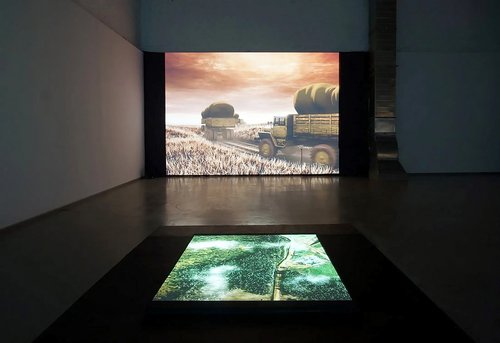
Roman Khimei and Yarema Malashchuk. You , 2024. Pedagogies of War. Exhibition view. Photo by Maru Serrano. Courtesy of Thyssen-Bornemisza Museum
Francisco Goya and Pablo Picasso’s searing images of Europe’s darkest historical moments provide a compelling hinterland for a thought-provoking exhibition of video installations by two award-winning young Ukrainian artists, Yarema Malashchuk and Roman Khimei. Curated by Chus Martinez, the exhibition is currently on view at the Museo Nacional Thyssen-Bornemisza in Madrid.
It was not until he was in his sixties that Spanish artist Francisco Goya (1746–1828) began work on something that what would later partly help define his legacy: the print series ‘Los Desastres de la Guerra’. These raw and honest works reveal flashes of a deeply felt social conscience beneath the surface of a court painter whose patrons were drawn from both the Spanish and French elites. Yet, fearing censorship and possibly also the disapproval of these wealthy and influential patrons, Goya kept the series private; it was not shown publicly during his lifetime.

Today centuries on we inhabit a more ostensibly democratic art world – though not without its contradictions – where young artists are granted platforms within major state institutions, often in peripheral spaces such as side galleries or, in this case, the basement of the Thyssen. Encouragingly, such state sponsored spaces still host exhibitions that do not shy away from difficult or political subject matter. Like Goya, artists responding to unfolding history help us reflect beyond the relentless glare of the media.
While neither Goya nor his compatriot Pablo Picasso (1881–1973) in his iconic painting ‘Guernica’ sought to soften the brutality of war, the work of Malashchuk (b. 1993) and Khimei (b. 1992) takes a markedly different approach. Their videos avoid explicit scenes of violence or physical suffering. As the curator Martinez suggests, images of violence – particularly when circulated through screens and social media – can generate further violence. Painting, by contrast, offers a degree of mediation; we understand it as representation rather than reality. This raises a crucial question: how should contemporary video artists engage with the true realities of war?
One precedent lies in a dramatic, filmed live performance, such as Marina Abramović’s (b. 1946) ‘Balkan Baroque’, presented at the Venice Biennale in 1997 (and won the Golden Lion award) in which she scrubbed bloodied cow bones dressed in a white apron, in a visceral meditation on the Balkan conflicts which saw her own homeland disappear – for which she felt deep shame.
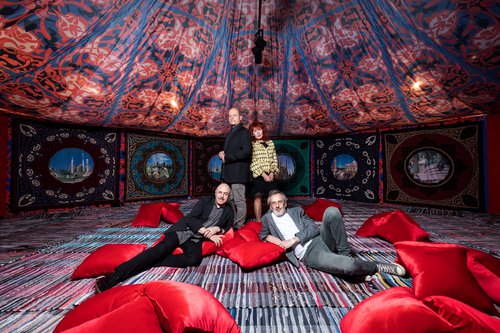
Called ‘Pedagogies of War’ the Thyssen show intentionally adopts a far quieter, more reflective strategy and that is its core strength according to Martinez. Comprising five video works produced since 2022, the exhibition transforms the museum’s basement into a subdued, yet polished cinema-like environment with comfortable beanbags for us to sit on. It invites contemplation of one of the most devastating chapters in recent European history: the tragedy of four years of ongoing armed hostilities following Russia’s incursion into Ukraine.

Malashchuk and Khimei, who have collaborated for over a decade and exhibited internationally, present war not through spectacle but through distance and nuance. In ‘We Didn’t Start This War’, a video work recently commissioned by the Thyssen, the artists’ position is explicit, this is no generalised representation of any war, with its anonymous victims on both sides as Goya shows us in his prints. Elsewhere, irony and historical layering complicate the narrative, lending the works the quality of a subtle, visual historiography. Their documentary approach distances the viewer from the graphic imagery typically associated with war reportage. As Martinez argues, these images cultivate slowness, encouraging deeper understanding rather than reactive fear – countering the emotional immediacy of contemporary media. Fear erodes trust in ourselves and our environment; this is an educational exhibition suitable for anyone.


Perhaps the most art historically nuanced work is ‘Wanderer’ (2022), which references German painter Caspar David Friedrich’s iconic ‘Wanderer Above the Sea of Fog’ (1817). The artists film themselves in the Carpathian Mountains, adopting the poses of fallen Russian soldiers. Their faces are obscured; their bodies lie in uneasy, ambiguous positions. The landscape, rendered with a nostalgic, almost cinematic quality, appears at once idealised and unsettled.
The work resonates with layered histories. During the First World War, the Carpathians were the site of significant Russian military losses in a fight against the Austro-Hungarian army. Today, the region serves as a refuge for those fleeing conflict. The piece also recalls earlier explorations of post-Soviet identity, such as the provocative 1994 series ‘If I Were a German’ by the Fast Reaction Group, which used irony to interrogate national identity and historical memory. Today, in a tragic reversal, in Western Ukraine those old enough to remember this feel the bitter agony of shifting colonial power.

Friedrich’s painting, often taught as the epitome of Romantic sublimity, also contains less examined yet distinctive undercurrents – anxieties about identity, land and nationhood and the Napoleonic threat as it receeded. The protagonist, stands on the top of a mountain with his back to the viewer, looking into the future, like many of the greatest things in life, it has an open-ended message. It is perhaps no coincidence that it was produced during the same period as Goya’s war imagery in the wake of the Peninsular War (1808–1814), existential anxieties about the threat of colonialism shaped people’s world views in Europe at the time.
The most emotionally resonant work in the Thyssen exhibition is a two-channel video installation ‘Open World’, made last year in 2025. Here, a seventeen-year-old Ukrainian boy, displaced from his home in Kiyv four years ago, reconnects with his home environment through a robotic canine avatar. On a smaller screen, we see him controlling the device and speaking through it. Moments of humour – such as calling out to his cat, who fails to recognise him – are tinged with quiet sadness; as he chats with his mother the emotions between the two are deeply touching. The interplay between distance, technology, and longing is difficult to watch without emotional impact.


As a coda – its own kind of tail – one need only cross the road to the Museo del Prado, where Goya’s haunting ‘El Perro’ (The Dog) resides. Painted on the walls of his home during his later years, when he was deaf and increasingly disillusioned with the Spanish political situation, the image remains profoundly open-ended. Like an open-world game, its jarringly sparse composition invites endless interpretation across time – past, present, and future.
Roman Khimei and Yarema Malashchuk. Pedagogies of War
Madrid, Spain
3 March – 21 June 2026