

At Zero Time: Leonid Rotar and the Poetics of Estrangement

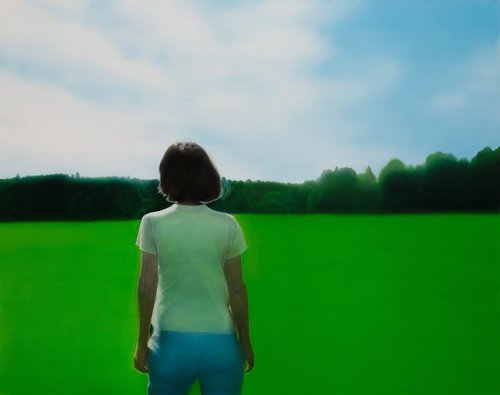
Leonid Rotar. Man, 2012. From the 'End of the World' series. Courtesy of Triumph Gallery
Bringing together forty works spanning more than two decades, this exhibition at the Stella Art Foundation in Moscow offers the most comprehensive view to date of Leonid Rotar’s singular artistic universe. Monumental yet deeply introspective, his paintings fuse Soviet visual traditions with existential solitude, creating images that feel at once timeless and urgently contemporary. Beneath their glowing red suns, humanity persists, isolated but not entirely without hope.
“I stopped very gently and sat upon the Time Machine, looking round. The sky was no longer blue. North-eastward it was inky black, and out of the blackness shone brightly and steadily the pale white stars. Overhead it was a deep Indian red and starless, and south-eastward it grew brighter to a glowing scarlet where, cut by the horizon, lay the huge hull of the sun, red and motionless”.

This passage from The Time Machine by H. G. Wells came immediately to mind as I entered Leonid Rotar’s (b. 1962) solo exhibition. Throughout my visit, I was accompanied by a persistent sense of unease – not an unfamiliar feeling in the present day, perhaps, but one here sharpened by paintings charged with an extraordinary inner tension, works that gently but insistently dislodge us from our comfort zone.
This compact survey, bringing together forty works spanning the artist’s career, includes a new series entitled ‘North’. In contrast to the monumental canvases for which Rotar is best known, these paintings possess a greater intimacy. Seen from a distance, they resemble vast signal fires; indeed, in the far north the setting sun can sometimes burn with just such an intense and improbable red. The great crimson sun is one of the central leitmotifs of Rotar’s oeuvre. For many years he has reworked the visual language of realism and Socialist Realism, placing figures drawn from the classical Russian pictorial tradition within apocalyptic landscapes at dusk, as though they remain entirely oblivious to the world unfolding around them. A solitary man rows his boat into gathering darkness; young women in traditional Russian dress dance a khorovod – once part of a pagan ritual honouring Yarilo, the sun god; elsewhere, scenes of haymaking unfold as mowers cross the fields and women gather the harvest. One is left with the unsettling impression that time itself has come to a standstill.

At the entrance to the exhibition, the viewer is confronted by ‘Zero Time’, a monumental image of a digital clock fixed at 00:00 against a black ground. The darkness seems almost capable of drawing one in: does it enclose a moment in which time has been emptied and reset, or does it open onto the vastness of the night sky? A similar atmosphere pervades the 2012 series ‘End of the World’, where the same black heavens, a pale white moon and a lifeless landscape frame the figure of a handsome youth, either quenching his thirst or embracing a cross – another symbolic motif that recurs throughout Rotar’s work. Here another theme emerges, indebted to the grand style: the cult of corporeal beauty. In Rotar’s paintings, beauty will not redeem a world that has reached the limits of its existence, but it will be the last thing to perish.

Yet, when one considers the full trajectory of the artist’s practice, the picture may not be quite as bleak as it first appears. Works from different periods readily recombine into new constellations, and a shift in context can transform their meaning entirely. This is precisely what occurred with ‘Zero Time’: in the project ‘Until Tomorrow’ (2006, Yakut Gallery), devoted to a nocturnal football match played beneath an enormous moon, those same glowing zeros appeared on a scoreboard, marking nothing more ominous than the moment of kick-off, while the exhibition’s title itself suggested hope rather than finality. Place a work in a different setting and it can be read in an altogether new way. Yet one should remember that it is not only the times that change, but the artist living through them. Twenty years on, Rotar has every right to endow his earlier works with fresh meanings, just as he may recombine familiar motifs to construct entirely new narratives.

Leonid Rotar is an intensely private figure. He avoids social gatherings and rarely, if ever, gives interviews. Born in Moldova in 1962, he completed his artistic education in Chișinău in 1981 before moving to Moscow to study film design at the All-Russian State Cinematographic University (VGIK), where he has lived ever since. Although Rotar never ultimately pursued a career in cinema, a distinctly cinematic sensibility has remained central to his work: his paintings often resemble stills extracted from an unseen film. His admiration for Soviet monumental art endowed them with their imposing scale, and for many years his preferred format measured approximately two by three metres. Such is the case with the series ‘Don’t Stay Silent’ (2008), in which a white, featureless figure gradually acquires individuality, emerging as a young man carrying a torch beneath a vast, dark-blue sky.

Rotar’s unequivocal artistic idol is Aleksandr Deineka (1899–1969), the pre-eminent Soviet painter, who once wrote that he was “always drawn to large canvases, so that the human figure upon them might be larger, more visible, more majestic”. Rotar embraces the same ambition, yet even in his most explicit homages to his master he introduces an unmistakable sense of estrangement. The young men who populate these paintings – often his own sons – appear profoundly solitary, as though each were the last person alive, a “naked man on naked earth”. Significantly, the mature phase of Rotar’s oeuvre emerged from similarly barren and depopulated landscapes. The series ‘Earth and Sky’ was exhibited in 2005 in the remarkable circular interior of the GasHolder in Moscow, then home to the now-defunct Yakut Gallery, and presented viewers with austere mountain vistas stripped of all human presence.

Despite his devotion to realism and monumentalism, and a severity that can at first seem forbidding, Rotar’s art is far less straightforwardly realistic than it initially appears. The unease generated by his perpetual twilight and sharply illuminated figures evokes a much broader art-historical lineage, extending from Romanticism to Metaphysical painting. Working with a relatively restricted iconography, Rotar handles his motifs with remarkable assurance and, at times, a measure of playfulness: in the ‘Until Tomorrow’ series, the moon retains all its radiant intensity while transforming first into a volleyball and then into a football.
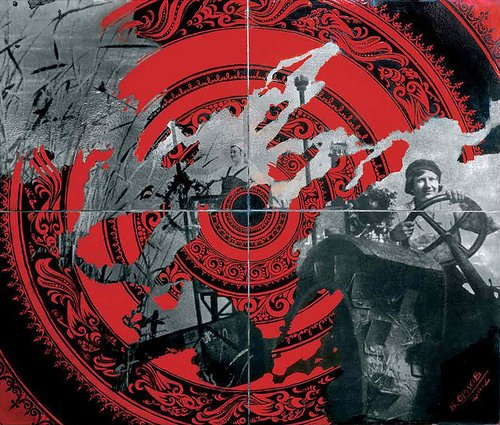
There is space, too, for postmodern reflection and experimentation. Alongside works that betray an undisguised fascination with the photographic avant-garde, the exhibition presents a number of compositions in which Rotar enters into dialogue with Kazimir Malevich, most notably in the series ‘Genesis’. The blank faces familiar from Malevich’s late peasant cycle are filled with what Rotar describes as “biological material” – vastly magnified cellular forms – which nevertheless fail to confer any genuine individuality upon their subjects. Elsewhere, a black cross is intersected by a white circle in the foreground, transforming the composition into an inverted Petri dish.

During his years at VGIK, Rotar produced a group of works connected with a proposed screen adaptation of The Stranger, a meditation on human alienation and absolute solitude beneath an indifferent, blazing sun. Even then, it was evident that painting – the autonomous easel picture – suited the artist more naturally than cinema. So it proved, although film has unmistakably left its imprint on his imagination. Those early works now survive only in an archival catalogue, yet by exhibiting them Rotar assigned them a lasting place within his own artistic biography.

The themes of solitude, estrangement and existential isolation, therefore, did not emerge merely twenty years ago; they have been present from the very beginning. Much that was produced in earlier decades reads differently today, and Rotar’s timeless images may never have carried all the meanings we are now inclined to discover within them. Yet the title of that early series, ‘Don’t Stay Silent’, set against apocalyptic landscapes and an increasingly dystopian reality, resonates today with particular force.