

Art-on-Don: St Petersburg’s Faberge Museum Continues to Map Local Art Scenes

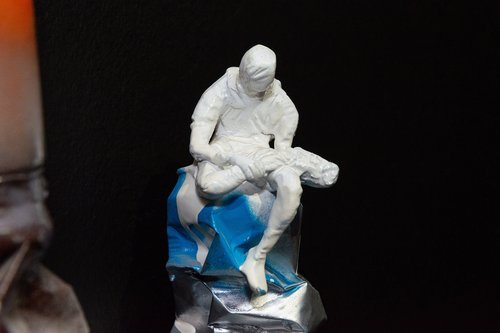
Daria Eladova. It is for love, 2024. Image provided by 'Steppe' Center for Contemporary Culture, Rostov-on- Don. Courtesy of the artist
The Fabergé Museum’s latest exhibition charts the contemporary artistic landscape of Russia’s Rostov-on-Don region, showcasing a scene defined by southern vitality and underground collectives. However, the exhibition’s curatorial framework and normalizing rhetoric threaten to blunt the radical edge of works that grapple with ideology, decay, and transgression in the post-Soviet era.
The Fabergé Museum in St. Petersburg, in partnership with the Link of Times cultural foundation, continues its long-term mission to map the landscape of contemporary Russian art – a project that runs parallel to the strategic interests of its founder, billionaire Viktor Vekselberg. Their latest exhibition, the fourth installment in the “Open World” cycle, focuses on the Rostov Oblast. This showcase marks a distinct shift from previous iterations that highlighted artists from Nizhny Novgorod and the industrial hubs of Perm Krai and the Urals. While the exhibition features a sprawling roster of over eighty artists, its breadth is balanced by a rigorous curatorial precision. Rather than attempting an exhaustive survey of art from the Don region, the exhibition succeeds by skillfully identifying and framing regional stereotypes – or, more accurately, by codifying a series of insightful empirical generalizations.

During the press conference and opening, expressions of gratitude were extended not only to Vekselberg but also to Gazprom and its board chairman, Alexei Miller. The company funded the restoration of pieces from the Taganrog Art Museum, which were damaged in 2023 by missile debris. These works were repaired by specialists at the State Russian Museum and subsequently displayed in its halls. The inclusion of this backstory – though external to the current exhibition – is telling: the showcase of contemporary art from the Rostov region at the Fabergé Museum follows the same normalizing logic found in the official rhetoric surrounding it.

The exhibition’s logic echoes the “Open World” cycle, which originally debuted under a subtitle commemorating the 80th anniversary of the Soviet victory in the Great Patriotic War. Now that this milestone has passed, the first floor functions primarily as a preamble; rather than defining the contemporary era, it seeks to illuminate its origins.
The undisputed hero in this section is Martiros Saryan (1880–1972). Born in Nakhichevan-on-Don – a city established by Armenians in 1779 and later absorbed into Rostov-on-Don – Saryan is represented here by three significant loans from the Rostov Regional Museum of Fine Arts. These include early still lifes from 1913 and 1918, alongside a portrait of Ukrainian artist Tatyana Yablonskaya (1917–2005). Interestingly, the latter was acquired by the Rostov museum from the Saryan Museum in Yerevan through a strategic exchange of two other canvases by the master.

Also featured is a cornerstone of the Leningrad school of landscape painting: Vladimir Grinberg (1896–1942), whose artistic identity was forged between his native Rostov-on-Don and St. Petersburg. Grinberg’s oeuvre is defined by a sophisticated range of influences. His 1918 portrait of the Rostov opera singer Sergei Shiltov – complete with allegorical attributes of the arts and sciences – is rendered in an ornate neoclassical style. In contrast, his 1940 portrait of his wife reveals a stylistic shift, executed with a fluidity and palette clearly indebted to Henri Matisse (1869–1954).

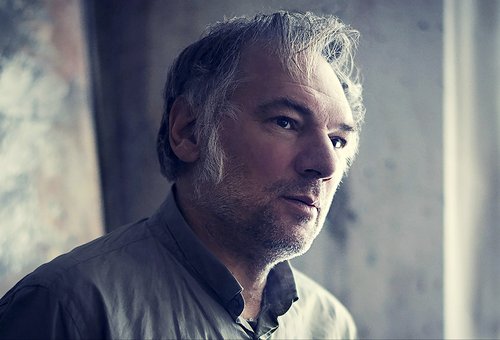
Sergei Sapozhnikov. Untitled. From the series 'Dance', 2017. Courtesy of Moscow Museum of Modern Art
The “Echoes of the Hermitage” collection exemplifies how Soviet and post-Soviet artists engaged with Western art from the turn of the 20th century. These influences are particularly evident in the works of Timofei Teryaev (1912–1982) – a graduate of the St. Petersburg Academy of Arts and a devoted pupil of Martiros Saryan – as well as his student Leonid Kabarukhin (b. 1951) and Georgy Likhovid (1948–2025). Teryaev’s reverence for his mentor is even captured in a still life on display, which features a reproduction of Saryan’s ‘Walking Woman’. Throughout the collection, impasto techniques and saturated tones rhyme boldly with the traditions of Cossack naïve art and the Don lubok. This aesthetic is shared by Boris Sporykhin’s dignified ‘Don Ataman Matvei Ivanovich Platov’ (1995), Sergei Gavrilyachenko’s nostalgic ‘Last Summer of 1913’ (2008), and the literal “folk pictures” of Yury Bessmertny’s ‘Week of Words’ series (1992).

The second floor continues to immerse the viewer in a sense of vitality and Cossack daring, underpinned by a ‘southern palette’ – however reductive that descriptor may be. The collection spans generations, featuring both perestroika-era masters and emerging contemporary artists, with a significant emphasis on works from recent years. For many, the ‘Don context’ is no longer their primary lens; however, their inclusion is rooted in shared lineage – specifically the mentorship of Leonid Stukanov (1947–2003) – and the local communities that served as a vital crucible for these now-iconic figures.

At the turn of the millennium, the region was defined by a vibrant network of artistic collectives, including ‘Sintel-Radunica,’ ‘Green Island,’ and ‘Group of Persons.’ However, the most radical and influential of these was ‘Art or Death.’ Founded in 1988, this independent association shaped the Rostov scene’s reputation in the Russian capitals for years. It united progressive students from Grekov College with the writers and musicians of ‘Peking Row-Row.’

Together, they staged provocative “sessions of mass psychosis” and fleeting exhibitions in cultural centers and pavilions. Most notably, they frequented the legendary paid toilet in Gazetny Lane – a site that held hallowed status as the former ‘Poets’ Basement,’ where the early 20th-century bohemia once gathered. The group’s core – Avdey Ter-Oganyan (b. 1961), Yury Shabelnikov (b. 1959), Valery Koshlyakov (b. 1962), and Alexander Sigutin (b. 1959) – engaged in a playful, almost clownish dialogue with art history. By interpreting masters like Henri Matisse and Paul Cézanne (1839–1906), they embodied the “Southern Russian Wave” version of transavantgarde – a term that remains ripe for critical reconsideration.

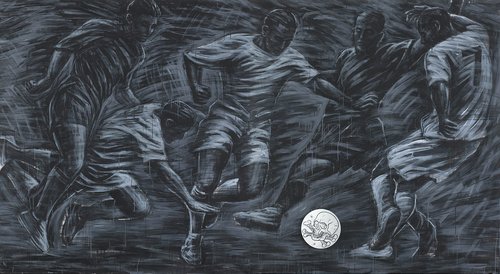
The current exhibition features later works by members of the ‘Art or Death’ group. Shabelnikov, who continued to provoke the public long after his move to Moscow, is perhaps best remembered for the 1998 performance ‘Mausoleum: Ritual Model.’ In collaboration with Yury Fesenko (b. 1955), Shabelnikov famously consumed a cake fashioned after the body of Vladimir Lenin. While an attentive viewer can uncover this history via a QR code, the exhibition itself maintains a decorous veneer; the dense hanging and traditional presentation effectively neutralize the subversive potential of the works. Here, Shabelnikov is represented by paintings from his ‘Requiem of Will’ (2005) and ‘Esoteric Football’ (2007) series, which dissect ideological iconography. Fesenko’s contributions include ‘Ruin. Carpet. Structure’ (1995) and two new “holey” canvases titled ‘Losses’ (2025). Featuring red and white Scythian horsemen, these works reflect on transience and the nature of physical and cultural ruptures. Similarly, Koshlyakov’s signature style is present in his depictions of imperial ruins painted on dilapidated cardboard.

Sergei Shekhovtsov (b. 1969), another prominent artist, joined the former ‘Art or Death’ circle later while living in Moscow’s squats. The Fabergé Museum currently features a sculpture made from his signature ‘poor’ material: foam rubber. Suspended from the ceiling, ‘The Gardener’ (2005) – part of the Tsvetaevo series – appears to spray toxic fertilizer over the neon-bright canvases and assemblages in the final hall. This “miracle solution” feels as though it were mixed by the curator: it acts as a pesticide, neutralizing the more reckless histories of the Rostov artists by omission, while simultaneously saturating the ‘Open World’ with an unearthly, acidic glow. This tension culminates in the decorative, high-contrast photography of Sergei Sapozhnikov (b. 1984), whose dynamic ‘Dance’ (2017) serves as the exhibition’s final, quintessential chord.
Open World. Contemporary Art of Rostov Region
St Petersburg, Russia
16 January – 12 April 2026