Andrey Kuzkin: Art between Action and Archive

The Man Who Lost His Head and Other Forest. Exhibition view. Moscow, 2026. Photo by Ekaterina Kozlova. Courtesy of Fabrika Centre for Creative Industries
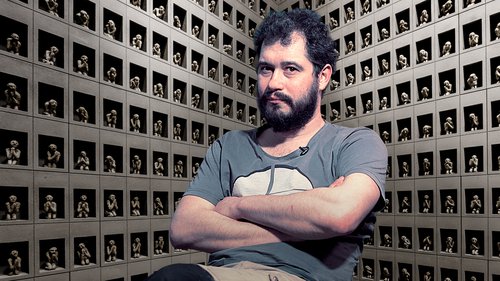
The exhibition ‘The Man Who Lost His Head and Other Forest Actions’ at the Fabrika Centre for Creative Industries in Moscow presents Andrey Kuzkin’s forest practice as an archive: a bread figure, documentation and text that ask what actually survives of an action.
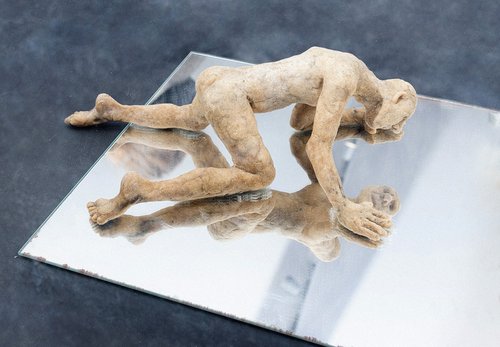
A walking, headless figure stands at the centre of ‘The Man Who Lost His Head and Other Forest Actions’, a solo exhibition of work by Andrey Kuzkin (b. 1979) at Fabrika in Moscow. Made from breadcrumbs, the sculpture is only one part of the work. The other consists of a video and photographs documenting the artist’s actions as he separates the head from the body and carries it into the forest. While the body remains in the exhibition space, the head ends up elsewhere. The work cannot therefore be experienced in its entirety in a single place; instead, it must be reconstructed through a sequence of actions unfolding across time and space.
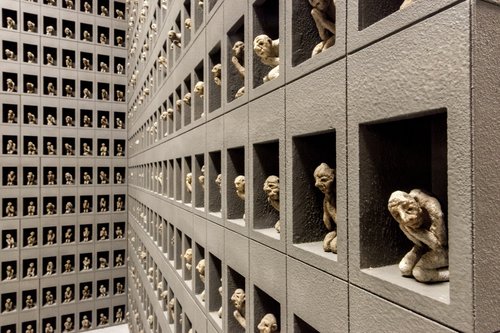
The exhibition brings together forty-four actions performed in the forest between 2012 and 2026, placing new work alongside a fourteen-year record of the artist’s repeated returns to the landscape of his childhood. Central to the exhibition is the concept of the archive, understood not simply as a collection of completed works but as a means of extending the life of an artistic event beyond the moment in which it took place. This raises a fundamental question: what exactly does the archive preserve – the action itself, the experience of performing it, or merely the evidence that it happened?

Kuzkin’s forest practice began in March 2012 with ‘Manipulator, Relocation of Valuables – 1’, an action in which he arranged around a hundred pairs of old shoes among the trees near the village of Anikeyevka in the Moscow region. The same shoes had previously featured in his installation ‘We, or the Effect of Presence’, shown at Fabrika in September 2011, where they symbolised the presence of exhibition visitors. Described by the artist as an attempt to “museumify the visits of viewers to an exhibition hall or museum”, the installation questioned the relationship between the artwork and its audience. The empty shoes also suggested the traces left behind by absent visitors, transforming an event in the present into something already remembered. By relocating the shoes to the forest, Kuzkin shifted the work’s meaning from collective experience to personal memory. The forest between Nakhabino and Anikeyevka, where he spent his childhood and where his father and grandparents are buried nearby, became more than an alternative exhibition space: it was a place of intimate connection with absent loved ones.
The relocation of objects from the public space of the exhibition to the personal landscape of the forest reveals the central purpose of Kuzkin’s forest actions. The artist seeks to revisit the landscape of his childhood memories and invest it with new experiences. Rather than attempting to recreate the past, he transforms a place associated with memory into a setting for new actions, bringing past and present, the external world and inner experience into dialogue.
For Kuzkin, the forest is far from a neutral backdrop. The artist recalls returning there after completing his project ‘Everything Lies Ahead’, for which he packed all his possessions into metal boxes. Having distanced himself from the objects of his former life, he sought to reconnect with “something real”. His return to the forest was significant: he was revisiting a place where he had existed long before becoming an artist. Yet the forest is no safe repository for the objects he leaves behind. They disappear, deteriorate or are taken by strangers, and these unpredictable changes often inspire subsequent actions. The work thus extends beyond the artist’s original gesture to encompass the changing fate of the objects themselves, over which he has no ultimate control.

At the same time, the forest becomes a space for organising attention. In the strand of Moscow Conceptualism associated with Andrei Monastyrsky (b. 1949) and ‘Collective Actions’, place is not a passive background. The field, the distance between participants, the route to the site of the action and the description that follows form a spatio-temporal construction. The event exists both in the territory outside the city and in the texts that accompany it. Emptiness here is not merely unfilled space. It arises as a gap between expectation and what is seen, between what happens and the ability to recognise the event. The visible movement of a person walking across a field does not exhaust what took place. A photograph of an empty field turns out to be a sign of the demonstrative essence of the action. The “empty action” is depicted by the absence of an image. The document points to something that cannot be presented as a stable object.
In Kuzkin this logic is transformed. His actions cannot be identified with the “empty action”, but absence becomes an active element. The empty shoes stand in for people; the missing head shapes the perception of the body. The viewer turns to the documentation and mentally joins the exhibition hall to the forest. What is inherited is the principle of the distributed work, whose meaning arises between object, place, action and evidence. Here, however, emptiness takes on a biographical and bodily colouring.
Documentation occupies a leading, not a supporting, place in the exhibition. Photographs, videos and texts do not merely confirm that the actions took place: they make them accessible to perception and link events of different years. It is the system of evidence that turns separate actions into a legible artistic practice.

The Man Who Lost His Head and Other Forest. Exhibition view. Moscow, 2026. Photo by Ekaterina Kozlova. Courtesy of Fabrika Centre for Creative Industries

The Man Who Lost His Head and Other Forest. Exhibition view. Moscow, 2026. Photo by Ekaterina Kozlova. Courtesy of Fabrika Centre for Creative Industries
In Kuzkin the archive holds the history of a person’s presence in a particular place. Each return relates to the previous ones, and one action gives rise to another. The artist stressed how hard it is to represent this whole: a collection of films or a book does not necessarily convey its structure if the events are perceived in isolation.
The artist’s commentary records what the camera cannot. As curator and art dealer Natasha Tamruchi observes, Kuzkin’s texts accompany the actions, merge with them and sometimes replace them, preserving not only events but also thoughts and emotions. Yet the selection of images, their arrangement and the accompanying explanations inevitably construct a particular version of what happened. The archive resists disappearance but cannot prevent loss. Tamruchi links Kuzkin’s practice to a fear of erasure, suggesting that expanding the circle of witnesses is a way of affirming his presence in the world.
Although Kuzkin regarded Monastyrsky as his teacher, he described his own actions as more personal and romantic, intended to be understood emotionally. Tamruchi contrasts the openness of Monastyrsky’s ‘Trips Out of Town’, which invites multiple interpretations, with Kuzkin’s commentary, which anchors each action in his personal experience. This emotional authenticity is both a strength and a limitation: by explaining his intentions and feelings, the artist risks leaving viewers little room for independent interpretation.
The exhibition, however, opens up new possibilities. Bringing the actions together reveals repetitions, shifts and contradictions that extend beyond the artist’s own explanations. The gaps between the original events, their documentation and their presentation today invite fresh questions and interpretations.

Kuzkin’s 2016 solo exhibition ‘The Right to Life’ at MMOMA had already brought together documentation of his actions and works from 2006 to 2015. Tamruchi identifies three forms of the project: the events of the artist’s life, an exhibition documenting them, and a book that reconstructs those experiences through language. At the time, this period of his life appeared to have reached a conclusion, its material organised and effectively “sealed”. At Fabrika, however, a new action reopens the archive, inviting a fresh interpretation of what came before.
‘The Man Who Lost His Head’ combines bread sculpture with performance. For Kuzkin, bread evokes nourishment, the human body, sacrifice, Christian symbolism and the prison tradition of modelling figures from bread. The material embodies a tension between sustenance and bodily vulnerability. In this context, the body remains in the public realm of exhibition, commerce and exchange, while the head is carried into the forest, a place associated with freedom and personal memory. The gesture suggests an attempt to preserve a realm of consciousness beyond the commercial circulation of art. Yet the head remains a physical object, and its removal raises a paradox: can part of an artwork truly escape public circulation when the act of removing it becomes part of an exhibition?
The figure itself was created in 2022 but remained disassembled at Fabrika for four years due to circumstances beyond the artist’s control. Although unplanned, this prolonged interruption adds another layer of meaning to the work. The separation of the head becomes not simply a symbolic gesture but the continuation of an action after four years of enforced inactivity.
Kuzkin’s poetic text changes the distribution of initiative: first the man models the figure and carries off the head, then the head leads him:
“The head detached from the body and rolled through the forest
and rolled for a long time
until it brought me to the right place.
There the head stopped
and I stopped with it.”

The artist finds himself led by his own work. The fairy-tale intonation creates a different order of causality: the artist does not designate the right place but discovers it. The photographs and video testify to the transfer; the poem testifies to the direction found. The mismatch between these testimonies keeps the work from turning into an illustration of a thesis.
The return of the forest archive to Fabrika closes a spatio-temporal arc. The shoes appeared here as a stand-in for viewers, then entered the artist’s personal history in the forest. Now that history is presented to the public again. The exhibition returns not the former installation but evidence of its other, subsequent life.

Withdrawal into the forest cannot be absolute: Kuzkin acknowledged that art remains a message for the public. The conflict therefore runs not between “authentic” nature and the “inauthentic” institution but between the need to preserve experience and the impossibility of conveying it without transformation.
The body is presented to the viewer, the head is absent, but the absence is documented. Emptiness becomes the condition of turning to another place and time. The forest is not a territory of final departure from art but a place from which art turns to the viewer again. Kuzkin’s exhibition unfolds between preservation and loss, object and action, personal experience and public testimony.
The Man Who Lost His Head and Other Forest
Fabrika Centre for Creative Industries
Moscow, Russia
15 October – 15 November 2026