

And the Last Shall Be First: Otdelnov’s Solo Exhibition in Moscow

Pavel Otdelnov. Front Row Seats. Exhibition view. Moscow, 2025. Photo by Ekaterina Kozlova. Courtesy of Fabrika Centre for Creative Industries
A startling collaboration between émigré artist Pavel Otdelnov and curator PollyT, called ‘Front Row Seats’ is inviting viewers to think deeply about current realities. Held in a self-organised art space NoNameForNow at the Fabrika Centre for Creative Industries in Moscow, this is Otdelnov’s first solo exhibition in Russia since 2022.
At first glance, the installation ‘Front Row Seats’ seems to consist of nothing more than two paintings and two wooden chairs in a small room. Yet judging by viewers’ reactions, its impact is as powerful as – and perhaps even greater than – many large-scale, big-budget projects.
Curator PollyT has been interested in Otedlnov’s work for some time. “In general, I am drawn to the need to form an attitude about what is happening now: it is a thirst for a kind of managed drama where I can contemplate and feel the pulse of the age in which we are living”. She saw an ideal metaphor for this phenomenon in two works by Pavel Otdelnov (b. 1979) which form his project ‘Ringing Trace’. She eventually wrote to him, and Pavel was receptive for which she feels deep gratitude. “We wanted to create a spacious yet minimal environment where people could themselves see the corrosion in our human desire to experience things alone, and so access to the space is limited to no more than four people at a time who sit in the front and only row”, explains curator PollyT. When she first conceived the exhibition, she had planned to use digital projections instead of original paintings, but fortunately it turned out both works were in Moscow and were handed over by friends of Pavel Otedelnov together with the legendary American modernist Adirondack chairs, designed specifically with easeful contemplation in mind, and still popular to this day.


Originally, ‘Trinity’ and ‘Spectacle’, Pavel Otdelnov’s two canvasses were part of the ‘Ringing Trace’ project, dedicated to the Soviet atomic programme, within the residency programme of the 6th Ural Industrial Biennale of Contemporary Art in 2021. However, PollyT suggested the artist look at the works from a different angle, taking as a starting point the first test of nuclear weapons at the American Alamogordo site on 16 July 1945, which the only journalist present, William Laurence, described as an “enormous green super-sun”.
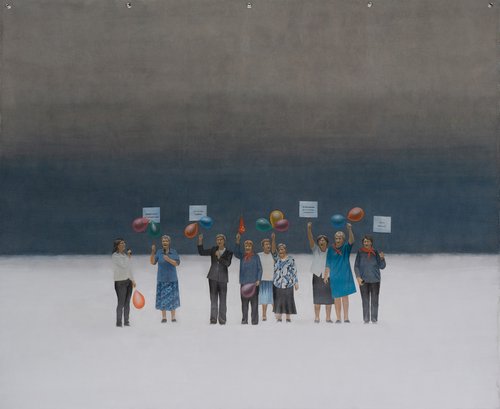
The second smaller-format painting is based on a photograph of an audience of VIP spectators illuminated by a nuclear flash in the Marshall Islands in the Pacific Ocean. The organisers of this “unique spectacle” attended to the comfort of these guests, giving them comfy chairs and special glasses to protect them from the intensity of the flash.
Even from the entrance of the exhibition, without reading the wall text or curatorial explanations, a difference in scale between the gigantic nuclear sun and the tiny human beings grabs one’s attention, which peculiarly emphasises our human foolishness and the readiness to take any risk for a unique experience that elevates ourselves above others.

Ultimately it is to this that the project is dedicated, namely our addiction to spectacles, which Otdelnov compares with radiation in terms of its inherent dangers. People want to sit in the front row, not only to feel like they are touching some great event and enjoy some exclusivity, but also to ensure that the rest of the world will find out about it. For this, they are prepared to do anything, resorting to mystification, lies or forgery. Nowadays, social media and ChatGPT handle this all with ease. Pavel Otdelnov reflects: “Finding a ‘sensation’ is becoming ever easier, and now the eager rush to share questions, theories, panic. The more real harm their gossip causes, the brighter the illusory suns burn, the stronger the joy of feeling the pulse of the age. One can sink back into the chairs again and contemplate.”
For a complete immersion in contemplation and reflection, the installation is accompanied by the sound of a Geiger counter recording, in contrast to the original ‘Ringing Trace’ project with just normal background radiation, as the curator did not want to exacerbate a feeling of “super-anxiety” in the viewer. “Here the territory is not contaminated, here it is already slightly calmed,” says PollyT.

It is not difficult to draw analogies between this and our current state of affairs. Pavel Otdelnov laments that our seats are in the back row, from where we can only helplessly observe the unfolding catastrophe, the consequences of which will affect more than one generation of residents of the affected territories and ultimately the world as a whole, “unable either to stop it or to look away”. However, perhaps even the spectators in the front row are merely under the illusion that they are following the wise advice “if you can’t beat ‘em, join ‘em” and are in control of the situation, although even from the school physics curriculum we know that once started, a nuclear reaction cannot be stopped, even if there is a sudden realisation of a grave error.


Unlike many Russian artists who are struggling to reestablish their careers abroad, Pavel Otdelnov has become relatively integrated into the Western art context. In recent years, there have been three major solo exhibitions in London: ‘A Child in Time’ (2025), dedicated to a Soviet childhood in the 1980s; ‘Hometown’ (2024) in the old waiting room of Peckham Rye station, where the “story of global uncertainty” is comprehended through landscapes of Dzerzhinsk, the artist’s hometown; and before these two his ‘Acting Out’ project (2022), conceived at the very beginning of 2022, and dedicated to the Cold War as part of the Soviet nuclear project. As Pavel Otdelnov has said previously, “I devised the exhibition in great detail. But a couple of days after I had drawn sketches, a new war had began, and not at all a cold one.”

It is remarkable that such a quintessentially Russian artist, seemingly inextricably bound to Russian realities and cultural codes, has found the key to the hearts of British audiences. As the artist himself admits, ‘I have found a new theme for myself: British utopias, mainly of the second half of the 20th century. It is a project that in some ways echoes my Inner Degunino and Russian Nowhere.’ It is hard not to recall the almost visionary work of the former winner of the Russian national Innovation award, now banned from official Russian institutions: ‘Can I Have the Geolocation? – Choose It Yourself’.
Pavel Otdelnov. Front Row Seats
Fabrika Centre for Creative Industries
Moscow, Russia
4–14 December 2025