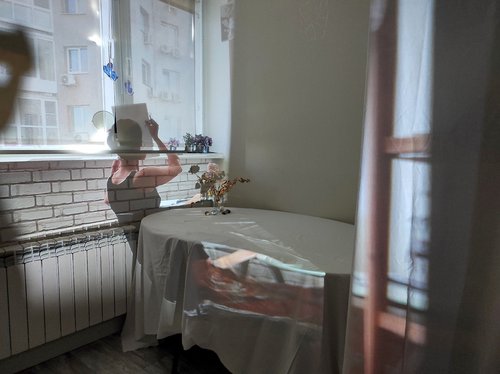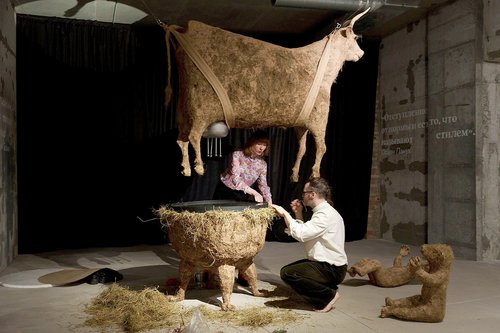


Voices of things. Exhibition view. Samara, 2026. Photo by Julia Itvi. Courtesy of Victoria Gallery
A Triennale That Has Outgrown Its Apartments
What begins as an alternative to the established art world does not always remain outside it. Over the past decade, Samara’s Apartment Triennale has turned private homes and unconventional spaces into a city-wide exhibition network. Today, as its influence expands and its profile grows, the project finds itself confronting a familiar question: can an anti-institutional initiative remain independent once it becomes an institution in its own right?
This year marked the fourth edition of the Samara Apartment Triennale. The initiative was launched in 2017, the same year that Moscow’s Garage Museum of Contemporary Art inaugurated its own triennial, a project that ultimately lasted only two editions, in 2017 and 2020. In response, the wags at Samara’s Victoria Gallery, founded by billionaire Leonid Mikhelson, devised a parallel event: an ironic provincial counterpart to the capital’s flagship exhibition. Where the Garage Triennial sought to map the diversity of artistic practice across Russia’s vast geography, the Apartment Triennale applied a similar logic on a local scale. Here, however, regions were replaced by artists’ apartments, garages, studios and workshops. Rather than gathering art within the confines of a museum, the organisers invited audiences to venture out into the city itself, navigating a dispersed network of addresses and encountering art within the spaces where it was created.

Acting as the Triennale’s organiser, Victoria Gallery compiles a schedule of events at each venue and what is of particular value is that curators from the gallery do organised tours around the sites. This format owes some debt to the legendary Shiryaevo Biennial, which was held in a village near Samara from 1999 onwards but had gradually faded out by the early 2020s. Each edition of that exhibition lasted for one day only, and its central event was what was known as a nomadic show: a crowd of spectators, led by curators, would walk from the jetty through the narrow streets of Shiryaevo, moving from one exhibit to the next. The Samara Apartment Triennale effectively picked up the torch of cultural enlightenment that the Shiryaevo Biennial had dropped and carried it forward adapting it slightly to the realities of a city of over a million, where, unlike in a rural backwater, it is no easy matter to hold a person’s attention for more than a couple of hours, or even minutes.


This year the Samara Apartment Triennale launched with a project that deconstructed the logic of urban space through a poetic lens. On opening night, dozens of people gathered in Artists’ Square on Nekrasovskaya Street, where Elina Alimpieva, Elena Zubova, and Darya Kartashova – the founders of the Society of Wild Garden Enthusiasts – along with artist Andrey Syailev (b. 1982) talked about the flora at the site. The square was planted with wild grasses which came from the left bank of the Volga, an area close to Samara popularly known as “Za-Volga” [the Far Bank]. Syailev added to this plant ensemble, uncharacteristic of the city, apricot saplings from his brother, who grows them at his dacha. The site itself is a former hospital garden, originally intended as a place of rest for patients. Today it offers a way to break free from the urban environment and find oneself almost in nature.


Part two of the opening of the Trinnale took place in Syailev’s studio in a building close to the square. One wall was occupied by a painting by legendary Samara artist Valentin Purygin (1926–2002). A work called ‘A Bright Day of Yarilo’ (1973–1991), this large neo-primitivist canvas depicts a creature resembling a forest spirit, who uses a brush to paint something abstract on a canvas. The painting also features churches, a chicken coop, trees, and flowing water. Before an audience and press, Syailev formally donated this effervescent, image-laden work to the collection of the Victoria Gallery represented by its recently appointed director, curator and artist Sergei Balandin.
For each edition of the Apartment Triennale, an event is held in Balandin’s flat. This time, the collective Krasnyi Kruzhok [Red Circle] – founded by students of Moscow artist Avdei Ter-Oganian (b. 1961) and whose members are spread across the country – staged an intervention there. Everyday objects and works of art in the flat had cartoon-like paper speech bubbles attached to them with phrases drawn from contemporary pop-psychology and social-media slang: “Are you in a place right now where you can hear this?”, “I’m in my prime”, “ADHD” or “Your feelings are completely valid”. By this point it is, of course, thoroughly exhausting when even a kitchen tap tells you that you are “doing well by sharing” – so that even the intended irony becomes annoying. The project was curated by Violetta Grishina (b. 1978), an artist who works at the Victoria Gallery, and is an active participant in Krasnyi Kruzhok.

This year the organisers of the Triennale sought to foster a greater sense of participation by launching an official Telegram channel where artists and curators could announce events and visitors could exchange impressions and commentary. Yet on opening night the channel was barely operational. A tightening of internet restrictions in Russia, coupled with technical problems, also rendered the gallery’s website – home to the Triennale programme – inaccessible. Rather than diminishing enthusiasm, the disruption gave the event an unexpected affinity with its historical antecedents. For a brief period, the apartment exhibitions seemed to revert to the conditions of the late Soviet nonconformist scene, when news of exhibitions travelled by word of mouth and personal recommendation. As the days passed, however, the digital infrastructure gradually recovered. The Telegram channel came alive with debate, photographs and documentation, allowing audiences ultimately to follow the Triennale’s unfolding narrative online.

This temporary disconnection from the network seems to echo the particular spirit of each edition of the Samara Apartment Triennale. Yet the exhibitions, originally conceived as an alternative to gallery and museum formats, have gradually become more conventional. The triennale itself has, over time, acquired an increasingly official character. This is hardly surprising: both the Shiryaevo Biennial and the Ural Industrial Biennial followed a similar trajectory. With the disappearance of those events, a larger cultural responsibility may now be falling upon the Apartment Triennale – and, judging by its current development, it appears ready to assume that role.