A Metaphysical Train Journey at Moscow’s Ton Centre

Change of Co-ordinates. Exhibition view. Moscow, 2026. Courtesy of Ton-Centre
Moscow’s Ton Centre is hosting two travel-themed artistic projects: the exhibition ‘Change of Co-ordinates’ and the experimental opera ‘Moscow–Petushki’. Curator and art critic Sergey Khachaturov visited both and found that the performance outshone the exhibition.
Ton Centre is housed in a 19th-century circular railway depot designed by architect Konstantin Thon. It consistently pursues the idea that the world should be perceived in motion. The centre’s ‘ideologist’, Irina Dzyuba, calls it a ‘metaphysical station’. In this round, temple-like space with its high dome, half the walls are transparent screens behind which the life of the real Yaroslavsky Station carries on. You can see the rails, the signal lights and the platforms. Trains glide past the windows all the time, sometimes so close that you feel you are inside a painting by René Magritte (1898–1967).

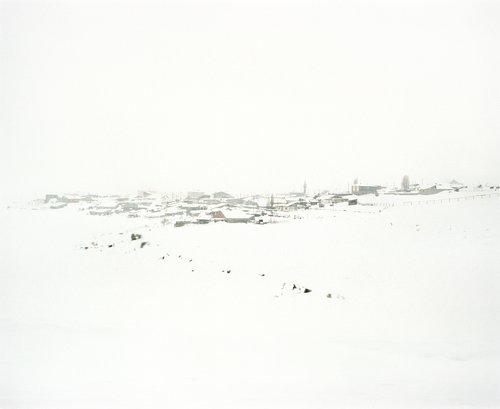
Travel lies at the very heart of Ton Centre, which is currently hosting two creative projects: the exhibition ‘Change of Co-ordinates’ and the opera ‘Moscow–Petushki’. The exhibition is a collaboration between Ton Centre, Serene Gallery and the Siyaniye Centre for Contemporary Art in Apatity. Siyaniye’s resident artists spent ten days in Apatity, a town in the Murmansk region, carrying out research, and the art on show is the result of their endeavours. Curator Alexander Blanar then added some other works by artists represented at the Apatity centre.
The exhibition design is evocative of the kind of improvised displays you might see in waiting rooms at airports or railway stations. The works, all by contemporary Russian artists, hang on temporary walls and mesh panels. The unifying idea is the currently fashionable notion of synergy. This unprecedented collaboration between institutions (Ton Centre and Siyaniye, founded by television presenter and art collector Andrei Malakhov) and various contemporary art practitioners is supposed to ignite a new and dynamic alliance. In practice, though, an exhibition in a waiting room tends to remain an exhibition in a waiting room.

On display are portraits by Nikita Kroko with a negative-image effect. Photographs by Anastasia Tsayder (b. 1983) of abandoned rooms in a Soviet institute, printed on transparent acrylic glass, rest on a shelf. Artem Lyapin’s (b. 1996) thorny frame casts a deep, ominous shadow on the wall. Inside it, an insect worked in repoussé, with wings of bobbin lace, appears to struggle. Mayana Nasybullova (b. 1989) has fused erased memories (barely distinguishable photographs of faces) into drops of resin that resemble amber. Misha Moiseev makes furniture modelled on shaped wooden shingles with a stepped profile. This is the so-called ‘lemekh’ roofing used on the domes of wooden churches in the Russian North.
Each work is interesting in itself and has been painstakingly executed. Taken together, however, they resemble an institutional progress report on the problems of contemporary art, with variations on a set theme. The subject of ‘Change of Co-ordinates’ turns out to be somewhat blurred. Memory fused into amber, with its erased photographs, could just as easily be found on the Baltic coast. And negative portraits against a dark blue background could belong to the depressive melancholy of St Petersburg.

I see several reasons for this arbitrariness in an exhibition intended to explore new territories, and they seem to me to be linked to the format of the grant commission. A ten-day trip always ends in a product of diplomatic compromise. Souvenir impressions of unfamiliar exoticism are overlaid with the ambitions of capitalist institutions seeking to promote new names. The result is something slightly simulated, adjusted to expectations of art with a vernacular, local flavour. It matters little whether it is shown at the Venice Biennale on the theme of Africa or at Ton Centre on the theme of the Arctic. The prevailing atmosphere is that of a waiting room, where scattered fragments of impressions never coalesce into a powerful energy of participation, empathy and co-creation.
That energy of participation and empathy was fully shared at the performance-opera ‘Moscow–Petushki’. It is even surprising that one of the central existential texts of 20th-century Russian literature, Venedikt Erofeev’s prose poem ‘Moscow–Petushki’, has only now been transformed into a grand musical production (although, according to composer Petr Aidu, there have been local attempts in Kyiv and St Petersburg).

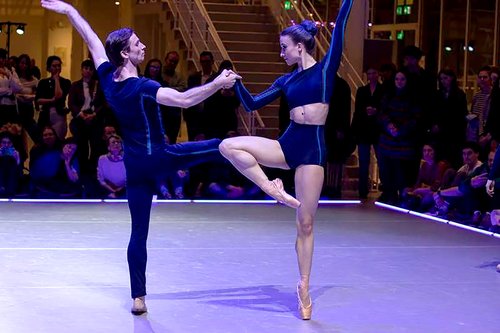
The new adaptation was initiated by Ton Centre’s artistic director and the opera’s stage director, Katya Bochavar, composer Petr Aidu, and librettist, musician and actor Grigory Krotenko. Together with the Persimfans orchestra, the vocal ensemble N’Caged, choirs and dancers, they staged a work which, to my mind, matches Erofeev’s text in the power of its effect. The text itself is in many ways poetry in prose (hence its designation as a poem). Its plasticity resembles a fresco depicting the existential suffering of a restless soul. All of world culture appears to us, refracted through a distorted, grotesque consciousness, as a collage of works by Bruegel, Dostoevsky and the Socialist Realists. The creators of the opera have turned it into a metaprogramme that breaks with every established convention of an ordinary spectacle.
Petr Aidu found the music in the sound of the text itself, in a tape recording of Venedikt Erofeev reading its chapters. By his own account, he merely presented the text as recitative and song, magnifying its sound. Aidu is the creator of a distinctive genre of sound landscapes, or soundscapes. He extracts sound from the most ordinary objects, transforming the surrounding space into a universe of sounds. This is, in fact, the principle on which the opera is built. The Persimfans orchestra gives voice to the Kremlin chimes, the pealing of bells, the rustle of angels’ wings and the drunken commotion of a station café. The remarkable musician-performer Grigory Krotenko, accompanying himself on the double bass, sings all the recitatives of the protagonist, Venichka, who has set off on an apocalyptic drinking tour and unexpectedly becomes the soloist of an ancient chorus and an Evangelist.
The musical narrative follows the hallucinatory wanderings of the restless soul of the protagonist, Venichka. The grotesque, cabaret-like style evokes the avant-garde (Dmitri Shostakovich’s satirical ‘Rayok’, the compositions of Alexander Mosolov and other early Soviet composers) and the theatre of Bertolt Brecht. Sonic imitations of sexual orgies sit alongside exquisite pastiches of Baroque arias. The montage of the action is like an absorbing physical performance based on the principle of synaesthesia. We seem to touch the very substance of sound, enter into it and meditate within it. In one episode, the choristers and soloists simultaneously read lines from the poem about choosing a president outside the wine and vodka shop in Petushki. A hum of spoken phrases fills the hall, their meaning indecipherable. This is an asemic narrative, in which there is no linear meaning. Intonation and the production of sound become essential. The effect is akin to contemplating a good abstract painting.

Like Virgil in Dante’s ‘Divine Comedy’, Venedikt Erofeev, and now Aidu’s team, lead us through the worlds of culture, from time into eternity. In Erofeev’s work, different epochs come into play; in Aidu’s opera, different musical styles are brought together in a montage. Rock and folk give way to Baroque arias, Romantic music to aleatoric music, sound art to Orthodox prayer. In the finale, the hero departs into eternity to the sound of the prayer ‘Give Rest with the Saints’. Like an echo, it shimmers into an endless perspective. All that remains is the panorama of railway tracks at night and trains gliding beneath the windows, their passengers becoming the heroes of the opera ‘Moscow–Petushki’.
According to Katya Bochavar, ‘Moscow–Petushki’ will enter Ton Centre’s repertoire. Further performances are planned for 2027.