

Triggers of Tradition

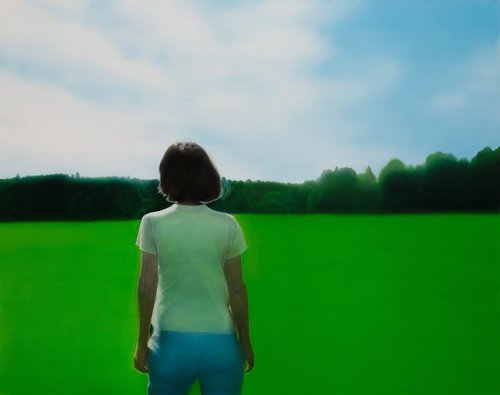
Dmitry Kolistratov. Misinformation, 2020. Russian Metamodernists. Exhibition view. Novosibirsk, 2026. Courtesy of Novosibirsk State Art Museum
A travelling exhibition ‘Russian Metamodernists’, now making its way across Russia’s state museum circuit, presents an ambitious attempt to define a new artistic generation. Bringing together accomplished painters shaped by rigorous academic training, it proposes metamodernism as a serious contemporary movement. Yet the very coherence of that claim remains uncertain, and it is precisely this tension between artistic strength and theoretical fragility that gives the exhibition its interest.
A travelling exhibition with the simple yet rather pompous title Russian Metamodernists is currently making its way across Russia. Its journey began in 2025 in Krasnodar, since then it has been in Nizhny Novgorod and is now on view in Novosibirsk. In May it will head to the Russian Far East, before finishing up in the capitals, Moscow and St Petersburg. Notably, the exhibition is hosted throughout by state institutions rather than independent galleries.

Russian Metamodernists. Exhibition view. Novosibirsk, 2026. Courtesy of Novosibirsk State Art Museum
The show features a large roster of strong artists: Evgenia Buravleva (b.1980) and Egor Plotnikov (b.1980), Masha Safronova (b.1979) and Anton Kuznetsov (b.1973), Timofey Smirnov (b.1980), Ivan Korshunov (b.1983), Vladimir Migachev (b.1959), Viktor Ponomarenko (b.1987), Anastasia Kuznetsova-Ruf (b.1983), Daria Kotlyarova (b.1980), among others. Most of them are graduates of the famed Surikov Institute in Moscow. They possess both reputation and authority, have undergone rigorous academic training, are skilled in classical draftsmanship, and nurture ambitions to reconcile such training with the challenges of the present.
In their program, the artists venture a bold claim: that metamodernism constitutes a new artistic movement—one they represent, just as earlier generations once rallied under the banners of Impressionism, Symbolism, or the avant-garde. It is, indeed, a risky assertion. First, because what unites these artists stylistically are shared principles that remain largely rooted in the culture of the late twentieth century. These include hyperrealism and mystical realism—the dominant tendencies among post-Soviet graduates of the Surikov school who have had the audacity not to become decorators of monumental public murals.

A glitch-like, surreal flickering of alien objects and images disrupts the carefully constructed realism of Timofey Smirnov. A metaphysical light seems to radiate from within the park landscapes of Evgenia Buravleva. The convulsions of space collapsing into a black hole instill dread in the urban visions of Vladimir Migachev. Office workers and kindergarten children suddenly become participants in infernal carnivals in the spirit of Hieronymus Bosch and Pieter Bruegel the Elder in the paintings of Masha Safronova.
In every case, we encounter a foundation of classical composition, constructed according to the principles of old master painting, the legacy of the Peredvizhniki, and Soviet art. Yet this compositional order is then strained, crumpled, and disrupted. Alien, often absurdist elements are inserted; logical coherence is fractured; planes are collaged. Similar strategies were already explored by Soviet modernists and postmodernists. Baltic photorealists, for instance, skillfully blended the lessons of Soviet art education with American Pop Art. Artists associated with the Leipzig School in the former German Democratic Republic—such as Neo Rauch (b.1960) —have long incorporated abstraction into realist compositions structured according to nineteenth-century conventions. The blunt, poster-like aesthetics of Soviet expressionism have likewise reshaped academic painting since the 1990s and 2000s. It remains unclear, then, why similar practices, as presented by graduates of the Surikov Institute, should be labeled metamodernism.

Russian Metamodernists. Exhibition view. Novosibirsk, 2026. Courtesy of Novosibirsk State Art Museum
Perhaps the answer lies in the contradictions and insufficiently concrete nature of the term itself. What these artists present in their travelling exhibition might best be described as eclecticism. In a positive sense, this eclecticism involves assembling a montage of different “trigger” techniques within the framework of traditional art. Yet this is precisely what orthodox postmodernists once did.
One might recall, for example, the British filmmaker Peter Greenaway (b.1942). In his films, he often took historical subjects—biographies of great painters and composers, or the plays of William Shakespeare—and rendered them in the lush visual language of Baroque painting. At the same time, he fractured this pathos through ironic, disruptive interventions, deconstructing the narrative and exposing the futility of any attempt to fully coincide with historical authenticity. In postmodernism, irony became synonymous with honesty in speaking about the past in the language of the present.

In their commentaries, the new Peredvizhniki—metamodernists—invoke the founders of metamodern methodology, the Dutch philosophers Timotheus Vermeulen and Robin van den Akker. As early as 2010, they authored what has come to be known as the Metamodernist Manifesto. At its conceptual core lies a crucial idea: the swing— or, in more rigorous philosophical terms, the atopy of metaxis.
The atopy of metaxis denotes a condition of being nowhere (“atopy”), of existing in a state of in-betweenness (“meta”). Such a condition resembles a perpetual evasion of final, weighty answers to the so-called “accursed questions.” It was precisely such programmatic answers—promises of a radiant future and the inevitable happiness of humankind in a communist earthly paradise—that modernism was prone to. At the same time, the atopy of metaxis implies an escape from the all-corroding cynicism and skepticism of postmodernism.

What emerges, then, is the amplitude of a swing. In one’s texts—whether visual, verbal, musical, or architectural—one seems to oscillate between nihilism and irony on the one hand, and elevated meaning and pathos on the other. Yet one never fully adheres to any position, never coincides with it. One becomes, instead, an ideal surfer.
It is perhaps precisely such traffic between academism and punk that the new painters—these metamodernists—have in mind. Yet for all the appeal of this proposition, certain questions arise, questions that even the theorists of metamodernism themselves have not resolved. These were articulated with particular clarity by Russian philosopher and cultural theorist Alexander Pavlov in his preface to the Russian edition of Metamodernism, published in 2019.
The first question is this: what, in essence, distinguishes metamodernism from postmodernism? Metamodernists consciously and openly “borrow” their philosophical foundation from earlier doctrines—above all from one of the central figures of postmodern thought, American writer and theorist Fredric Jameson (1934-2024). In scholarly terms, they are thus eclectic. References to value-laden meanings within an atmosphere of total skepticism and self-reproducing quotation already existed in some of the finest works of the postmodern era—in the films of Peter Greenaway and Wes Anderson (b.1969), in the paintings of Neo Rauch, and in the objects of Matthew Barney (b.1967).

Indeed, at the present exhibition, the imagery of graduates from the Surikov Institute seems to inherit themes from both Erik Bulatov (1933-2025) and the duo Komar (b.1943) and Melamid (b.1945). Breakthroughs toward value-based meaning undoubtedly occurred in earlier generations of artists. Thus, there is little genuinely new to be found in such metamodernist continuity.
The second question: why does ‘metamodern’ succeed ‘postmodern’, rather than precede it? After all, the notion of the ‘in-between’ would logically come before the ‘post’. This somewhat schizophrenic sequence, I would argue, is explained by the fact that metamodernism is a method devised in the offices of academic institutions, rather than one forged through the lived course of history itself. As such, it lacks the capacity to adapt formally across different registers of existence. It resembles a project blueprint assembled from pre-existing conceptual forms, yet lacking the flesh of its own language.
Finally, the third question: in the 2010s, the world still existed within a relatively stable cocoon of a predictable future. It was therefore easier to speak of a ‘turn of history’ as something foreseeable and intelligible. The catastrophic events of recent years have not only torn to shreds the End of History as proposed by American political theorist Francis Fukuyama (b.1952), but have also forced us to abandon any attempt at producing even a moderately coherent or comfortable prognosis. The world now hangs in a state of suspended time. Any attempt to describe it risks being simultaneously archaic—already outdated—and premature.


Metamodernism, too, has aged prematurely. From a youth, it has instantly turned into a somewhat boring old man—kind and likable in his sentiments, yet, sadly, no longer quite “getting it”. A collection of good paintings by good artists under the banner of metamodernism explains very little today. Perhaps it would be more honest to recall the well-known Soviet art historian Alexander Kamensky, who titled his book on young artists of the late Soviet period ‘Romantic Montage’.