

Soviet Dreams in Today’s Moscow

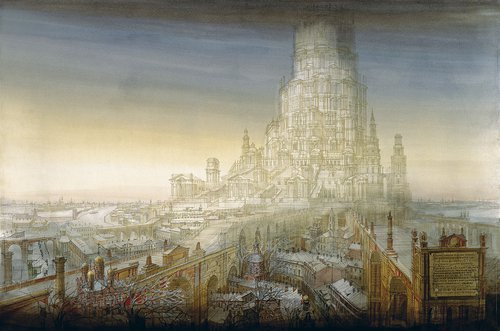
Konstantin Zvezdochetov. Types of Moscow: typhosis and paparazzi (diptych), 2003. Courtesy of Vladey
The Soviet past continues to exert its presence on Russian art today. Artists and curators actively return to its key figures and events, as well as to the everyday life and atmosphere of the period. Above all, they revisit the USSR’s final decades – a time that has left a lasting imprint on the present, shaping contemporary realities and the outlook of those living in Russia today. Across many practices, we can discern a range of strategies for engaging with the Soviet legacy.
Konstantin Zvezdochetov (b. 1958) is currently showing at VLADEY at the Atlants with an exhibition titled ‘A Picture-Maker as a Guest at a Gallerist’s’. Among the works on view is his canonical ‘Artists – to the Metro Builders’ (1992), first exhibited at documenta IX in Kassel. The monumental mosaic panel depicts a trio of caricatured villains from the beloved Soviet comedy ‘Kidnapping, Caucasian Style’ (1967). Recast in a language that recalls Moscow Metro decoration, the film still is elevated into a kind of post-Soviet sublime: mass culture hardens into something looming and imperious – an image that presses down on the viewer and resists domestication. Zvezdochetov has long mined these fragments of the post-Soviet cultural unconscious. At times he stylises his imagery in the idiom of Soviet caricature; at others he filters “foreign” realities through Soviet optics – grotesque gangsters or screen beauties from Western cinema, as they might appear in a late-Soviet imagination. Throughout, he injects the unfolding disorder with an extreme wit and cultivated absurdity. Only by working at that pitch – laughing without sentimentalising – can he approach a past he knew first-hand rather than by hearsay, a past whose chapters were not only formative, but often deeply unpleasant.

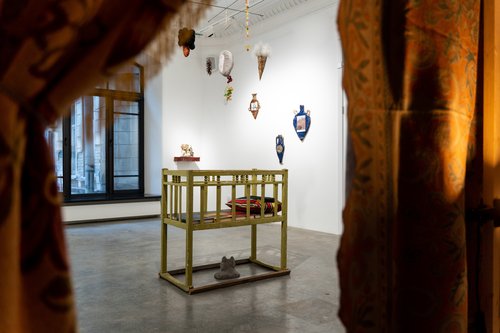
Konstantin Zvezdochetov. A Picture-Maker as a Guest at a Gallerist's. Exhibition view. Moscow, 2026. Courtesy of Vladey

Konstantin Zvezdochetov. A Picture-Maker as a Guest at a Gallerist's. Exhibition view. Moscow, 2026. Courtesy of Vladey

Konstantin Zvezdochetov. A Picture-Maker as a Guest at a Gallerist's. Exhibition view. Moscow, 2026. Courtesy of Vladey
Olga Chernysheva (b. 1962) approaches late-Soviet reality in an entirely different register. In her solo exhibition ‘Dream Street’, held last year at Moscow’s GES-2 House of Culture, she seemed at first glance to be depicting material realities more typical of the 1990s–2010s. Yet a closer look reveals that, in mood, her photographs, drawings – and especially her videos – directly inherit the visual language of the Brezhnev-era “stagnation”: its hush, its suspended time, its melancholy. We encounter faces that are closed off and unwelcoming, or, conversely, a demonstrative absorption in some small task – an evident effort to forget, if only momentarily, the weight of existence. The atmosphere recalls the worlds shaped by filmmakers such as Kira Muratova and Roman Balayan. These concerns will return again in Chernysheva’s forthcoming solo exhibition, ‘From the Paper Sheet’, at Moscow’s AZ/Art centre.

Olga Chernysheva. Dream Street. Exhibition view. Moscow, 2025. Photo by Daniel Annenkov. Courtesy of GES-2 House of Culture

Olga Chernysheva. Dream Street. Exhibition view. Moscow, 2025. Photo by Daniel Annenkov. Courtesy of GES-2 House of Culture

Olga Chernysheva. Dream Street. Exhibition view. Moscow, 2025. Photo by Daniel Annenkov. Courtesy of GES-2 House of Culture

Olga Chernysheva. Dream Street. Exhibition view. Moscow, 2025. Photo by Daniel Annenkov. Courtesy of GES-2 House of Culture
There is yet another example. The title of the group exhibition at Shift Gallery, ‘Will This Last Forever?’ – curated by Andrei Vasilenko – plays on Alexei Yurchak’s celebrated study ‘Everything Was Forever, Until It Was No More’ (2006). Yurchak, an anthropologist and Professor at the University of California, Berkeley, traced the USSR’s final two decades: the “high” Brezhnev-era stagnation; the brief Andropov interlude of the “iron fist”; the era of “races on gun carriages” (the successive state funerals of General Secretaries); and, finally, Gorbachev’s perestroika. Taken together, these phases formed a period of acute systemic crisis. What Yurchak captures is the paradoxical speed of the transition: from a barely maintained semblance of stability – what he famously terms society’s “hypernormality” – to catastrophic turbulence. That turbulence culminated in the collapse of the USSR and continued to reverberate across the post-Soviet world for years thereafter. His book has already served as a conceptual touchstone for curators addressing the stagnation period. In 2020, for instance, a team at the State Tretyakov Gallery led by Kirill Svetlyakov presented a wide-ranging, contradiction-filled panorama of late-Soviet culture in the major exhibition ‘Not Forever. 1965–1985’.

Unlike the project from six years ago, Vasilenko does not interweave official and unofficial art. His protagonists are either direct participants in the artistic underground – Leonid Sokov (1941–2018) and Sergey Mironenko (b. 1959) – or artists working in that same lineage: the Blue Noses group (Vyacheslav Mizin (b. 1962) and Alexander Shaburov (b. 1965)), Diana Machulina (b. 1981), and Kutya (b. 1981). Somewhat apart stands Denis Kryukov (b. 1977), who comes from a dynasty of thoroughly official artists yet, in his own practice, operates on the terrain of the underground. There is, however, something that unites both exhibitions. Svetlyakov’s project was, quite literally, a major museum study; and Vasilenko, though working within a small gallery space, approaches his subject on a similarly museological scale. With greater resources, he would almost certainly have produced a more expansive and ambitious project – a possibility already suggested by the way the display feels cramped within the available premises. Yet this enforced density ultimately works in the exhibition’s favour. It immediately evokes the Soviet “housing question,” so acutely felt for decades, and it also conjures the stifling atmosphere created by ideological pressure and cultural prohibitions.

Alongside Yurchak, Vasilenko has another guiding star: Boris Groys’s essay ‘The Communist Postscript’ (2005). From it, the curator takes the proposition that, unlike the capitalist project – whose primary medium was money – in the socialist world this role was performed by language, and above all by an ideological sign system. It is precisely to that system that the exhibition’s participants return.
The first association is, naturally, the propaganda and agitation that permeated Soviet life. Sergei Mironenko’s monumental polyptych ‘I Have Nothing to Say to You in the Language of Art’ (1990) shows a figure holding a blank white sheet. His entire stance – arm raised, body turned half to the side – signals an impulse to address an audience, to speak out. Yet his lips are sealed. Across the four upper canvases, the mouth is literally locked shut by a red rectangle, directly recalling the schematic, ironically flattened “slogan” format developed within Sots Art and Conceptualism. Across the four lower canvases the “slogan” migrates onto the sheet of paper, but the mouth remains closed. The character reads as a typical intelligentsia figure: someone who wants to articulate an individual thought, yet whose utterance dissolves into the ideological stream – or who simply does not dare to speak, out of fear of punishment.

Kutya’s ‘Protective Mechanism’ (2026) reminds us that ideology is not only slogans; it is also the texture of everyday life. The quotidian is saturated with representations that remake reality in their own image. Kutya’s textile collage – two children’s blankets, deliberately and loosely stitched together and decorated with embroidered cats and flowers – carries the uneven breath of shortage and improvisation: the disarray of domestic life, the poor quality of consumer goods (state resources diverted toward the arms race). The object points to a familiar late-Soviet strategy: quite literally assembling new things from old ones, with newspapers and magazines full of practical “how-to” columns devoted to such life hacks. With time, this domestic inventiveness can even acquire a certain warmth. But, as the saying goes: the picture may be funny – the situation is frightening.

Blue Noses are represented by the video ‘Props for a Revolution’ (2003), in which the artists parody the textbook iconography of “popular revolt” drawn from the Soviet legendarium, and by two works from their recent series ‘The Kaliningrad Münchhausen’ (2025). The first stand-collage stages a scene featuring Yuri Andropov, Allen Dulles, and Marilyn Monroe. It is accompanied by a mock-instructional text about the machinations of Western intelligence services intent on “corrupting” Soviet youth, as well as a multiple-choice test designed to “reinforce” the material. In the second work from the series, a contemporary character enters: the singer Larisa Dolina, recently notorious for a scandal surrounding the sale of an apartment. Here she offers Lenin money from the German General Staff – money he refuses.
This luxuriant fantasy is rooted in the underground culture of Soviet anekdoty: short jokes circulated orally, accumulating the discontent of citizens who had no means of speaking publicly. Yet even in genres that appear transgressive, ideological constructions often persist in surprisingly orthodox form, merely becoming further entrenched in consciousness. One is tempted to suggest that today’s memes – performing a largely analogous social function – operate in much the same way.

Denis Kryukov likewise proceeds from the culture of the Soviet anecdote: profound, encouraging, or bitter, and often threaded through with literary classics and films that “everyone” knew – a point at which his approach converges, simultaneously, with both Zvezdochetov’s and Chernysheva’s. Kryukov’s works from 2023 to 2025 capture an everyday visual lexicon at its most mundane level: candy wrappers, habitual street scenes. Drawn in liner pen, these images are punctuated by short phrases – “Wake up,” “Scattered to the four winds” – and sometimes by entire micro-scenes: “Each time he accidentally rode past his stop, Andrei Vasilyevich thought: ‘Never mind – our street will have its holiday too.’”
Standing apart is a sculpture by the late Sots Art classic Leonid Sokov: ‘A Broken Soviet Coat of Arms’ (1988), made at the moment when the USSR had entered a fatal dive despite repeated emergency attempts at modernisation. Unlike Sokov’s often comic works, here no clear joke is detectable. Through the crumbling plaster emblem, artificial fur sprouts like grass. Paraphrasing Vladimir Mayakovsky (1893–1930), the ship of state has been wrecked against everyday life. Sokov records the system’s collapse with a stark, almost documentary dryness – though in reality it would not come until three years later.
All the works described deploy different strategies. Each takes Soviet reality – its relics, or their contemporary reverberations – and translates it into a register legible even to viewers who, by virtue of age, did not live through the final decades of “real socialism.” Groys is right: to treat that period as a semiotic system is to make its images – repressed from memory, or absent from it altogether – translatable into a language one can quickly learn to speak. This Soviet “alphabet” seems to have lodged itself in the unconscious. When viewers encounter exhibitions that address this stratum of inner life, even without extensive textual framing, they immediately register familiar notes. And once caught, dense and tangible figures, objects, and situations begin to crystallise out of the “music” of that spirit. Words are spoken; stories are told.

The question, then, is not how precisely this substance corresponds to historical fact (most likely, not very), but how one is to coexist with such dreams. One must learn – but there are no teachers: only oneself, only experiment, and the willingness to take risks.
Konstantin Zvezdochetov. A Picture-Maker as a Guest at a Gallerist's
Moscow, Russia
26 December 2025 – 5 April 2026
Olga Chernysheva. From the Paper Sheet
AZ/Art Centre for Contemporary Art
Moscow, Russia
27 February – 17 May 2026
Will It Be Forever?
Moscow, Russia
11 February – 28 March 2026