

Rerooting the Body: Vulnerability as Subversion in Contemporary Art

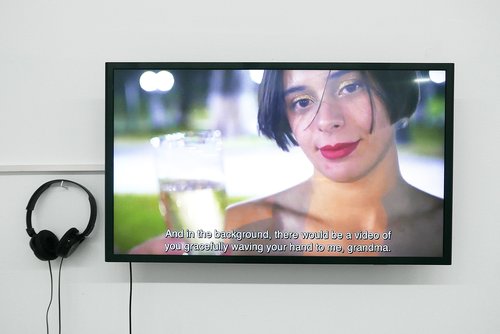
Andrea Fajgerné Dudás. Come into My Arms, 2017. Courtesy of the artist
Increasing numbers of millennial artists from Eastern Europe are exploring the female body as a site of political resistance. From intimate self-portraits to powerful performances, they are challenging patriarchal norms and state control through raw vulnerability and radical honesty. Their art transcends traditional boundaries, transforming personal trauma into collective testimony.
Recently walking past the graveyard in my sleepy coastal town in Montenegro, I caught sight of some new graffiti depicting a male and a female figure holding a bow between them, strung with an arrow which was pointing at the woman’s heart. It was not some logo of a football club or rock group but a depiction of the legendary performance of Marina Abramović (b. 1946) and Ulay (1943–2020) called ‘Rest Energy’ which they did in 1980.

Abramović has become a pop icon; where the female body has been a core subject in the history of art for centuries, depicted, analyzed, theorized until it seems everything that could be said has been said, it leaves us asking ourselves what potential for real subversive change remains today? Does the female body still hold avenues for genuine artistic expression, or have radical gestures been absorbed into a consumable spectacle? Contemporary female artists working across Eastern Europe, might provide the answer.

A recent exhibition of the work of Maria Kapajeva (b. 1976) in Tartu, ‘By Losing Them, I Become a Whole’ is about her preventive double mastectomy following a genetic diagnosis. Her scarred chest, the altered body, the flat plane where breasts once were, the direct and unflinching self-portraits in the exhibition which document the process and result are arresting – but why? This is photography as evidence – documentation of what patriarchal culture expects women to conceal. “To this day, a woman's body whether its pain, illness or lived experience – is often treated as ‘other’, constrained by rigid gender norms and medical bias. Rather than embracing the complexity of womanhood, society continues to mystify and objectify women, reducing them to narrowly defined roles,” read the opening text to the exhibition, curated by Šelda Puķīte. The vulnerability in her images is factual, not metaphorical. Her body testifies to trauma, survival, altered flesh but also her reality and her wholeness.

The decision to remove her breasts without implants was, she explains, a revelation to herself: “It was fascinating how my body reacted. I suddenly realized this is one of the struggles I’ve had with my body all my life, pretty much since my breasts started to grow, always the feeling they are too big, always kind of frustrated about having them.” Six months post-surgery, she finally feels at home and whole in this new version of her body.
By refusing to hide her scarred chest, Kapajeva reclaims bodily autonomy from both medical authority and gendered beauty standards. Her reference to Sarah Lucas’s 1996 ‘Self Portrait with Fried Eggs’ becomes a continuation rather than critique – transforming Lucas’s provocative gesture into something more radical. Kapajeva’s self-portrait is titled simply ‘Portrait of a Woman’, insisting on the fundamental question: what does it mean to be a woman? Her nakedness isn't provocative – it is evidentiary. This happened to my body. I survived it. I won’t hide it.

Kapajeva also underwent the removal of her ovaries in an oophorectomy that triggered a surgical menopause and by documenting her final monthly period she also brings this topic into the public domain, recalling an earlier work of hers, a set of 30 T-shirts printed with the sentence: “My life function is not related to motherhood.” Her work deliberately disrupts this silence around the invisibility of women’s health and queer embodiment. The mastectomy, she reflects, made her queerness feel “more grounded in the body... my body now better represents for me the queerness which I always felt inside.”

Her exhibition extended beyond personal testimony with ‘The Transformation of Silence’ which are bell sculptures cast from breasts, creating a growing collective archive. Women who have experienced cancer, mastectomies, or simply resonate with the work contributed casts that will eventually hang alongside Kapajeva’s own. The bells give sound to unspoken experiences, each with its individual tone – a metaphor for giving voice to what patriarchal medical systems demand ought to remain silent.

Hungarian artist Andrea Fajgerné Dudás (b. 1985) works at the intersection of painting and performance to confront what remains taboo about the female body – motherhood, breastfeeding, and domestic labor. She examines the role of women in society through her personal experiences.
“Both the canvas and the body – my own body – are projection surfaces through which I convey social messages. I show my own fat body with all my blemishes, stretch marks and cellulite because I keep it beautiful, and I feel good in my skin. My own body is my model, I paint myself as Venus, and I strip naked in my performances if my message requires it. I am not ashamed to show my body. My body is the canvas.”

Her positioning as a female artist from Eastern Europe is crucial to an understanding her work. This geographic and ideological liminality – caught between Western feminist models and post-socialist realities – shapes her artistic approach to the female body, which refuses both Western consumer feminism and Eastern conservative nationalism. Like Kapajeva, she uses painting and self-portraiture to make visible what systems – medical, domestic, political – expect women to hide. Her “in between” position – geographically, politically, aesthetically – becomes a site of critique rather than limitation, questioning both Western and Eastern models of femininity and their claims on women’s bodies.

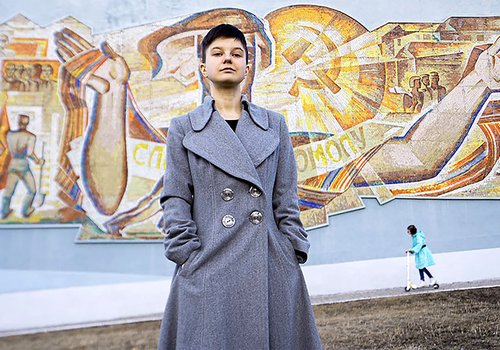
Where Kapajeva and Dudás use their personal bodily experiences as a gateway to broader issues, Katrin Nenasheva (b. 1994) uses her body as proxy for those whose suffering remains institutionally invisible. Sometimes labeled as part of a ‘third wave’ of Russian actionism – though such labels risk flattening the complexity of her practice – Nenasheva’s work diverges sharply from the spectacular confrontations of earlier actionists: the staged heroic, photogenic provocations of Pussy Riot and Petr Pavlensky designed to reveal state repression.


Art historian Angelina Lucento reflects that Nenasheva turns away from “direct confrontation with the masculine spectacle of state power” toward what might be called an aesthetic of care. In her characteristically lengthy performances – for three weeks she carried a metal bed frame chained to her back, stuck needles in her feet, dressed the wounds of orphanage survivors, documenting their scars, embodying and drawing attention to the punishments suffered by those in state institutions. Nenasheva’s method uses her visible, performing body to testify to invisible suffering.
This is not art for galleries – in recent years her practice has increasingly shifted to the realm of social work – with people with disabilities, Ukrainian refugees in Russia, teenagers with addiction issues. Following her own arrest, Nenasheva even organized support groups in prison, she described creating community behind bars: “In my cell there were girls who had been arrested for a repost, or for attending a protest, so we connected pretty quickly and organized support groups for one another... We organized a cool union for ourselves – it was communism, in the best sense.”

She sees this organizing as inherently political: “For me it is a political act, because I feel uniting people is very important and necessary... Some mechanisms of mobilization are important in Russia, like community practice, because people, including artists and activists, are acutely separated from one another.” Her work with marginalized populations – prisoners, psychiatric patients, orphans – makes her body a vessel for state violence that would otherwise remain hidden. The bow and arrow of ‘Rest Energy’ pointed inward, turned into an instrument of witnessing systemic cruelty rather than interpersonal trust.


The work of Alisa Gorshenina (b. 1994) evades state systems of control, although she herself has fallen victim to them on multiple occasions. She reroutes and re-roots the female body into nature via archaic folk traditions. One of the central images of her works transforms her own blood vessels into tree roots. Gorshenina describes the convergence as natural: “I like that these are essentially different things, but they connect into one. As if nature becomes more humanized.” Or perhaps more accurately: as if the human body reveals its fundamental continuity with earth, soil, root systems. The veins become roots; the body reroots itself in ground that predates and exists beyond governmental control.

She describes this connection through what she calls “Ural Coma” – a term for the specific psychic weight of living in industrial Ural cities. “People here live as if sitting in an iron box, crushed by the city, but inside them still sits an animal that demands reunification with nature,” she explains. “This can be perceived as fiction, but sometimes I think that the Ural Coma is more real than I myself am.” Her work offers an escape route from that iron box – not through confrontation with the state but through remembering the body’s animal nature, its rootedness in earth that predates industrial extraction and urban suffocation.
“I do not work with existing myths,” she reveals. “I rather create and live in a revived myth.” These are the myths of her grandmother and father, stories where mountains are frozen serpents, where tree trunks look like hair roots, where the great snake Poloz crawled around the earth and dove into the ocean. “In my art, nature is something animate, alive. I like this intersection.” Her anatomical self-portraits insist on the body as simultaneously personal and political.
Where Kapajeva’s body testifies to medical and social systems and Nenasheva’s witnesses state institutional violence, Gorshenina’s body connects to something older: folklore and ritual from the Urals demonstrating the body-nature continuum before patriarchal systems entered to sever it. In her work the vulnerable female body doesn't confront the state directly but circumvents it by reconnecting to sources of strength outside state frameworks entirely.

This sentiment is echoed in the work of Lithuanian artist Eglė Budvytytė (b. 1981) who creates choreographed performances that become videos accompanied by songs she has written, featuring both male and female bodies. ‘Songs from the Compost: Mutating Bodies, Imploding Stars’ (2020) explores decay, decomposition and the mutation of living organisms with a posthumanist and ecofeminist agenda situating the human body in nature to blur and question the boundary between body, environment, and the organisms within it. Performers writhe horizontally in forests and sand dunes, their movements mimicking and blending into the landscape as a way to “embrace the creature dimension, the animal ancestor within us.”

The costumes, created in collaboration with artist Marija Olšauskaitė (b. 1989), were buried in the ground to partly decompose before being worn – literally incorporating earth and decay into the performers’ second skins. This process of material transformation extends Budvytytė’s exploration of bodies as permeable, subject to the same processes of breakdown and renewal as any organic matter.
Budvytytė will represent Lithuania at the 61st Venice Biennale next year. She describes the upcoming project: “We’re readying for a deep dive into the ideas that have been feeding us in recent years – the intimacies of relations between land and bodies, ritual and the power of collectivity.”

What unites these artists is a deliberate use of vulnerability as a political tool. Not vulnerability performed for empathy or aesthetic consumption, but vulnerability as evidence against systems of power. The bodies – naked, scarred, enduring, exposed – testify to what authoritarian structures want hidden: medical trauma, state violence, institutional neglect.
This is the radical potential of body-based work. As Kapajeva reflects on medical bias and bodily control: “In both systems – capitalism and communism – it is all patriarchal which ultimately sees the female body as a reproduction body, but also as less important and less valuable.” The refusal to hide bodily “imperfection,” institutional damage, or complicity becomes a political act of reclaiming ownership from state, medical, and capitalist systems that claim women’s bodies as territory.
The body as witness, as evidence, as political statement. In an era when even radical art gets absorbed by institutions and markets, perhaps the images that survive, that get claimed and reproduced on walls are the ones that still feel transgressive. The ones that remind us: This is real. This matters.