

Reimagining the Artist Book

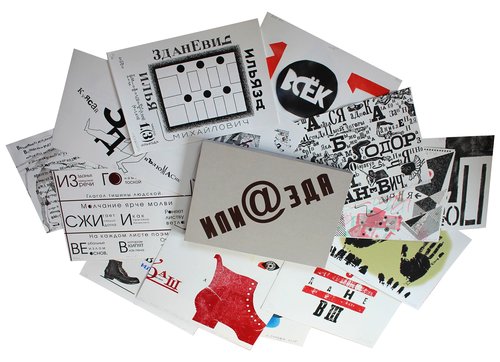
The Face of New Art: The Russian Futurist Book. Exhibition view. Moscow, 2025. Courtesy of V.I. Dahl State Museum of the History of Russian Literature
Two Moscow exhibitions explore the genre of artist books from 1910s Futurist publications to 1990s works by the late Alexander Konstantinov. Meanwhile, contemporary Russian artists like Igor Ponosov and Anastasia Albokrinova continue experimenting with artist books, creating interactive, evolving objects that challenge traditional boundaries between the viewer and a work of art.
There is currently not one but two exhibitions running in Moscow which explore the oft overlooked genre of the artist book or ‘livre d’artiste’. The V.I. Dahl State Museum of the History of Russian Literature has on display a selection of rare Futurist publications from the 1910s. Important writers from this circle such as David Burliuk (1882–1967), Vasily Kamensky (1884–1961), Aleksei Kruchenykh (1886–1968), Vladimir Mayakovsky (1893–1930) and Velimir Khlebnikov (1885–1922) collaborated with leading artists of their time notably Natalia Goncharova (1881–1962), Mikhail Larionov (1881–1964), Kazimir Malevich (1879–1935), Olga Rozanova (1886–1918) as well as many others. Across the city pop/off/art gallery has curated a show of artist books by Alexander Konstantinov (1953–2019) which he made in the 1990s.


If the artist book is sometimes assumed to be a forgotten genre, this is clearly not the case. Even if it is less frequently discussed today, artists continue to experiment with the form, expanding its possibilities in diverse and often unexpected ways.
Igor Ponosov (b. 1980), a St Petersburg – based artist widely recognised for his research into graffiti and street art, also works extensively with artist books. Over the past five years, he has produced at least five such works, all executed using collage – a method that is equally central to his wider artistic practice. ‘Through Images’ (2020), one of Ponosov’s most notable artist books, is held in the collection of the Garage Museum of Contemporary Art. The work is sewn together from ready-made materials – specifically fragments of fabric typically used for street banners. The metal eyelets of the banners are left visible, while photographic images are directly affixed to the surface. Another version of ‘Through Images’ forms part of the collection of the Street Art Repository in St Petersburg.

Igor Terentyev. Fact, 1919. Courtesy of V.I. Dahl State Museum of the History of Russian Literature

Aleksei Kruchenykh. Learn Khudogi (Artists): Poems, 1917. Courtesy of V.I. Dahl State Museum of the History of Russian Literature

Aleksei Kruchenykh, Velimir Khlebnikov. Mirskontsa (Worldbackwards), 1917. Courtesy of V.I. Dahl State Museum of the History of Russian Literature

Olga Rozanova. Aeroplanes Over the City, Illustration for the book 'War' by Aleksei Kruchenykh, 1916. Courtesy of V.I. Dahl State Museum of the History of Russian Literature

Aleksei Kruchenykh, Velimir Khlebnikov. Game in Hell: A Poem, 1912. V.I. Dahl State Museum of the History of Russian Literature
“The artist book removes the distance between viewer and creator,” Ponosov believes, “and I’m in favour of exhibiting books that are not contained in glass cases. Unlike canvas, installations or works on paper which you usually cannot touch, you can leaf through a book and you have a completely different experience of interaction. I also like the possibility of telling a story. In an artist book, the viewer follows a trajectory set by its creator. It is an exhibition in miniature: what otherwise require an entire hall can fit into one brochure. I like this kind of intimate scale, I generally value small objects more, ones you need to peer into. We are already surrounded by loads of hypertrophied massive stuff, whilst the value of art lies precisely in slowing down and switching attention to contemplating something that is difficult to notice.”


Another artist book by Igor Ponosov, ‘Conventional Signs’ (2022–2024), emerged as a logical continuation of his ongoing series ‘Imaginary Journey’, the materials for which he began collecting in the second half of the 2010s. The project is grounded in found ephemera – primarily ticket stubs and fragments of maps – which form the conceptual and material basis of the work. During the pandemic, when physical travel became impossible, Ponosov turned to this project with particular intensity. ‘Conventional Signs’ was presented publicly for the first time in 2022 at his solo exhibition at Syntax Gallery in Moscow, where the book itself was also exhibited. The project remains open-ended and continues to evolve to the present day. “In this book I construct non-existent spaces,” Ponosov explains. “I took not only modern tourist maps but also outline maps from my school days, and they were published back in the Soviet times.” The outline maps did not appear by chance. By their very nature, they are marked by “blank spots” that call out to be filled in – requiring, in a sense, rediscovery. Through this process, Igor Ponosov constructs an alternative space – time continuum, inviting the reader to journey into the past and step onto unexplored terrain. The subsequent development of the project follows a clear internal logic. More than two years after its first presentation, the book travelled with the artist across Europe, was exhibited in Germany and Switzerland, and – most importantly – continued to grow through successive additions. “Now it’s in storage in Strasbourg,” the artist notes, “and it’s not impossible that if I open it there on my next visit, I’ll want to add something again. This, incidentally, is another reason why I like the book – it can be added to. It’s a very living object, one that changes over the years.”

Moreover, this year in Essen, Ponosov, together with his friend and frequent collaborator American artist Brad Downey (b. 1980), conducted a week-long workshop on collective creativity and the birth of art from everyday practices. As part of this event, it was decided amongst other things to make two artist books with the combined efforts of participants and their mentors. “We stole a menu from an ice cream café,” Ponosov recalls “and filled it with photographs of our performances, inscriptions and stickers that we collected around the city. And we also attached road signs to the cover and found artefacts.”
However, the artist book as a medium does not, in principle, require adherence to conventional expectations. Ekaterinburg-based artist Anastasia Bogomolova (b. 1985) deliberately overturns its underlying logic. For Bogomolova, the handmade nature of the object and the labour invested in its production are of primary importance. In this emphatically processual project, launched in May 2025, she returns to material remnants from an earlier body of work, ‘Eurotour’ (2017–2022): a collection of receipts amounting to 212,866 roubles and 62 kopecks—a sum that also lends the new publication its title. Following her own devised method, Bogomolova transforms these receipts into handmade paper, which will form the physical basis of the book itself. Visually, the work is conceived as “a hybrid of a long till receipt and a travel map,” and will incorporate a detailed financial report of the expenditures referenced in the title, alongside photographic documentation of movement and reflective commentary on the uncertainties and contingencies of artistic practice. The edition, whose precise production method remains intentionally open, will comprise twenty copies for sale and two additional artist’s copies.

'Albanac’ (2020), a lightbox book by Samara-based artist and curator Anastasia Albokrinova (b. 1987), is also held in the collection of the Garage Museum of Contemporary Art in Moscow. As the title suggests, the name is a portmanteau formed from the word ‘almanac’ and the artist’s surname. The book is produced entirely using graphic editing software and printed with ultraviolet ink on plastic; however, its physical construction and mode of engagement decisively distinguish it from conventional zines and printed publications.
“The basic idea behind this project is a collection of collections,” Albokrinova explains. “The book has five chapters, each a kind of list of similar things: sunsets on the Volga, fragments of words, newspaper texts crossed out, heraldic monads, autobiographical objects. For me, a collection is something that exists not in sequence, but in the unity of time and space. A collection is all its elements at once, and only the direct experience of interaction determines which will be encountered first and which second. That is why I wanted ‘Albanac’ to be not a book you leaf through from beginning to end, but a construction kit – one in which each viewer chooses for themselves which chapter or page to look at.”


Therefore the lightbox book is arranged like a wooden casket. A light panel is installed at the bottom, and the chapters are stored in the lid. “Each chapter is assembled in an envelope as a stack of transparent pages,” the artist explains. “Placing them on the light base, we concentrate on a specific unit of meaning. But we can also resist the set rules – play, overlay and combine.”
So far ‘Albanac’ only exists in a single copy. But at the Garage in February 2026 at an upcoming exhibition ‘The Female Artist’s Book’ Albokrinova plans to present a new version of the lightbox book. “The original ‘Albanac’ turned out to be too complex,” the artist admits, “and does not work without using a thoughtful approach or mediator. The new version will be reduced to three chapters, which will be distributed as separate objects, all remaining as casket-lightboxes, and their content will be updated and reworked. Such a form will make it possible to reveal the structure of each ‘collection chapter’ and make the experience of independent research more accessible.”

The Face of New Art: The Russian Futurist Book
V.I. Dahl State Museum of the History of Russian Literature
Moscow, Russia
22 October 2025 – 29 March 2026
Reflections. Artist Books. Alexander Konstantinov
Moscow, Russia
8 November 2025 – 30 January 2026