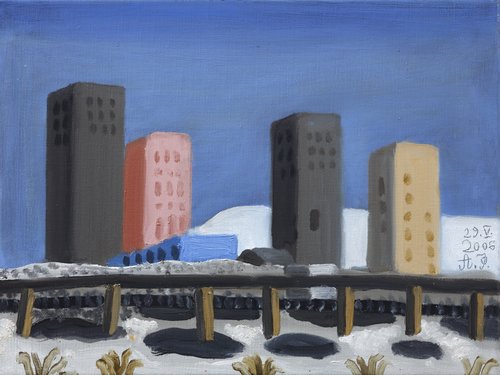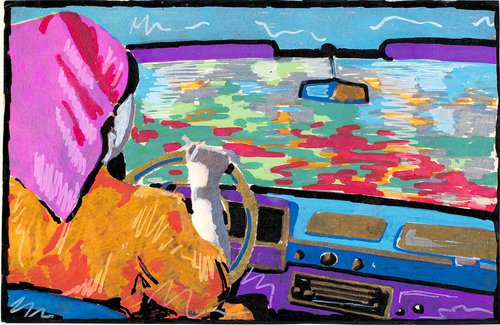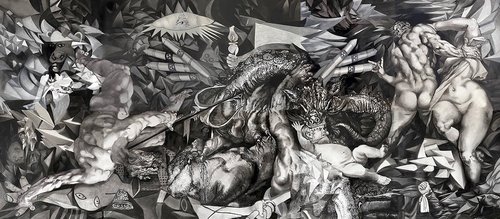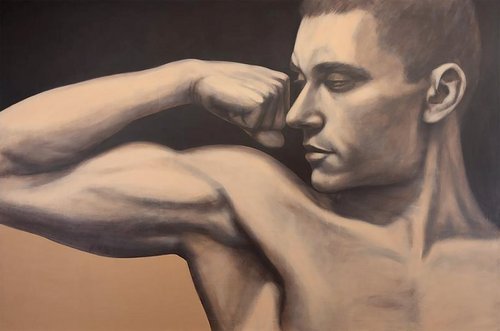


Ivan Razumov. Progress, 2026. Courtesy of Ovcharenko Art
How Russian Artists Are Appropriating Art History in 2026
Copyism has become the new black of Russian contemporary art, while “museumness” serves as its obligatory dress code. Alexander Florensky’s exhibition ‘A Brief History of Art’ at the Veretyevo Art Estate on the outskirts of Moscow offers a particularly eloquent example of this tendency, revealing how artists increasingly retreat into a self-contained world of quotations, reproductions and reimagined masterpieces, creating art that speaks less about reality than about art itself.
A Russian country estate is scarcely complete without art. The Veretyevo Art Estate, some 110 kilometres from Moscow, occupies the grounds of a former Young Pioneer camp and has become renowned for a distinctly Russian cultural programme, where literary readings flow naturally into evenings at the bathhouse, and boat trips lead to exhibition openings. The new works of Alexander Florensky (b. 1960) are perfectly suited to this leisurely, aristocratic rhythm of life. In his recent series created in 2024 ‘A Brief History of Art’ Florensky revisits masterpieces from across the world, reimagining them through his own distinctive artistic lens.

Alexander Florensky is a prominent artist from St Petersburg and one of the founders of the Mitki movement, which at the turn of the 1980s and 1990s was arguably the most popular art group in Russia among the public at large. The Mitki ironically recreated the lifestyle of a “generation of janitors and night watchmen” – Soviet escapists of the seventies and eighties – with an emphasis on a vaguely nautical romanticism and a culture of drinking. The group’s ideologist, Vladimir Shinkarev (1954–2026), died in April 2026. The group itself effectively disbanded many years ago. Today, Florensky, like many Russian artists, spends a considerable part of his life abroad. Having settled in Tbilisi, he became curator of the Licht gallery there in 2022.
For the series ‘A Brief History of Art’, Florensky drew on more than eighty well-known paintings. The most frequently represented artist in Florensky's selection is, perhaps predictably, Niko Pirosmani (1862–1918) a Georgian naïve painter who is close to Florensky not only geographically but also stylistically. The most popular genre in Florensky’s temporary 'museum' is the still life: there are more than twenty of them – Flemish, Dutch, Spanish, and French visions of ‘natura morta’ by Ambrosius Bosschaert (1573–1621), Willem Claesz Heda (around 1593/1594–1680/1682), Juan van der Hamen (1596–1631), Jean-Baptiste-Siméon Chardin (1699–1779), and others – and they chime with the generous welcoming spirit of Veretyevo. Maritime and river scenes by the Dutch painters Adam Willaerts (1577–1664) and Willem van de Velde (1633–1707), or the French Claude Lorrain (1600–1682) and Claude Monet (1840–1926), recall the local pleasures of boating on the Dubna and the Volga. And Antoine Watteau’s (1684–1721) ‘The Embarrassing Proposal’ speaks to the kind of problems that can arise during a day out in the countryside.

Copying the Old Masters remains today a traditional staple in academic training. But it has also been an important strand in Russian folk culture and naïve art. Larissa Kashuk, a former head of the painting department for the second half of the 20th century at the State Tretyakov Gallery, spent many years assembling her own collection of Russian primitives, consisting of reproductions of canonical museum works made by naïve artists.
Florensky’s series not only quotes this tradition of the ‘folk copy’ but ironically reproduces ‘museumness’ itself – that is, the historically contingent, accidental sequence in which works by various artists, from different periods and genres, come to coexist within a museum. In each of ten canvases produced in the same size (140 by 100 cm), Florensky ‘glues’ different works together. Sometimes they rhyme with one another by artist or theme – a female figure paired with another female figure, a Pirosmani with a Pirosmani, a Flemish still life with a Dutch one. Sometimes they are joined compositionally: the line of the horizon in Monet, for instance, continues into the line of a bridge in Lorrain. Elsewhere, frequently, the pairing is absurd – an incongruous assembly, on the notional flat plane of a single canvas, of utterly disparate source images, held together only by the unity of the artist’s own hand: his palette and brushwork, the forms of faces or the manner in which leaves are rendered. The style Alexander Florensky has developed over many years is “neo-naïf” – painting executed by a professional artist who looks to the tradition of folk art.

Copyism is the new black of Russian contemporary art, and “museumness” its obligatory black tie, worn by artists of every generation and social milieu. Even at the most informal and fleeting of Moscow’s recurring exhibitions – the Bolotnaya Biennale, held from 29 to 31 May 2026 on the rooftop of the Moscow Palace of Youth – the trend was impossible to miss. The emerging artist Katerina Vasilyeva presented corrugated-cardboard versions of the ‘Mona Lisa’ and ‘Girl with a Pearl Earring’, reduced to little more than their instantly recognisable silhouettes and displayed within a booth resembling a miniature gallery. At the other end of the spectrum, Ivan Razumov (b. 1972) mounted an exhibition at Ovcharenko (Vladey), one of Russia’s oldest independent commercial galleries.
Razumov took canonical Russian paintings of the 19th century as his starting point and transformed them. He inserted Valentin Serov’s (1865–1911) ‘Portrait of Isaac Levitan’ (1893) into Levitan’s (1860–1900) own painting ‘Above Eternal Peace’ (1894), so that Levitan, in the guise of an almost Sabaoth-like figure, looms out of the clouds above his own landscape – pointing, at the level of metonymy, to the “inner meaning” of the original, which many of Levitan’s contemporaries perceived as an image of the divine, mediated through the depiction of Russian nature. Both originals have been in the collection of the Tretyakov Gallery since 1894, purchased by its founder, Pavel Tretyakov. Razumov’s ‘Levitan Above Eternal Peace’ (2026) was first shown to the public at Art Moscow fair earlier this year. Isaac Levitan was one of the most refined colourists in late nineteenth-century Russia. Razumov’s manner of execution is strikingly unlike the personal styles of either Levitan or Serov: this is Levitan and Serov, joined by the steady hand of a craftsman trained at the Surikov Institute.

‘The Flying Carpet’ (1880) by Victor Vasnetsov (1848–1926) is a canonical ‘fairy-tale’ Russian painting: Prince Ivan returns triumphantly to his homeland with the magical Firebird. The monumental canvas, close to three metres in width, is one of the best-loved works in the collection of Nizhny Novgorod Art Museum. In ‘Free Flight’ (2026), Razumov has removed Prince Ivan and the Firebird from the composition entirely: what remains is only an oriental carpet, hanging aimlessly above a brooding Volga landscape. By stripping the painting of its central motifs – the hero’s victory and his homecoming – Razumov has deconstructed the myth. What is left is only anxiety, uncertainty, and the emptiness of the signifier. A condition that gives expression to the reality of Moscow in 2026.
All that has filtered through from the museum are its endlessly reproduced images, degraded and distorted. They multiply and disappear by turns, generating a false world of pseudo-likenesses, synthetic forms that are sometimes absurd, sometimes caricature-like – for they reproduce Russian realism and historicism of the 19th century without its painterly tension and its metaphysical and/or nationalist and/or socially critical pathos. Razumov’s painting is like the shed skin of a rattlesnake: the leathery husk retains the shape of the snake but can no longer bite.

This turn to the classical tradition is particularly pressing in Russia today because any authentic conversation about urgent contemporary problems is difficult if not impossible at times. Contemporary subject matter is a minefield for an artist, who risks triggering a charge of “LGBT propaganda,” or straying into the territory of the “AUE subculture” (a term that can in theory encompass the widest imaginable range of cultural phenomena, from Russian chanson to gangsta rap) or sinking into the swamp of “discrediting traditional spiritual and moral values” (a formulation capacious enough to be applied to virtually any image that makes critical use of Russian or Soviet symbolism). The number of prohibitions and restrictions keeps growing, and it is easier for an artist to withdraw into a cosy cell of “art about art” – work that describes itself on its own terms.

Ivan Razumov. Museum Exhibition. Part One. Appropriations and Reconstructions
Moscow, Russia
27 May – 5 July 2026
Alexander Florensky. A Brief History of Art
Moscow Region, Russia
23 May – 13 September 2026