

How Artists Are Fighting Back Time

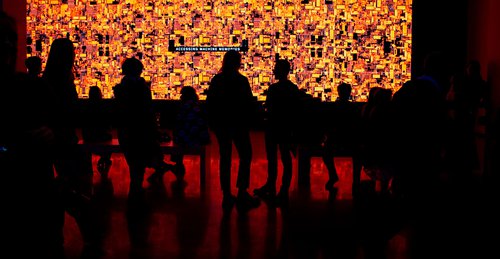
No/Time. Exhibition view. Moscow, 2026. Photo by Yulia Tsyganova. Courtesy of M2 Gallery
Two new exhibitions in Moscow, a solo show of work by millennial artist Asya Zaslavskaya ‘The Path of Time’ at pop/off/art gallery and ‘No/Time’ at M2 gallery provoke a reflection on how contemporary artists engage with time and the mechanics of how we measure it – clocks.
At pop/off/art gallery in Moscow almost colourless, snow-like shards are on display – artefacts of memories and fragments of life. Fragile and barely perceptible images coexist with brutal and heavy ones. Naïve paintings with few flowers hang next to a banal neon sign advertising a florist shop. The flower drawings resemble a child’s exercise book covered in little doodles. It serves as a reminder of times long past where special moments in time were lovingly captured in albums with pictures from nature and poems. And the pages of these albums were interlaid with dried flowers.

There are two dimensions of time present in this solo exhibition dedicated to Asya Zaslavskaya (b. 1998). One of them is brutal and heavy like the kind of clock mechanism you might find on official governmental buildings. This time is depersonalised and indifferent, like the florist shop sign. It moves inexorably, crushing individual lives and destinies beneath it. The other dimension: personal time, hard-won and fragile. It is captured in the exhibition not only in the drawings with flowers. There are the white canvases with embroidered pearls which are barely visible. They look like pinheads and become pricks of time, those punktums that Roland Barthes wrote about, meaning the pricks of unyielding reality in the art of photography. These punktums are like concretely lived moments, not staged by art, where life is placed on a pin head. Under your feet in the centre of the exhibition space there are silver ice flakes. They remind you of the Snow Queen’s broken mirror in Hans Christian Andersen’s famous fairy tale. The shards of the Snow Queen’s mirror are scattered across the world. One of them got into the eye of the boy Kai. His heart turned into an ice flake. He wanted to freeze the course of time in the halls of the Snow Queen. There he tried to assemble the word ETERNITY from ice shards, but never managed to complete it.

Broken and traumatised time expresses a personal existential drama. One might want to forget it, but it gives no rest and is constantly disturbing. Fragments of a clock face hang on one wall of the gallery. On the opposite wall there is a Swiss wall clock. The body rotates around its axis clockwise. An excellent image of fixing an alarming event.
Observing Asya Zaslavskaya’s interesting exhibition made me reflect on some examples in contemporary art where figures representing time are made into works of art and become a cardiogram of existential experiences.

Of course, one can begin in prehistory, with the eternal Salvador Dalí (1904–1989). In his work, flowing, melted time lives in paintings, the most famous of which is ‘The Persistence of Memory’ (1931). Art historians believe that in this image Dalí captured the theme of transience, simultaneously the non-linearity of time, the relativity of ideas about world order.
Images of clocks have long been placed in paintings in which characters seem knocked out of the usual flow of time. For example, in Dutch still lifes on the theme of vanitas, vanity of vanities, images of clocks symbolise the futility of all earthly glory. They are depicted next to a skull, precious jewellery, attributes of the arts and sciences. And they seem to illustrate the theme not of time, but precisely of timelessness, of falling out of the race of vain human affairs in the finale, where Death rules the ball. Salvador Dalí became the heir to the fixation of this tragic dislocation of the space-time continuum.

At the turn of the current millennium, many artists have continued exploring themes of personally endured time. A parallel to Asya Zaslavskaya’s clock faces can be found in two clock faces of wall clocks in the installation ‘Untitled’ (‘Perfect Lovers’) by Felix Gonzalez-Torres (1957–1996). The work includes a pair of identical wall clocks positioned close to each other. They touch and always show the same time. This time, in the opinion of art historian Robert Storr, symbolises the desire for happiness, as well as the wheel of fortune, in which glory can turn into disappointment and deprivation. Two clock faces hanging next to each other are also perceived as resilience in the face of trials, the ability to be together despite all circumstances (including queer censorship). Gonzalez-Torres’s partner Ross Laycock died of AIDS. Aware of his friend’s diagnosis, the artist formulated the following: “We are synchronised now and forever. I love you”.

The theme of traumatic experiences of figures of time as images of personal memory is embodied in the conceptual easel paintings. For example, the half-erased and seemingly decay-covered figures and forms in paintings by Luc Tuymans (b. 1958), on the one hand, make one recall the native Belgian tradition of depicting time as a witness to the transience of all earthly things. On the other hand, these fragments of the past snatched by memory, of the past washed away by new events, are associated with Barthes’s punktum, pricks of unstaged reality, the most honest scratches of identity. In Russia, a similar existential melancholy in half-erased images imitating decay-covered photographs was captured by Eduard Gorokhovsky (1929–2004). Today the Nizhny Novgorod artist from the Tikhaya Workshop, Alexei Starkov (b. 1993) can be considered his heir.

Asya Zaslavskaya. The Path of Time. Exhibition view. Moscow, 2026. Photo by Evgeniya Senina. Courtesy of pop/off/art gallery

Asya Zaslavskaya. The Path of Time. Exhibition view. Moscow, 2026. Photo by Evgeniya Senina. Courtesy of pop/off/art gallery

Asya Zaslavskaya. The Path of Time. Exhibition view. Moscow, 2026. Photo by Evgeniya Senina. Courtesy of pop/off/art gallery
The clock mechanism in contemporary art can also become a theme of artistic reflection. Artist Dmitry Morozov (::vtol::) (b. 1986) invents various retro-mechanisms, sometimes resembling working clocks with the outer case removed. These mechanisms live their own life, they don’t care about our emotions. They knock, click, moan, sob. Morozov shows them as ruins of time. These ruins of time become the quintessence of the retrofuturism style. Asya Zaslavskaya’s clock face rotating around its own axis also interestingly engages with such a nostalgic idea.
The ‘No/Time’ exhibition at M2 Gallery, curated by Anastassia Loktaeva, presents the multiplicity of ways of understanding time and even its abolition (hence the particle ‘no’ appears). The exhibition generalises many of the themes touched upon above. “We understand ourselves through time and time through ourselves,” says the curator. The exhibition has gathered together leading artists from different generations of contemporary Russian art. According to the idea of the curator, the exhibition is divided into three narratives. The first: linear, positivist time, flowing along the broad road of life, captured, for example, in a stretched and wound rope in nature in a 1978 action by the group ‘Collective Actions’ (the work was called ‘Time of Action’).

Asya Zaslavskaya. The Path of Time. Exhibition view. Moscow, 2026. Photo by Evgeniya Senina. Courtesy of pop/off/art gallery

Asya Zaslavskaya. The Path of Time. Exhibition view. Moscow, 2026. Photo by Evgeniya Senina. Courtesy of pop/off/art gallery

Asya Zaslavskaya. The Path of Time. Exhibition view. Moscow, 2026. Photo by Evgeniya Senina. Courtesy of pop/off/art gallery

Asya Zaslavskaya. The Path of Time. Exhibition view. Moscow, 2026. Photo by Evgeniya Senina. Courtesy of pop/off/art gallery
The second narrative: eschatological time with traumatic experience of death and hope for Resurrection. This is the time of Christian history, and it is captured, for example, in the mirror surfaces in installations by Slava Nesterov (b. 1989). If one peers into the gleaming metal mirrors, one can see engraving with half-erased inscriptions and layered images of angels which appear to move. New technologies and mediaeval affect from encountering the miracle work together unexpectedly convincingly.
In this same section, photographs by Polina Rukavichkina (b. 1995) are interesting. In one of them a wall with a scar is photographed: pieces of insulation and parts of the wooden framework stick out through torn plywood cladding. Under this scar is a winged angel painted on plywood. A precise formula of today’s melancholy with questions tormenting us about the departed sacred dimension of life.

The third section can be conditionally called: private time, intimate and part of a real person’s life. The St Petersburg artist Grekht (b. 1989) has constructed a wooden structure from old parts of tables, chairs, cornices, balusters, poles. It has turned out rather like an altar or cradle, under which stands a wooden automobile assembled from toy fragments. It personifies an invisible protagonist. Like ::vtol::, Grekht shows personal time through the tactile experience of worn, ruined structures living their own life.

When reflecting on all these examples, conversation about time seems to avoid the ‘future’. A melancholy of ruins reigns everywhere. Probably, in our traumatic time such a view is understandable. Sergei Mironenko (b.1959) who belongs to the younger generation of the artists of Moscow Conceptualism, offers some perspective on time as a moveable feast. At the ‘No/Time’ exhibition he presented a work called ‘Past – Future’. This is a wooden model of a scale with a movable arrow that goes from Past to Future and back. At each concrete moment in time we are free with our own hand to determine the degree of our optimistic or pessimistic well-being.
Asya Zaslavskaya. The Path of Time
Moscow, Russia
4 February – 1 March 2026
No/Time
M2 Gallery (Entry by appointment on the gallery’s website)
Moscow, Russia
13 February – 30 March 2026