

Data-Art. Always Collecting

For millennia, gathering knowledge meant preserving a bond between representation and reality, observer and observed. Yet as we feed the lived experience of billions into the maws of generative algorithms, that anchor has been severed. In a society where every digital action can be tracked, analyzed and weaponized, the concept of data must be reclaimed as a site of new ethical struggle.
Data is not new - what has changed is our relationship to it. In writing ‘Living in Data’, the Canadian artist Jer Thorp (b. 1974) looked at the word “data” in 10,325 articles published in the New York Times between 1984 and 2018. He found that its semantic companions had shifted from relatively neutral terms like information and digital toward a more visceral constellation: scandal, politicians, disinformation, friends, life and games. This trajectory is telling: data has become a lived environment. To use Shoshana Zuboff’s term, we leave ‘digital exhaust’ whenever we use our devices – data pooling on servers as patterns and traces, a kind of testimony to who we are.

The contemporary world’s discourse—communicating through this “exhaust” – was taken up by the Moscow-born, New York – based artist and new media theorist Lev Manovich (b. 1960), who coined the term ‘data art’ in the early 2000s. In his 2014 project ‘On Broadway’, Manovich and his team built an interface: a spatial data map of Broadway and its adjacent streets that operates as a sociological mirror. Layering 660,000 Instagram photos with additional datasets, they render the “soul” of the twenty-first-century metropolis through the activity of its inhabitants. In doing so, Manovich echoes the Russian avant-garde filmmaker Dziga Vertov (1895–1954), who nearly a century earlier captured the pulse of a new public via montage – everyday movements assembled into the analytic vision of ‘Kino-Eye’. For both Vertov and Manovich, data becomes a diagnostic instrument for dissecting the collective – yet the same techniques, of course, can be turned toward very different ends.
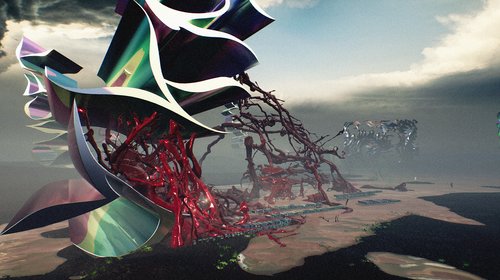
Istanbul-born, Los-Angeles-based Refik Anadol (b. 1985) inherits this logic of aggregated visibility, but the diagnostic intent has been inverted. In ‘Machine Hallucination,’ 100 million photographs of New York scraped from aross social media teach a Style GAN2 ADA algorithm to generate a math-ghost of the metropolis across 1025 latent dimensions of sorted pixels. The result is spectacular, immersive – and divorced from urban experience. This is no ‘Kino-Eye’ observing the surroundings – the ‘Machine-Eye’ observes its own latent space. If Manovich uses data to reveal society, Anadol uses it to reveal the algorithm; the city becomes a coordinate to be mined for aesthetic vibrations. “If a machine can learn, can it dream, can it hallucinate?" Anadol asks, positioning himself to bridge human memory and future generations.
Applied to the anonymous digital exhaust of Instagram, this approach produces a certain spectacle, but when Anadol turns the same machinery toward MoMA’s 136,000 digital scans of artworks created through specific historical struggles and political commitments, the collision of interpretations makes the ethical friction emerge. Is art history a source of disparate colours and textures? Watching Anadol perform a secondary act of colonization, transforming artistic visions into enormous fluid screensavers, one witnesses the aestheticization of extraction itself.

Dataland, the first museum of AI art under Anadol’s direction, set to open in a Frank Gehry-designed Los Angeles development this spring, may mark a turning point in whether new institutional context can reshape how we encounter algorithmically generated work. Dataland’s collection now centres on Anadol’s own projects, including outputs from his Large Nature Model, a novel generative AI system trained on what is described as the most extensive “ethically sourced” dataset of the organic world, captured across the planet through lidar, photogrammetry, ambisonic audio and hi-res video techniques. Though in the digital age we must learn to always ask ourselves the questions: for whose benefit is this? Who controls the intelligence and for what purpose? The vocabulary of sustainability and ethics might sound like a wrapper for the same extractive practice.
In ‘All Data Are Local’ (2019), media researcher Yanni Loukissas argues that data always carries the imprint of place, time and circumstances of origin; it is never universal or neutral, and always local in its consequences. To acknowledge this locality, to see data as embedded in specific contexts capable of feedback and revision, is to work with it as cultural artefact.
Russia-born Helena Nikonole, artist, independent curator and educator working across European institutions, investigates the mechanics of that extraction as a site of subversion. In “The Other View” she exposes how surveillance data becomes training data by hacking IP cameras monitoring a mirror gallery. As visitors arrive to take selfies in Kusama-style infinity room installations, they are caught in two simultaneous surveillance streams: one an overhead documentation of bodies moving through space, the other capturing the staged selfies of visitors laboring for Instagram. Who watches and why determines the meaning of the data. By feeding these social media images into a neural network in the second iteration of the project, Nikonole demonstrates the feedback loop at the core of contemporary society: people liquidate their privacy into data assets, which trains systems that then dictate how people perform.

Refik Anadol. Machine Hallucination. Exhibition view. New York, 2019. Artechouse NYC. Image from Refik Anadol's website. Courtesy of the artist

Refik Anadol. Machine Hallucination. Exhibition view. New York, 2019. Artechouse NYC. Image from Refik Anadol's website. Courtesy of the artist

Refik Anadol. Machine Hallucination. Exhibition view. New York, 2019. Artechouse NYC. Image from Refik Anadol's website. Courtesy of the artist

Refik Anadol. Machine Hallucination. Exhibition view. New York, 2019. Artechouse NYC. Image from Refik Anadol's website. Courtesy of the artist

Refik Anadol. Machine Hallucination. Exhibition view. New York, 2019. Artechouse NYC. Image from Refik Anadol's website. Courtesy of the artist
Situatedness is activated by the St. Petersburg-born, Tokyo- and Vienna-based artist Egor Kraft (b. 1986) through a form of “reverse archaeology”: a research practice in which gaps in our knowledge of the past are examined – and provisionally filled – via machine learning. In his ongoing ‘Content Aware Studies’, Kraft works with a dataset of thousands of 3D scans of damaged classical friezes and sculptures from institutions worldwide, including the Pushkin State Museum of Fine Arts in Moscow. He deploys the algorithm as a synthetic agent of historical speculation, reconstructing missing details and generating multiple plausible versions, each equally contingent. By foregrounding the fact that our idea of the ancient is, in part, an accident of survival, Kraft exposes the seams of the past. The generated, normalized forms – once governed solely by classical canons – remain tethered to specific objects and to specific histories of damage, excavation, restoration, and loss. When these smoothed, augmented versions are carved back into marble, they produce a strange vertiginous effect: they make visible, at once, what we have – and what we have misplaced to time.

Working with data as kinetic force rather than representation, Moscow artist Dmitry Morozov (::vtol::, b. 1986) explores speculative co-existence with inorganic agents. A tentacled prosthesis of ‘Adad’ reacts real-time to lightning strikes worldwide; each strike, a point of meteorological data, is converted into a physical hammer-tap against one of twelve piezoelectric crystals. The released electrical discharges trigger light and sound. In ‘Poise→[d]’ ::vtol:: incorporates organic data, chemical and physical reactions linked to an algorithm to directly control the behavior of sound generation. Within these projects, data functions as an informational flux connected to material systems, maintaining its wildness even when routed through computational logic.

Katja Novitskova. Patterns of Activation (Jumping Spider, Termite Cathedral Mounds, Growth Potential). Image from Katja Novitskova's website. Courtesy of the artist

Katja Novitskova. Patterns of Activation (Deers Kissing, Vision Mode). Image from Katja Novitskova's website. Courtesy of the artist

Katja Novitskova. Patterns of Activation (C. Elegans). Image from Katja Novitskova's website. Courtesy of the artist
Tallinn-born Katja Novitskova (b. 1984) who is today based in Amsterdam tracks a different kind of locality. In her ‘Patterns of Activation’ series, she isolates photographs of animals from social media and materializes them as flat aluminum sculptures. By extracting these semiotic lures that generate significant internet traffic from their circulatory context and fixing them in physical space, Novitskova strips bare the economy of attention that produced them. Aluminum sculptures act as taxidermy for the internet’s viral impulses and preserve the moment before the scroll continues. More recently, she has turned this method inward, feeding documentation of her past shows into a generative model to produce ‘impossible’ combinations of her own work, approximations, rendering the results in material form. Data, these digital zombies reveal, is a network of relations and dependencies, shaped by what circulates (or what gets left behind).
In ‘The Language of New Media’ Lev Manovich recounts another story of cultural objects turning into data, the original sin of computing: starting in 1936, Konrad Zuse built the Z1, a prototype personal computer, in his parents’ apartment in Berlin, programming it directly onto defective 35mm film stock purchased from studios. On surviving strips, binary code can be seen punched over the original frames of interior shots. “Whatever meaning and emotion was contained in this movie scene has been wiped out by its new function as a data carrier,” Manovich states.

Just as the same dataset can yield different visualizations depending on methodology, artists demonstrate that data can function as a dynamic aesthetic medium shaped by the questions we pose to it. Whether we treat data as an anonymous commodity or acknowledge its locality (its pulse, its history, its embedded relations) determines what becomes possible. From this acknowledgment might emerge a radical potential: the possibility of working with data as cultural memory, as testimony, as situated knowledge rather than a mere extractable resource.