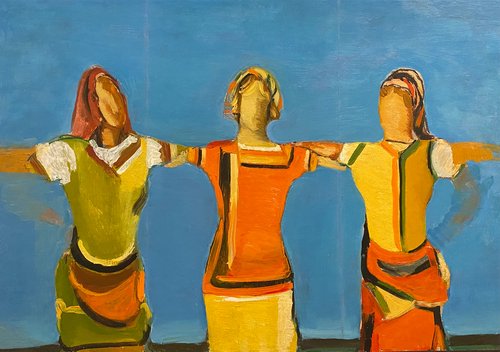


Burliuk’s Geese

David Burliuk. Return. Exhibition view. Moscow, 2025. Courtesy of House of Russian Abroad named after A. Solzhenitsyn
Although in the history of the Russian avant-garde David Burliuk is mostly associated with Futurism he experimented with many different styles throughout a long and eventful career. An exhibition in Moscow of works from his Bashkir period shines a light on a little-known side of this versatile artist’s oeuvre.
An exhibition of works by David Burliuk (1882–1967) has opened at the House of Russian Abroad in Moscow, a tightly curated show which combines works from two collections: the Bashkir State Art Museum named after M.V. Nesterov and the National Museum of the Republic of Bashkortostan.

David Burliuk has long been reduced to anecdote. If there is any Russian artist of the twentieth century about whom one could write an entire book of entertaining stories, it is he. From his very surname, his contemporaries – already during his lifetime – coined the intuitively intelligible verb to burliuk, meaning to behave outrageously, to play the fool with abandon.
In 1920 in Vladivostok, he fixed one of his dirty socks in the centre of a white canvas, having pulled it out from under his bed, and declared to the poet Nikolai Aseyev: “This will be the highlight of the exhibition. There will be a crush around this sock. Newspapers will write about it.” Many decades have passed, but Aseyev still recalled Burliuk's sock in conversation with Fyodor Levin, a man of letters and political worker.

Burliuk’s one life would have been enough to fill ten lives. He studied painting in Munich, Paris, Kazan, Odessa and Moscow, all the schools and academies leaving their imprint on him. He was one of the leaders of Russia’s first group of leftist artists, ‘Venok-Stefanos’ founded in Moscow in 1907. A few years later on a wealthy Ukrainian estate managed by his father, he organized the creative union Hylaea, the first group of Futurists in the Russian Empire. In 1912 he was the author of an article ‘The Savages of Russia’ for the almanac ‘Der Blaue Reiter’ published in Munich, a programmatic document of the European avant-garde. Vladimir Mayakovsky said of him: “Burliuk made me a poet.” And this is only the beginning of his biography as poet, artist, publisher, journalist, curator, impresario and patron.

The main characteristics of David Burliuk’s paintings are their mutability and omnivorous nature. “He is whatever kind of artist you like. If you need a realist, then Burliuk is a realist. <...> if you need an impressionist, Burliuk will show you dozens of his plein airs. If you need a neo-impressionist, you will find dozens of such canvases at Burliuk’s. If you need a cubist, futurist, stylist – as many as you like – there are hundreds of those. But which are the real ones? Who knows? Does Burliuk himself know?”, wrote the poet Alexei Kruchyonykh in 1934.

There are two explanations for this, and both are as old as Russian avant-garde. “You, like Christopher Columbus, are the only one to have discovered for us the America of New Art”, exclaimed the man of letters Vasily Kamensky in 1927. “Penetrating into the kitchens of his neighbours in art, he cooked up soups according to the recipes of others. He was like a special bureau for manufacturing paintings in many different directions”, poet and literary critic Sergei Spassky said in 1940. All three knew Burliuk not by hearsay: he was their closest comrade in the avant-garde.

The truth lies somewhere in the middle: ardent for everything new, Burliuk instantly assimilated and appropriated everything new that he saw and passionately propagandized it. He possessed the temperament of an innovator and the talent of a producer. But for him there existed no value difference between the folk paintings of a Ukrainian cottage and the abstractionism of Vassily Kandinsky (1866–1944), the realism of Ilya Repin (1844–1930) and a Japanese print. He absorbed everything and produced extracts.

David Burliuk was a postmodernist before postmodernism. In an eternal search of the new, he constantly negated his former self and constantly returned to his former self, which led and leads to numerous oddities with his legacy, because he did not hesitate to date his late American works sometimes to the years of the Russian Revolution, or even before it. And unlike Malevich (1879–1935), who reconstructed his own biography systematically, recreating and dating those works which according to his theory he should have consistently painted in certain periods of his development, Burliuk did this, it seems, chaotically and uneconomically, not caring about “art history”, but only about the present moment. That is, about sales.

In Russia, most of Burliuk's works have been preserved in Bashkiria. He preferred to spend the years of the First World War in places to which his wife was connected, the villages of Iglino and Buzdyak, where he harvested hay together with his father-in-law. A persistent opinion that he was hiding there from the barracks is hardly justified. David Burliuk had only one eye due to a childhood injury, and was not subject to conscription into the active army. Rather, he foresaw the coming famine, and as a family man, preferred to wait out the storm in a peaceful place. According to legend, in 1917 he took four Buzdyak geese to his metropolitan comrades (these geese were famed for being plump), but along the way the train stopped due to the revolution, the geese started rotting, and Burliuk threw them into a river and returned to his family. During 1918–19, he travelled via Omsk, Tomsk, Irkutsk and Chita to Vladivostok, and from there arrived by steamer in Japan on 1 October 1920.

In Russia, the first post-emigration solo exhibition of Burliuk took place in Ufa in 1987. The Ufa collection has particular value because it consists of works of art all from a specific period with clear provenance. It is unknown exactly how many works he created from spring 1915 to 1918 in Bashkiria and estimates range from the modest academic figure of 200 works to 1,500, the latter a fantastic number, if one does not take into account the artist’s unprecedented productivity (according to art historical researchers he brought back 350 sketches from a summer of study at the Odessa school). At present, Bashkiria possesses nearly forty of his works from the collection of the Ufa Proletarian Museum (now the Bashkir State Art Museum named after M.V. Nesterov), which was divided up in the 1920s into three unequal parts: the largest part is now kept where it once was, the smallest ended up in the Museum of the Peoples of the East (now the National Museum of the Republic of Bashkortostan), plus three Burliuk works were transferred to a temporary exhibition in the town of Zlatoust, and have never returned from there, and are kept today in the city’s Local History Museum (they are not included in this count and do not participate in the new Moscow exhibition). All 37 are exhibited together in Moscow for the first time.

Burliuk’s works from his Bashkir period demonstrate that the transition from the avant-garde to Socialist Realism in Soviet painting was neither abrupt nor accidental. On the contrary, these works anticipate that shift. In the steppes of the Urals, Burliuk developed a distinctive synthesis: a post-Impressionist painterly language combined with a resolutely realistic choice of subjects and figures. This very combination would, a decade later, become the hallmark of AKhRR (the Association of Artists of Revolutionary Russia), particularly after it absorbed the Bubnovy Valet (Jack of Diamonds) group.

Equally significant is Burliuk’s nationally inflected thematic focus – rows of Tatar children, views of mosques – which appears almost to answer a Soviet “social commission” well before such a mandate was articulated, and indeed before the establishment of Soviet power itself. In this sense, the Bashkir Burliuk could easily have taken his place among officially sanctioned Soviet artists.
While the exhibition sets out to present the work of the “father of Russian Futurism,” it ultimately reveals something more unsettling: that Russian Futurism had already exhausted its radical potential even before the Revolution.

David Burliuk. Return
House of Russian Abroad named after A. Solzhenitsyn
Moscow, Russia
16 October, 2025 – 1 February, 2026