

Beyond the Frontier: The Evolution of Migrant Art Spaces in Georgia and Serbia

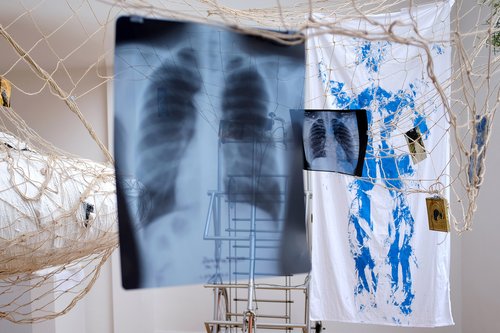
Tasya Asya. Grounded. Exhibition view. Tbilisi, 2026. Photo by Roman Savchenko. Courtesy of Rubezh
As a new wave of migration has reshaped the post-Soviet cultural landscape over the past few years, artists have been forced not only to relocate but also to reinvent the institutions that support their work. In Georgia and Serbia, a new generation of independent, community-driven art spaces is emerging, offering both creative refuge and a model for cultural resilience in exile.
Since the outbreak of conflict in the region in 2022, the post-Soviet space has been shaken by waves of migration. This powerful movement has spread across several popular destinations, with Georgia and Serbia emerging as two of the most prominent.
Tbilisi, which quickly became a new artistic and cultural hub, is now home to ‘Rubezh’ (‘The Frontier’), a cultural centre and the heart of Georgia’s migrant artist community. ‘Rubezh’ was founded in 2022 in Bishkek, Kyrgyzstan, in a private house shared by a group of friends. From the autumn of 2023, its basement became a shelter for refugees. A community largely made up of artists began to form around this group of friends, gradually transforming the house into an informal cultural space. Alsu Garapova, one of the founders of ‘Rubezh’, had the idea to do an exhibition and helped shape both its name and its concept. What was initially planned as a small exhibition evolved into a full-scale festival.
Co-founders Garapova as chief curator, and Andrei Morev as lead producer, describe the project as follows: “‘Rubezh’ stands for crossing borders. We have crossed physical borders, as well as mental ones, facing new realities, discovering new purposes, and meeting new people. It’s about surpassing multiple frontiers - that’s what we were trying to capture. The project reflects our lives and our most recent experiences.” To embody this idea, participation in ‘Rubezh’ exhibitions is open only to artists with personal experience of migration.

The first festival lasted for three days and centred on a contemporary art exhibition, accompanied by an extended programme of concerts and performances. The event significantly altered the local cultural landscape and drew attention to the co-living space as a cultural venue. Festivals soon became a regular occurrence, taking place every few months. In 2024, the community decided to relocate to Tbilisi for political reasons.
After moving to Tbilisi, they settled in a townhouse near the city centre. The space now hosts exhibitions, artist talks, film screenings, language clubs, and other cultural initiatives. It has already staged its fourth festival, ‘Rubezh: Death’. Since the first edition in Bishkek, each festival has carried its own subtitle. The most recent explored themes of passage, transformation, and memory.

‘Rubezh’s latest solo exhibition, ‘Grounded’, as the curatorial text states, “explores the afterlife of totalitarianism and post-Soviet realities.” The artist, Tasya Asya (b. 1992), presents an array of pseudo-archaeological artefacts, including ceramics, assemblages, and displays of found and gifted objects. Together, they construct a compelling image of what remains of a collapsed empire and what may be discovered among its ruins. Most of the installations communicate through miniature forms, doll-like proportions, a monochrome palette, and the intervention of strikingly ordinary everyday objects. Tasya Asya explores gravity as a fundamental force not only in physics but also in politics, examining its role within authoritarian systems. Her works combine serious themes with elements of interactivity, allowing visitors to move between unsettling subjects and moments of subtle humour.
Although ‘Rubezh’ has already begun to develop an institutional framework, Andrei and Alsu continue to emphasise: “We view the project as a ‘diaspora’ - not in an ethnic sense, but as a way to define the relationships within this artistic community. Community building remains our priority, with the main goal of creating a network to support those in need.” The project continues to evolve. A major collaboration between Tbilisi-based ‘Rubezh’ and the Turkish ‘Helicon Art Center’ is currently being developed as a multicultural artist residency. In the longer term, ‘Rubezh’ aims to establish an international network of “houses” – residencies for migrant artists that provide space and resources around the world.

In Serbia, the migrant community has also launched similar initiatives. However, in a country where a significant proportion of the population holds right-leaning political views and expresses support for the Russian authorities, immigrant-led projects face different challenges, including social stereotyping and a more difficult political environment.

‘KP Radionica’, a cultural space founded in 2024 by Russian-born artists and co-curators Nu Simakina and Nadezhda Lopardina, combines exhibitions with educational and cultural programmes, bringing together a predominantly migrant community. The group exhibition ‘Ne Ti Rusi’ (‘Not Those Russians’) held this Spring at KC Grad and co-curated by Nu Simakina, addresses stereotypes surrounding Russian-speaking migrants – such as assumptions of patriarchal values and imperial attitudes – in an effort to dismantle them, declaring: “These are Not Those Russians” (‘Ne Ti Rusi’).
The exhibition featured a number of works exploring some of the most common experiences of migration. One notable example is ‘Da/Yes’ (2026) by Elena Vasilieva (b. 1973), which intertwines text and texture, merging language and craft. It depicts a damaged landscape of a traditional hand-woven Serbian rag rug known as a krpara, with the word “Da” (“Yes”) appliquéd across its surface. The word appears to burrow into the fabric, becoming absorbed within its woven strands. Significantly, it is shared by both the Russian and Serbian languages.

Another striking work is the self-reflective installation ‘Hospitality’ (2026) by Nadezhda Lopardina (b. 1984), which speaks to the tension between personal convictions and the desire to avoid conflict when hosted by those who support authoritarian values. The installation highlights the conflict between tradition and individual choice. It consists of a table laid with a simple tablecloth, a bottle of vodka, the head of cabbage, and several cloves of garlic, inviting visitors to share both the experience and the offered refreshments.
Nu Simakina expands on the concept behind the exhibition: “We wanted to talk about the stereotype of the Russian immigrant – an IT guy who spends all day in a coffee shop opened by another immigrant, with neither of them making an effort to integrate. At the same time, we wanted to give visibility to this specific group of Russians who do not support the authorities at all. Our community is mostly horizontal; Nadezhda and I take the lead sometimes, but there is no permanent curator. It is also very important for us to stay open to any kind of collaboration.”

While other migrant-oriented spaces in Belgrade – such as ‘Nordistica Gallery’ (currently closing) and ‘WOONDER’ Studio (now permanently closed) – have struggled to survive because of financial difficulties, ‘KP Radionica’ continues its work.
Yet even Tbilisi-based ‘Rubezh’ has acknowledged its own financial difficulties. This raises a critical question: can community-driven, horizontally organised structures sustain themselves without stable funding or institutional support?
Projects such as ‘Rubezh’ and ‘KP Radionica’ reveal a shift in how contemporary art institutions are formed in times of crisis. These independent initiatives prioritise community care over commercial success and, in doing so, challenge traditional gallery models. In exile, where stability is elusive, precarity itself becomes both a creative strategy and a political condition.

Migration routes remain fluid. Artists move between countries, sometimes out of necessity, sometimes by choice. Yet the resilience of Russian-speaking artistic communities in Georgia and Serbia demonstrates that creative solidarity can outlast any border, and that making art in exile is not merely about survival it is about redefining what home, identity, and resistance mean today.