

Windows to the West: The Foreigners Who Collected the Soviet Underground

Dmitry Krasnopevtsev. Still Life with Tree and Jars, 1987. Fragment of the painting. From collection of Eric Peschler, Switzerland. Courtesy of Bonhams
The forthcoming sale of the Eric A. Peschler Collection at Bonhams, featuring works by some of the leading figures of Soviet nonconformist art acquired during Peschler’s long engagement with Russia, offers a timely reminder of the remarkable collections assembled by Westerners living and working in the Soviet Union. But these diplomats, journalists, academics and businessmen did far more than buy art: through their friendships, publications, exhibitions and patronage, they became vital conduits through which the Soviet underground first reached and was understood by the West.
From the late 1950s onwards, an extraordinary group of Westerners entered the private world of Soviet unofficial art. They included American diplomats and academics, German journalists, Swiss diplomats, Italian businessmen and publishers. Some assembled collections of hundreds or even thousands of works. More importantly, many subsequently wrote books, organised exhibitions, financed publications, introduced artists to museum directors and ultimately gave their collections to institutions.

The peculiar economics of unofficial art in the Soviet Union meant that these salaried diplomats, journalists and academics were able to assemble collections that would be financially unimaginable for people in comparable professions today. Works could be bought for exceptionally modest sums, exchanged for scarce goods or simply given to friends. But this is not simply a narrative about the power of foreign currency in a hermetically closed world. Many of these collectors – and certainly those who went on to assemble the largest collections – were essentially acting as art patrons and cultural philanthropists.
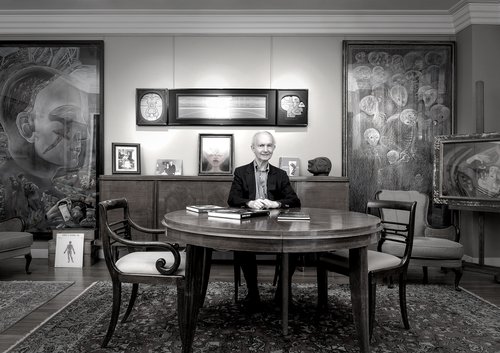
With hindsight there is a sense that these Western collectors formed a kind of community albeit scattered over decades because they often came from very similar backgrounds. There were the diplomats Peter and Allen MacDonald at the American Embassy; Arthur and Marillyn Odum; French cultural attaché Stéphane Tatischeff and his wife Anne; Swiss diplomat Martin von Walterskirchen and his wife Ursula; Italian diplomat Massimo Baistrocchi; and numerous others whose names have largely disappeared from the historical record but whom I have encountered over several decades since I started taking an interest in this field. There were journalists – Nina and Edmund Stevens occupied a particularly important position in Moscow’s unofficial artistic community, their home in central Moscow turning into an informal underground salon where artists and Western visitors met and socialised. The German correspondent Norbert Kuchinke became another committed collector and advocate. Then there were academics, towered over by Norton Dodge, whose initial reason for travelling to the Soviet Union was economic research rather than art. And there were businessmen like Alberto Sandretti who spent years in the USSR working on FIAT’s enormous Soviet automobile project and Jack Melkonian, a Swiss entrepreneur and textile engineer. Eric Peschler, whose collection comes up for sale at Bonhams this autumn, crossed several categories: journalist, writer, broadcaster, collector and eventually author of books on Moscow’s artistic world.

What emerged throughout the 1960s and 70s and lasted until perestroika was something hybrid: part social network, part informal art market and part cultural infrastructure, performing many of the functions that galleries, critics, curators and publishers would normally have provided.
There was a noticeable concentration of Americans, Germans and Swiss in this community. The Cold War created an entire American professional class devoted to understanding the Soviet Union. American universities developed Soviet studies programmes; newspapers had Moscow bureaus; scholars travelled to conduct research – an environment from which Dodge emerged. West Germany had a different relationship with the USSR. The legacy of the Second World War, the division of Germany and subsequently Willy Brandt’s Ostpolitik created an intense political and cultural engagement with the Soviet Union. Expanding trade and cultural relations brought German businessmen, journalists and intellectuals into Soviet society. Norbert Kuchinke, Moscow correspondent for Der Spiegel and Stern from 1973, became deeply immersed in Russian culture and formed an impressive collection of works by Leonid Purygin.
Most spoke fluent Russian and were exceptionally well-educated, cosmopolitan, adventurous and intellectually curious. They had unique access and could sit in an artist’s kitchen discussing art and politics without an interpreter. Bringing art books, literature and magazines from the West, they were participants in the social world of the Soviet underground, witnesses as well as consumers.
Eric Peschler turned his experiences into books. Having lived in the Soviet Union from 1957 to 1961, he published Privat in Moskau: Begegnungen mit Kunst und Künstlern in 1966. More than twenty years later came Künstler in Moskau: Die neue Avantgarde (1988), on which the young Soviet art historian Victor Misiano collaborated, followed by ‘Ateliers de Moscow: Dessins contemporains’ in 1989. Peschler and Misiano’s collaboration is particularly interesting because it seems to connect two generations: the foreign observers and collectors who had gained access to unofficial Soviet art through personal relationships, and a younger generation of Soviet art historians and curators who were beginning to provide it with a professional critical framework.

Alberto Sandretti made his collection available to exhibitions. Back as early as the mid-1970s, twenty-five works from it were included in ‘Progressive Trends in Moscow’ in Bochum in 1974, while works from the collection were subsequently included in the legendary ‘Biennale of Dissent’ in Venice in 1977. Later, in the mid-1980s Martin von Walterskirchen brought a Swiss museum director into the studios of Moscow underground artists, including Grisha Bruskin (b. 1945), with a view to presenting the work in Switzerland. Here was a diplomat, with all his other professional responsibilities, doing something normally performed by a dealer or curator. Jack Melkonian represents perhaps an even more interesting form of patronage through his financial support for the magazine A–Ya, which presented unofficial Soviet art to an international readership.
With such a broad-reaching, identifiable community of collectors in the Moscow underground over three decades, to what extent did their tastes influence the art that was produced – or, perhaps more importantly, the art that subsequently became visible in the West?
Firstly, there was a question of access: which of the artists in the underground were they able to meet? Dodge was very unusual in the scale and breadth of his collecting, which reached far beyond even the borders of Russia. Moscow-based artists recur repeatedly in Western collections formed before perestroika, especially Oscar Rabin, Vladimir Nemukhin and Dmitry Krasnopevtsev, and later Ilya Kabakov, Erik Bulatov and Oleg Vassiliev. Many other equally interesting nonconformist artists existed outside these circles. During the Soviet times a foreigner’s visa could be cancelled if they left Moscow and today the history of underground art remains stubbornly Moscow centric. Then there is the more complicated question of Western expectations. Art that could be interpreted as dissident or oppositional was particularly relevant within a Cold War context. The temptation to understand Soviet nonconformism primarily through politics could obscure the aesthetic, philosophical and spiritual concerns that actually preoccupied many artists.


Did foreign demand merely select certain kinds of Soviet art, or did it eventually begin to influence what was produced? Taken to its extreme, Sandretti famously quipped about some artists painting “souvenirs” for foreigners. Bright winter scenes of snow-covered Kremlins by Vassily Sitnikov (1915–1987), for example, became a body of work associated particularly with foreign collectors. The distinction between what Westerners chose to collect and what artists may have begun to produce for them is an intriguing one, but also difficult to disentangle.
Editor, curator and art historian Victor Misiano recalls: “These international collectors played a very big role. There were very few professional art critics and art historians that came to Moscow before perestroika.”
Misiano remembers Czech art critic Jindřich Chalupecký who came to see Ilya Kabakov and was influential both on the artist’s work and his reception in the West and cites the French curator Jean-Hubert Martin as a notable exception among Western art professionals, coming to Moscow in connection with the great Moscow–Paris exhibition back in the late 1970s. “But of course,” Misiano recalls, “the artists were friends with journalists, diplomats – very intelligent people.”
His recollection points to something important. It was not simply that unofficial artists lacked patrons within Soviet Russia. They also lacked the normal professional structures through which artists are recognised, interpreted and ultimately validated: museum curators, critics, dealers and an international exhibition network. In that vacuum, friendships with foreign diplomats, journalists, academics and collectors acquired an importance far beyond the simple act of buying art.

By the end of the 1980s the situation changed quickly, accelerated by perestroika. Sotheby’s Moscow auction of 1988 represented a symbolic endpoint. Art that had circulated privately for decades suddenly confronted the international auction market, where prices appeared almost overnight and began to replace the personal understandings and nuanced kitchen-table relationships of what had been a remarkably close network.
It disrupted everything. Artists who had developed their own unspoken hierarchy within small circles created over decades experienced this formerly stable structure being turned upside down. For the first time, an external international market could assign financial values to artists and works independently of the hierarchies that had evolved within the underground itself.
Looking back, the patronage of these Westerners in the Soviet underground seems a singular phenomenon, and I wonder if it has many parallels elsewhere in the history of art collecting, certainly on such a scale. Yet despite the enormous role they played, it is worth asking whether there was also a downside.
When it came to these representatives of a kind of Western intelligentsia – although that term is rarely used in a Western context – there is a double edge to their contribution. On the one hand, collectively they preserved a remarkable body of Russian cultural heritage and helped several generations of artists find an audience beyond the Soviet Union. On the other, the academic and political contexts through which the work was initially presented in the West may also have encouraged it to be understood primarily as an ethnographic, socio-historical or Cold War phenomenon, rather than wholeheartedly for its aesthetic value and its connections with postwar Western art history, with which it shares much in common.

Ülo Sooster. Self-portrait, 1959. From collection of Eric Peschler, Switzerland. Courtesy of Bonhams
Norton Dodge’s epic collection of some 25,000 works from this era is perhaps the most striking example. It is housed in the Zimmerli museum at Rutgers, a North American university museum, where Dodge specifically wanted it to be studied. As an academic himself, he wanted this enormous record of unofficial Soviet artistic life to be preserved, researched and understood. Yet the result is that the largest and most significant collection of Soviet nonconformist art remains within a university context rather than being integrated into a more mainstream, purely fine art institution. The Zimmerli itself today is doing a lot to promote its Soviet collection beyond academic circles, and has recently relaunched the website, transforming it into an encyclopaedia of underground art.

Perhaps this is the final paradox of these extraordinary international collectors who unwittingly took on the mantle of art patrons despite being professionals in other fields. They helped preserve the work, gave artists an audience when official institutions would not, and carried both artworks and ideas across an extraordinarily difficult cultural border. But in doing so they also inevitably helped determine which artists became visible in the West and the intellectual framework through which those artists were understood. Decades on, these choices are being unpicked, reconsidered and the story of Soviet non-conformism is being written by new collectors and Russian based art historians who are looking at it today with fresh eyes.
The Eric A. Peschler Collection. Non-Conformist Art of the Soviet Era
Paris, Online
25 September – 5 October, 2026