The Two Kandinskys

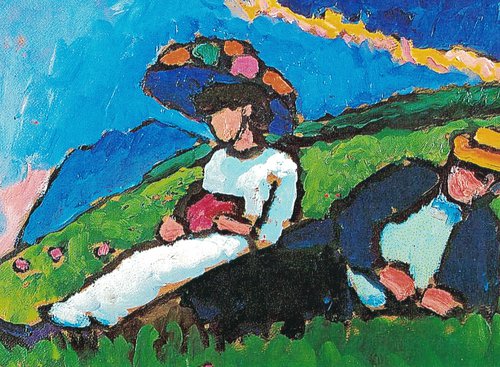
Wassily Kandinsky. Das bunte Leben, 1907. Courtesy of Christie’s
Two masterpieces by Wassily Kandinsky, painted fifteen years apart, have appeared on the international auction market within months of one another, offering a revealing perspective on the artist’s extraordinary transformation from a painter of Russian folklore to a pioneer of geometric abstraction. Yet the contrast between ´Das bunte Leben´ (1907) and ´Betonte Ecken´ (1922–1923) raises a question that goes beyond artistic development or market value: why does Kandinsky remain so closely associated with Russian cultural identity for some collectors, while others see him primarily as a central figure of German and Western modernism? Perhaps the answer reveals as much about the cultural identities, histories and expectations of those looking at his work as it does about Kandinsky himself.
Back in the early 1990s, I first encountered the work of Wassily Kandinsky (1866–1944) as a student of German modernism, particularly Expressionism. Deeply inspired by this pioneer of abstraction, I made a solitary pilgrimage to Murnau at the age of twenty-two, fascinated by the Russenhaus and the stories it held. Yet at the time, I had only a limited understanding of the complex cultural connections between Russia and Germany, or of the questions they might raise about Kandinsky’s artistic identity. When I joined Sotheby’s some years later, I found that his market was truly international, with important works regularly appearing at auction and attracting considerable attention from serious North American and European collectors. Looking back, although I was aware of his cultural roots, I had come to know Kandinsky almost entirely as a German artist, without seriously questioning how a painter so deeply rooted in Russian culture had come to occupy such a central place in the history of Western modernism. Although today I see this with different eyes, I think this perception is quite typical.

I am reflecting on this now more than thirty years later, because by sheer coincidence, two outstanding paintings from very different moments in Kandinsky’s career have appeared on the international art market. The first, ´Das bunte Leben´ (1907), is rooted in figuration, folklore and the human experience. The second, ´Betonte Ecken´ (1922–1923), represents the emergence of a highly sophisticated geometric language, almost entirely liberated from conventional representation. At first glance, the two could hardly be more different. Yet perhaps they are expressions of similar artistic and spiritual concerns, articulated through radically different visual languages.
Kandinsky’s ´Das bunte Leben´ sold in London this October for $41.8 million, while ´Betonte Ecken´, with a pre-auction estimate of $60–80 million, has reportedly already been guaranteed by the auction house, effectively securing a sale before the bidding begins. The apparent disparity in value between these paintings is striking, particularly given the considerably larger scale of ´Das bunte Leben´, a restitution painting that hung for years in the Lenbachhaus in Munich. Yet market value does not necessarily reflect art-historical significance or cultural heritage. What the auction house’s valuation suggests is that ´Betonte Ecken´ has greater commercial potential, appealing to a broader pool of wealthy international collectors and fitting more readily into a major collection of modern and abstract art.


With economic sanctions restricting the participation of many Russian collectors, Kandinsky’s Western market remains particularly important. In the West, he is celebrated above all for his non-objective paintings, and rightly so, given his pioneering contribution to the development of abstraction. Yet auction records tell a more nuanced story: at the very highest end of Kandinsky’s market, the distinction between figuration and abstraction appears far less decisive than one might expect. The artist’s current auction record belongs to ´Murnau mit Kirche II´ (1910), a painting created on the very threshold of abstraction, which sold at Sotheby’s in London three years ago for £37.2 million. Of Kandinsky’s ten highest auction prices, six are for fully abstract compositions, several dating from his Bauhaus years, while the remaining four are for figurative paintings or works that occupy the fascinating territory between representation and abstraction. On the whole a large body of his figurative paintings have Russian subjects – with the exception of the record work which depicts a view of Murnau a crucible of abstraction and crucial to Kandinsky´s biography.
When Kandinsky painted ´Das bunte Leben´, he was not yet the pioneer of non-objective painting that we recognise today. He had moved to Paris the year before, and perhaps Matisse’s ´Le Bonheur de vivre´ was in his mind when he painted this huge canvas, an all-encompassing representation of human existence, deeply rooted in his native Russian culture. A beautiful and moving panorama of life from birth to death, it is a celebration of life in all its facets.

It was in Germany that Kandinsky’s oeuvre was first systematically studied, and by the early 1980s the first two volumes of the catalogue raisonné had been assembled by the German art historian Hans Konrad Roethel (1909–1982), who had first become interested in Kandinsky’s Hinterglasmalerei in the 1960s - an exceptionally specialised aspect of his oeuvre. Following Roethel’s death, the American curator Vivian Barnett took over the project, becoming director of the Roethel-Benjamin Archives at the Solomon R. Guggenheim Museum in New York in 1992 and an undisputed authority on the artist. While this German-American initiative provided the scholarly framework for the study of Kandinsky’s work, his institutional recognition and public awareness have been nurtured over decades by the Guggenheims. It was Hilla von Rebay who first introduced Kandinsky’s work to Solomon Guggenheim, who went on to acquire over 150 works. Kandinsky is today one of the most important artists represented in the Guggenheim collection. Significantly, ´Betonte Ecken´, one of the first fully resolved abstract canvases Kandinsky painted at the Bauhaus, once belonged to Rebay. The Guggenheim name, its iconic museum and the numerous exhibitions of Kandinsky’s work held in New York over many decades have helped, in many ways, to Westernise the artist himself.

If Russia made the man, Germany made the artist. Kandinsky trained in Germany, had spoken German since childhood with his maternal grandmother, and from the outset was fully integrated into the German modern art movement. It was there that he made his first fully abstract paintings, undoubtedly his crowning achievement. He wrote his treatise ´On the Spiritual in Art´ not in his native Russian but in German. The titles of many of his major works are in German reflecting where they were painted. After returning to Russia in 1914, he left once again nearly a decade later, as artistic freedoms began to wane in the years following the Revolution, and took up a teaching post at the newly established Bauhaus in Weimar, at the invitation of Walter Gropius. He eventually acquired German nationality and taught in the language, having spent some three decades of his life in Germany over two distinct periods.
Looking at the work he produced at the Bauhaus, however, the geometric lines, seemingly so remote from the figuration of the Murnau years, evoke something of Suprematism. So too does his use of primary colours, which in ´Betonte Ecken´ appear in clearly defined forms and blocks, with shapes and dynamics somewhat reminiscent of Suprematist art. Yet looking at this large painting, with its clean white background covered in blocks of colour and expressive lines, it is hard not to see it as a spiritual precursor to post-war American abstraction, a painting that could hang happily alongside American works produced two decades later. Look once, and you can discern some of the abstracted symbolism of his early works – eschatological imagery, summits, spears and the colour blue at its centre. Look again, and the painting seems to point towards the work of artists such as Arshile Gorky (1904–1948) and even Jackson Pollock (1912–1956).

Although Kandinsky was invited to North America in 1941 to escape war-torn Europe, he never set foot in the United States. And although Pollock never acknowledged Kandinsky as a direct influence, Pollock’s first patron was Peggy Guggenheim, while music played a unique and central role in the visual language of both artists.
As an art dealer and former auction house expert, my own experience is that collectors from the Russian diaspora are mostly interested in Kandinsky’s pre-Bauhaus paintings. I have rarely, if ever, been asked to find a Bauhaus work. Over the years, I have developed a sense of what Russian collectors are looking for, and although ´Betonte Ecken´ does not tick that box, there are one or two major collectors of Russian background today who have both the financial means to acquire the painting and more cosmopolitan collecting tastes and experiences hewn from decades living in the West. Russian museum collections have good holdings of early figurative paintings and especially the key years 1910-1914, however, very limited holdings of works from the Bauhaus years, hence Russian audiences are far less familiar with them. And today at a moment of generational wealth transfer, when important works by Kandinsky are once again becoming available in the West, often once in a lifetime acquisition opportunities, many of these collectors find themselves effectively excluded from the market.

It often feels as though we are looking at two Kandinskys: one understood through Western eyes, the other through Russian ones. In the West, the post-war period was particularly kind to abstract art, which came to be associated with liberalism, freedom and openness. European and American audiences have not merely embraced Kandinsky; they have adopted him, and made him their own, firmly establishing him within the Western artistic canon. In the process, it is easy to overlook how deeply his work was rooted in Russian thought and culture, and in the pioneering avant-garde movement to which Russian artists made such an extraordinary contribution.
Ultimately, I wonder whether any other Russian artist has ever succeeded quite so completely in becoming part of the Western artistic establishment as Wassily Kandinsky, while remaining so profoundly connected to the cultural traditions of his homeland.