Krasnoyarsk Scans the Art Market from the Urals to the Pacific

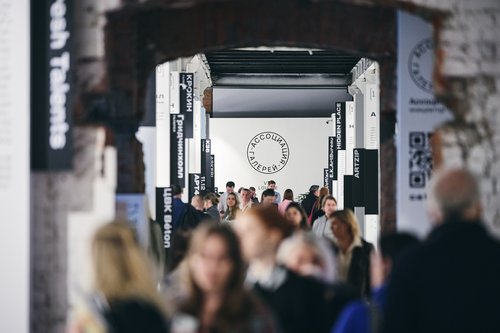
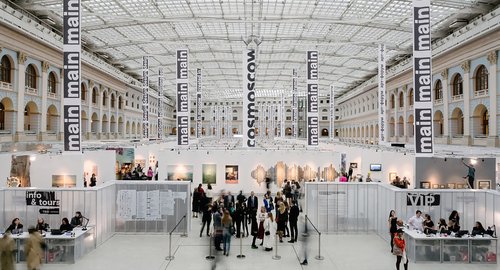
SCAN Fair. Exhibition view. Krasnoyarsk, 2026. Photo by . Courtesy of
Krasnoyarsk recently hosted the third SCAN contemporary art fair, gathering galleries and artists from across Siberia and the Far East. While the fair’s commercial numbers cannot compete with Moscow's art market, The Art Newspaper Russia’s Nadezhda Lisovskaya reports that this year’s respectable results prove the regional scene is thriving.
Benefiting from a move to a far more spacious and accommodating venue, this year’s SCAN contemporary art fair saw total sales surge by 50 percent, surpassing 12 million roubles. What makes this figure impressive is that prices remained highly accessible, starting at 2,000 roubles and seldom exceeding 50,000 roubles. The exceptional calibre of the booth architecture and curated pieces successfully dispelled any notions of a provincial exhibition; indeed, several of the talents on display in Krasnoyarsk have already made a successful splash on the national stage this year at Moscow’s Cosmoscow and Blazar fairs.

Perhaps the most striking feature of SCAN was its informal, unpretentious atmosphere, a welcome departure from the snobbery and self-importance of mainstream art fairs. The art on display was also less showy and strident than one normally expects: less plastic and cartoonish imagery, more natural materials and engagement with local contexts. Even the artists’ names on the stands – Pasha, Katya, Yura, Sonya – had a familiar, almost homely ring to them, immediately inspiring a sense of warmth and trust, as though these were not strangers but long-forgotten childhood friends. Another unusual feature was the exhibition format: rather than occupying an entire booth, each artist and gallery was allocated just one wall. This presented fair director Liliana Marré and curator Oksana Budulak with a particular challenge: how to bring together three different artists within a confined space, ensuring that their works neither clashed nor overshadowed one another, but instead entered into a dialogue and created a sense of synergy.
For the first time, SCAN welcomed five galleries from Moscow and St Petersburg – known locally as ‘Western’ galleries – several of which presented works by artists originally from Siberia, effectively bringing their art back to its region of origin. Moscow’s Pennlab presented ‘Tales’, a series by Ural photographer and researcher Fedor Telkov (b. 1986), while St Petersburg’s Anna Nova showed ‘Time of the Earth’ by Dima Filippov (b. 1989). Pop/off/art brought works by the artistic duo Vika Begalskaya (b. 1975) and Alexander Vilkin (b. 1982), while Artzip, whose founder Olga Popova comes from Krasnoyarsk, presented works by Ekaterinburg artist Dinara Hörtnagl (b. 1988). In a light-hearted reflection on local loyalties, pop/off/art founder Sergey Popov joked that in Krasnoyarsk he was known simply as Olga’s husband.

Moscow gallery scena/szena presented works by Anastasia Rybakova, recently named among The Art Newspaper Russia’s ‘Top 50 Young Russian Artists’. In her series ‘Forest Flower Seekers’, Rybakova depicts rare, protected flowers growing in the famous Krasnoyarsk Stolby Nature Reserve, accompanied by charming little gnomes clambering over their stems and petals. The artist imagines that the flowers become lonely without human visitors, particularly as many nature reserves have been closed due to the threat of bear attacks. Her gnomes therefore keep the plants company, bringing a touch of humour and warmth to the scenes. Priced at just 25,000 roubles each, the small paintings on shaped plywood sold out within minutes of the fair opening.
The Omsk art group ‘No Excuses’ presented works made in Moscow during their residency in the studios at the Garage. Their ‘Reliquaries’ are artefacts sealed in plastic containers, priced at 10,000 roubles each which “…preserve our memories, found objects and images. We explore provincial chic, urban outskirts, vernacular urban creativity and the shine of everyday life,” the artists explained.

Dasha Gauzer (b. 1978), from Magnitogorsk, draws on childhood memories and her professional experience in the fashion industry. Her mother was a pharmacist who often took her daughter to work, where she would play with colourful blister packs and ampoules. Today, Gauzer turns these familiar pharmaceutical forms inside out, reversing their traditional purpose: whereas a capsule’s value normally lies in what it contains, in her ceramic sculptures everything of interest is on the outside, leaving us to wonder whether there is anything inside at all. Anastasia Redgrin (b. 2001), from Novosibirsk, takes a different approach, combining interiors and exteriors in collages and miniature ceramics that offer a glimpse into her distinctive imagination. The artist describes herself as thinking in rooms, often encountered in her dreams, and has developed a repertoire of around five interconnected spaces that flow into one another. These intriguing fragments of her inner world are available from just 3,500 roubles for a ceramic piece.
Artist Vidoomka’s stand was devoted entirely to car tyres. At first glance, the images resemble photographs, but closer inspection reveals them to be meticulously executed, hyperrealist watercolours. The artist explains that this unusual subject emerged following the birth of her child, when her world suddenly seemed to shrink to just a few blocks around her home. Looking for ways to entertain herself during walks with her baby, she began paying closer attention to the everyday details of her surroundings, eventually discovering an unexpected fascination with car tyres.

Yura Adomeyko (b. 1991) presented ‘Ball on…’, a series of small wooden objects tracing the adventures of a geometric form through works such as ‘Ball on the Neck, Ball on the Corner and Ball on the Cupboard’. For the artist, the series explores the importance of context in contemporary art, and how it can sometimes matter more than the object itself. “The ball, wandering from one of my projects to another, becomes something more than just a ball in new circumstances. In essence, it is a one-man theatre, where the ball plays a new role in each object,” he explains. In ‘Ball on the Cupboard’, for example, opening the cupboard doors reveals that what initially appeared to be a simple sphere is, in fact, a skull.
Natasha Yudina (b. 1982) was selected as the fair’s headline artist, with works displayed both on her stand and in the lounge area. A member of the Siberian Ironic Conceptualism movement, Yudina sees herself as a successor to Joseph Beuys (1921–1986). She is best known for her objects enveloped in snow-white fur, evoking the heavy snowfalls of the Siberian taiga. Her sculpture ‘Venus in Fur’ and a painting from the series ‘Scary Siberian Dreams’ were the most expensive works at the fair, each priced at 1 million roubles, although neither found a buyer. A more affordable piece, ‘Hamlet’, a fur-covered skull complete with real teeth of uncertain origin, sold for 80,000 roubles.

Curiously, from its very first edition, SCAN acquired an unofficial satellite event, a kind of Salon des Refusés. Known as SCAM, it emerged from an initiative by the local artistic community, when artists who had not been selected for SCAN joined forces to create an alternative space where anyone could exhibit and sell their work. In many cases, the works are no less compelling than those endorsed by established institutions, while the prices are considerably more accessible. What began as a tongue-in-cheek act of protest has since evolved into a fair in its own right, embraced even by the organisers of SCAN, who included it in their official programme for visitors.
This article was first published in Russian on the website of The Art Newspaper Russia on 16 October 2026.