

Cosmoscow and Russia’s Hunger for Contemporary Art

Cosmoscow 2026. Moscow, 2026. Courtesy of Cosmoscow Press Office
Russia’s leading contemporary art fair, Cosmoscow, has changed hands and returned with a cutting-edge cross-section of contemporary art in Russia. With museums’ engagement with contemporary artists at a minimum, the fair remains the only major venue for tracking trends in the domestic art market. As a result, it has attracted a huge influx of visitors, buoyant sales across gallery booths, and a growing number of new collectors.
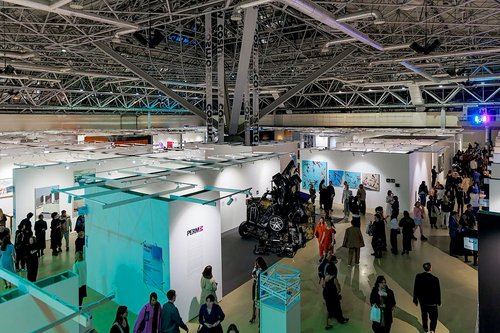
“It’s hell inside!” was the repeated refrain from those leaving the Timiryazev Center as others streamed through the doors. It was three o’clock in the afternoon, just two hours into the preview of Russia’s premier art fair, Cosmoscow. The two floors occupied by the fair were already packed, despite the 40,000 rouble ticket for the collectors’ and professionals’ preview – around $520. Of course, it is unlikely that many of those squeezing between the booths had actually paid that much for admission, but in the days that followed, thousands certainly paid the standard 2,750-rouble ($30) entrance fee. A constant flood of visitors continued throughout the fair, culminating in an unprecedented 60,000 visitors. What is behind its success?

Visiting a Collector. Collector of the Year booth. Cosmoscow 2026. Moscow, 2026. Courtesy of Geometria Fund

Visiting a Collector. Collector of the Year booth. Cosmoscow 2026. Moscow, 2026. Courtesy of Geometria Fund

Visiting a Collector. Collector of the Year booth. Cosmoscow 2026. Moscow, 2026. Courtesy of Geometria Fund

Vladey booth. Cosmoscow 2026. Moscow, 2026. Courtesy of Vladey
“Today, Cosmoscow is the only large-scale event in the country dedicated to contemporary art. It’s wonderful to see this art attracting such interest, but a pity that audiences have practically nowhere else to satisfy their visual hunger,” Natalya Litvinskaya, owner of the Lumiere Gallery, told Art Focus Now.
Indeed, the past four years have been difficult for contemporary art in Russia. The Moscow Biennale of Contemporary Art ceased to exist several years ago, while leading national museums from the Hermitage in St. Petersburg to the Pushkin Museum and Tretyakov Gallery in Moscow appear to have put their contemporary art programmes on hold, increasingly relying on exhibitions drawn from their own collections. Significant contemporary art festivals have largely disappeared, while institutions operating in the field – Cosmoscow among them – are forced to organise exhibitions under the watchful eye of potential censorship.


This year alone, there have already been several controversies at the Moscow Museum of Modern Art, where exhibitions have been closed almost immediately after opening. The same could have happened at Cosmoscow, had gallery owners not already learned from experience. “Nevertheless, it’s always a lottery,” several dealers said in unison. Inspection teams still made their way around the booths, identifying artists whose works, they said, had to be removed.
There is another explanation for the crowds at the previews: the rise of collecting as both a social pastime and a means of socialising. Over the past decade, nearly every museum in Russia has established its own Collectors’ Club or Friends programme, built up an endowment fund and, of course, found ever more ways to entertain its donors. These extend beyond private parties and out-of-hours tours to group trips to leading art fairs and biennials around the world.

Entrepreneur Zoya Galeeva, named Collector of the Year by the fair, explains that, for her, collecting is “also about accumulation, about building social capital. And how do you make friends, find people close to you, when you are an adult?” Her stand at Cosmoscow, designed to resemble an apartment filled with art, is one of the best at the fair.
Collector activity at this edition of the fair was exceptionally strong. Three St. Petersburg collectors also presented their own booths. Sergey Limonov and his Limonov Art Foundation staged a solo exhibition, Zverinets (Menagerie), devoted to the work of Vladimir Kopeikin (b. 1996). Denis Khimilyayne created an installation to mark the publication of If It’s Not So by Olga and Oleg Tatarintsev (b. 1967 and 1966).


The recently opened apartment museum dedicated to Georgy Guryanov (1961–2013), the legendary St. Petersburg artist and musician, also mounted its own presentation at the Timiryazev Centre.
The main news surrounding the fair itself is the change in its ownership. Its new principal owner is 60-year-old Grigory Berezkin, a media mogul and owner of the ESN investment holding company, ranked No. 75 on Forbes’ list of Russian billionaires, with a net worth of $1.8 billion. The fair’s founder, Margarita Pushkina, remains both its public face and its director.
The sale itself appears to have given a boost to the gallery line-up. After a long absence, Vladimir Ovcharenko, one of Russia’s leading dealers, returned with both Ovcharenko Gallery and Vladey Auction House, occupying substantial booths in the centre of the fair. As always, the gallerist didn’t skimp, showing large-scale works by Valery Koshlyakov (b. 1962), Alexey Kallima (b. 1969) and Pavel Pepperstein (b. 1966), among others, with prices starting at $30,000.
A total of 108 galleries participated in the fair, with Russian art and photography accounting for 95% of the works on display.

Vladimir Mironenko. Russian Miracle, 1990. Courtesy of E.K. ArtBureau

Marc Chagall. The Accordion Player. From the series 'Chagall. Lassaigne', 1957. Courtesy of Altmans Gallery

Oleg Dou. Macabre, 2026. Courtesy of a-s-t-r-a gallery

Ivan Gorshkov. Untitled, 2026. Courtesy of Gallery X.L.A.M. Gallery

Vincenzo De Cotiis. Untitled. Courtesy of KRASSKY Gallery

Oswaldo Vigas. 'The Large Head' tapestry. Courtesy of Rafinad Gallery
Iragui Gallery, with spaces in Moscow and Paris, offered a true museum rarity for €70,000: Pavel Pepperstein’s 1979 graphic album The Adventures of Joseph Katsenelson. Created in the spirit of Moscow Conceptualism by the son of renowned conceptual artist Viktor Pivovarov (b. 1937), the work was made when Pepperstein was just thirteen, as a gift for his father. Even in this youthful work, one can already discern the subtle, imaginative style of the future master.
Syntax Gallery, winner of the Booth of the Year award, also presented works by established artists. One section was dedicated to another major figure, Alexander Kosolapov (b. 1943), and included one of the most expensive works at the fair: his sardonic 1994 canvas Constitution Day, priced at €82,000. Another section was filled with dried metal flowers by France-based sculptor Dmitry Bulnygin (b. 1965).

Boroom Gallery booth. Cosmoscow 2026. Moscow, 2026. Courtesy of Boroom Gallery

Space Four Gallery booth. Cosmoscow 2026. Moscow, 2026. Courtesy of Space Four Gallery

WE Gallery booth. Cosmoscow 2026. Moscow, 2026. Courtesy of WE Gallery

Lavdansky Studio booth. Cosmoscow 2026. Moscow, 2026. Courtesy of Lavdansky Studio

Krassky Gallery booth. Cosmoscow 2026. Moscow, 2026. Courtesy of Cosmoscow Press Office
Another contender for best booth, pop/off/art gallery, showcased works by two leading women in Russian contemporary art: Irina Nakhova (b. 1955) and Olga Chernysheva (b. 1962). Nakhova’s painting Kiss was offered at €16,000, while Chernysheva’s vertical panel from the Industrial Mountaineering series carried an asking price of €33,000.
Emerging Russian art was represented primarily by independent artist groups. Tikhaya Studio from Nizhny Novgorod sold woven towels featuring Lena Lisitsa’s (b. 1991) photographic images of pre-revolutionary Russia, with prices starting at €1,200. The artist-run PARAZIT Gallery from St. Petersburg offered works from the collective project Hat from €200, while the Community of Contemporary Siberian Artists presented photographs by Elina Gusarova from €300.

An even broader cross-section of emerging art, however, awaits visitors at Blazar, Cosmoscow’s satellite fair dedicated to young artists, which takes place from 17th to 20th of September. In the meantime, Cosmoscow’s online edition remains open until 30th of September.