

ArtVilnius 2026: Between Vilnius, Warsaw and Vienna

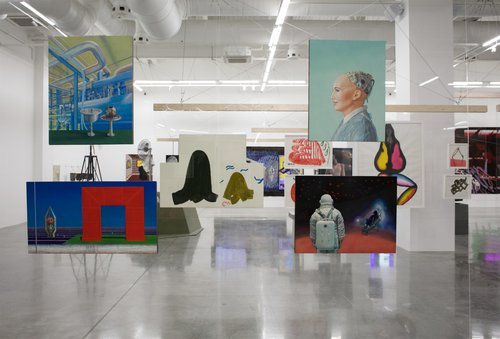
ArtVilnius’26. Exhibition view. Vilnius, 2026. Photo by Augustinas Žukovas. Courtesy of ArtVilnius
For its 17th edition, ArtVilnius looked beyond the Baltic and towards a wider Central and Eastern European axis. Seventy galleries and institutions brought painting, ceramics, glass, photography and installation to LITEXPO, while TAKAS and the Project Zone gave the fair a broader cultural frame than the booths alone.
For its 17th edition, ArtVilnius shifted its gaze. After last year’s close survey of the Baltic art scene, the fair widened its horizons, tracing a cultural axis from Vilnius through Warsaw to Vienna. Across LITEXPO, seventy galleries and institutions presented some three hundred artists from twenty countries, giving the fair a distinctly more outward-looking character.

Lithuania nevertheless remained firmly at its centre. Around two-thirds of the exhibitors were local, but what emerged was a picture far broader than Vilnius alone. Galleries from the capital were joined by a strong contingent from Kaunas and voices from Klaipėda on the Baltic coast, while the Vilnius Academy of Arts participated through six galleries spanning Vilnius, Kaunas and Telšiai. Exhibitors from Panevėžys, Šiauliai, Utena, Molėtai, Ukmergė, Trakai and Dusetos further revealed an art scene whose energy extends well beyond the capital.
Among the international exhibitors, the Baltic neighbours still felt closest. Latvia formed the largest international contingent, with ISSP, TUR, PILOT, Bazar’t and Agijas Sūnas from Riga, while Estonia was represented by KOGO from Tartu and OKAPI and Artrovert from Tallinn. The sharper new accent, however, came from Poland. LETO and Le Guern returned from Warsaw after an absence of almost a decade, joined by first-time participants HOS and Fijewski Gallery. Austria brought a more seasoned international presence in Christine König Galerie and Galerie Sturm & Schober, while galleries from Stockholm, Düsseldorf, Florence, Cluj-Napoca and London pushed the fair’s geography further outward. There were familiar faces too – Galerie Nivet-Carzon, Galleri NB and Tsekh among them – so that moving through the booths had something of the atmosphere of a reunion, albeit one punctuated by new introductions.

Painting dominated, but not in any single register. Figurative work often leaned towards the psychological or theatrical: Robert Bluj’s (b. 1970) large, cool-toned nudes had an almost suspended stillness, while Andrius Zakarauskas (b. 1982) packed his canvases with restless, expressive bodies and faces.
Abstraction provided a countercurrent. At Giedra galerija, Giedra Purlytė’s (b. 1969) layered Materializacija (2026, €3,500) seemed to construct itself gradually out of colour and light, while Daiga Krūze’s (b. 1980) broad, gestural canvases at Bazar’t (€3,000–5,000) made the movement of the brush their subject. Elsewhere, painting escaped the stretcher altogether: at Kunstkamera, Sigita Maslauskaitė-Mažylienė (b. 1970) finished a five-metre painted frieze with a knitted fringe (€8,000), turning the canvas edge into part of the work.

Animals kept appearing. Monika Plentauskaitė (b. 1993) at Meno Niša painted a unicorn resting on a worn sofa, a stuffed swan and a penguin chick in the muted, slightly theatrical light of old museum dioramas (€450–5,400). At GODÒ, Giedrius Jonaitis (b. 1963) dressed a taxidermied moose and wolf in gleaming armour (€5,700 and €4,000). The animals kept their own presence here, fragile and watchful, and each artist met them differently, with tenderness, wit or irony.
Further on, painting loosened its hold and the fair became more tactile. Clay, glass and textile began to interrupt the walls, introducing rougher surfaces, flashes of reflection and a different sense of scale.
Ceramics were everywhere, but rarely polite. At Dusetų dailės galerija, Rima Leipuvienė’s (b. 1979) scorched-looking houses, horses and birds (€1,000–2,500) had the feel of objects excavated from some half-remembered landscape. At Le Guern Gallery, Aleksandra Liput’s (b. 1989) sun-like forms from We Are a Dream (2024; €1,200 and €1,600) were stranger and more talismanic, while Four Humors (2025), in glass and metal (€8,000), pushed the work into something sharper and more bodily. Glass reappeared at LDS galerija in Eglė Pilkauskaitė’s (b. 1989) masks, where amalgam turned each face into a dim, ghostly mirror (€1,000 each). Elsewhere, thread became a kind of drawing: Maria Arendt (b. 1968) stitched city plans onto linen (€300–4,000), translating the hard geometry of streets into something intimate and handmade. At ISSP, the Riga duo MareunRol's went further still, transforming folds of fabric into glowing wall pieces (€250–8,000) that hovered somewhere between costume, sculpture and stage set.

A digital sensibility ran quietly through the fair: glossy surfaces, flattened space, recurring characters and visual cues drawn from meme culture. Its persistence was hardly surprising. For artists who grew up online, the screen is less a subject than an environment - as instinctive a visual field as landscape once was to earlier generations.
The more interesting question was what artists did with that inheritance. At times, the language of the screen felt simply repeated, with works seeming conceived as much for circulation as for sustained looking. The strongest pieces resisted that speed. At HOS, Marta Jamróg’s (b. 1983) series Neural Connections in the Brain of an Embryo with ADHD translated information overload into dense, almost biological fields of acrylic, dry pigment and oil. Prices ranged from €900 for the smaller canvases to €6,600 for a two-metre work.
Photography occupied a quieter but consistent place, with most prints priced at €300–400 and larger formats reaching €2,500. At OKAPI, Heleliis Hõim’s (b. 1987) Darién presented Guna Yala villages and flooded jungle in broad, composed images whose calm surfaces belied a much harsher reality of trafficking and cultural erosion. At Christine König Galerie, Erwin Kneihsl’s (b. 1952) small silver-gelatin collages moved in the opposite direction, making photography feel less like image than object.

Several stands gave the fair a useful sense of historical depth, bringing figures from 20th-century Lithuanian art into direct conversation with the present. At Meshka Tech, more than 20 works by Linas Leonas Katinas (1941–2020) – oils, watercolours and mixed-media pieces priced between €1,050 and €9,500 – were shown alongside three works by his daughter, Deima Katinaitė (b. 1974), and one by his father, Leonas Katinas (1907–1984). Three generations occupied the same wall, turning what might have been a retrospective gesture into something more intimate and continuous.
Elsewhere, the historical thread was looser but no less telling. Kunstkamera showed Pranas Gailius (1928–2015), the Lithuanian-born painter and printmaker who spent much of his career in France, including Scène de la vie, an acrylic and mixed-media canvas from the 1980s–90s, priced at €4,000. At The Room, six works by Eugenijus Antanas Cukermanas (b. 1935) were on view, with Frizas (2009) at €6,600. These works carried with them another cultural climate entirely, reminding visitors that much of the region’s modern art developed under political and institutional conditions very different from those of today’s fair.

The century’s fascination with perception resurfaced in a more polished key at Galerie Sturm & Schober. Wolfram Ullrich’s (b. 1961) acrylic reliefs on steel seemed to shift as the viewer moved past them, their angled planes alternately protruding, receding and folding in on themselves. Ravo (2022), priced at €15,000, was among the fair’s more expensive works. A stranger discovery came at The Passenger, where four lithographs by Hermann Nitsch (1938–2022) brought the raw physicality of Viennese Actionism into the booth. Each Untitled sheet, produced between 2018 and 2022, retained the splashes, drips and tangled gestures of his performance-based painting.
One of ArtVilnius’s more appealing traits, however, was that it did not insist on a single level of entry. At Kauno menininkų namai, prints began at €8. Elsewhere, graphic works could be found from around €40 and small paintings from a few hundred euros. At The Rooster Gallery, Vasare + Lukas painted miniature tomatoes, carrots and cape gooseberries on canvases barely larger than a postcard, priced between €40 and €180. Sabīne Līva’s (b. 1976) 10 × 10 cm Air Mail Series at Bazart Art Gallery cost €60 each, while small oils by Andrius Makare Makarevičius (b. 1982) at GODÒ were offered for €200–380. For first-time buyers, the Young Collector’s stand gathered works from participating galleries in the €325–1,000 range.

At the other end of the scale, the fair allowed itself rather more swagger. At TWO LONG BLONDES & MADEINBRITALY, Ann Carrington’s (b. 1962) elaborate bouquets assembled from plated cutlery reached €21,500, while Eva Mitera’s (b. 1981) circular sky paintings rose to €16,350. Robert Bluj’s large nudes at Fijewski Gallery were priced up to €21,600, misted seascapes by Łukasz Olek (b. 1982) up to €17,800, and Andrius Zakarauskas’s Oh, My Sunshine! at The Rooster at €12,300.
The result was a market with unusually elastic boundaries: museum-generation names and emerging artists, editioned prints and five-figure paintings, secondary-market material at Ars Via and, at the most approachable end, books, postcards and Curiela design for visitors not yet ready to buy a work of art.

ArtVilnius was not only about the booths. The talks programme ranged across the mechanics of the art world – collecting, institutions, artists’ careers – but some of the liveliest discussion circled around artificial intelligence and the legal and ethical problems raised by machine-generated images. Between talks, performances, tours and collaborative projects kept the fair in motion. Families were drawn in too: three art schools, including the M. K. Čiurlionis and J. Vienožinskis schools, ran workshops, while one stand gradually disappeared beneath a growing accumulation of visitors’ drawings.
TAKAS, the fair’s annual programme of sculpture, installation and performance, offered a welcome change of pace. This year it was curated by the Vienna-based artist, curator and writer Aliaksei Barysionak, who brought together 11 artists from Lithuania, Latvia, Estonia, Belgium, Belarus and Ukraine. Their works did not sit neatly apart from the fair but surfaced throughout LITEXPO – in corridors, transitional spaces, awkward corners and outside – so that they were often encountered almost by accident.
That element of interruption was important. A fair encourages a particular rhythm: booth, wall, label, price, next booth. TAKAS repeatedly broke it. Its artists returned to displacement, ecological anxiety and the fragility of ordinary life, using industrial materials, fragments, archives and traces of landscape.

Among the strongest works was Anna Mari Liivrand’s (b. 1993) Amid Bitter Flowers, in which poisonous Estonian plants were engraved into stained and found glass, creating something poised between garden, memorial and ruin. Katsiaryna Miats’s (b. 1996) I Think About Home A Lot was quieter but equally unsettling, transferring family photographs onto antidepressant packaging in cyanotype. Because the works were dispersed rather than concentrated in a single space, TAKAS never quite resolved into one exhibition. It revealed itself in fragments, depending on where you walked and what you happened to notice.
Last year, the Project Zone focused on private and institutional collections from Lithuania, Latvia and Estonia. This time it followed the fair’s Vilnius–Warsaw–Vienna axis, bringing together institutional and gallery projects that sat slightly apart from the commercial stands. Curator Neringa Bumblienė framed the contrast neatly: Vilnius as restrained and conceptual, Warsaw and Vienna as more hybrid and provocative.

Warsaw’s Zachęta National Gallery of Art showed Deaf Rebellion. Renewal, a performative video by Bogna Burska (b. 1974) and deaf artist and activist Daniel Kotowski (b. 1993), revisiting the 1988 Deaf President Now! protests at Gallaudet University. Presented in Vilnius with Lithuanian Sign Language translation, the work made accessibility part of its structure as well as its subject. Galeria Studio shifted towards sensuality and the cosmic with works by Magdalena Abakanowicz (1930–2017) and Natalia LL (1937–2022).
Vienna brought the collective Gelitin, represented by Meyer Kainer, with sculptures referring to the Moretti Veneziani - Venetian jewellery figures in which luxury and colonial caricature uneasily meet.
Vilnius, by contrast, was represented by two of its best-known artists. Emilija Škarnulytė’s (b. 1987) Tethys surrounded the glass object Jūratė’s Tears with video projections evoking geological deep time, while Deimantas Narkevičius’s (b. 1964) Stones in Pairs photographed boulders across central and eastern Lithuania twice over, leaving their meanings deliberately unresolved.
The Rothko Museum in Daugavpils invited visitors to contribute to Pēteris Martinsons’s (1931–2013) ceramic City of Dreams, while the Stasys Museum in Panevėžys brought sculptures by Stasys Eidrigevičius (b. 1949), translating familiar ex-libris motifs such as Crown, Ship, Well, Windmill and Tower into three dimensions. Having moved to Warsaw in 1980, Eidrigevičius also provided a quiet link between two of the cities around which this year’s programme was built.

Among the prizes, Best ArtVilnius Artist and €3,000 went to Laura Selmistraitytė (b. 1987) at The Passenger for large woodcuts of crumpled sheets and draped fabric, their pale surfaces almost photographic despite the laborious technique. Best Young Artist, also with a €3,000 prize, was Latvian painter Andris Kaļiņins (b. 1994) at TUR, while Vytautas Viržbickas (b. 1987) received the €2,000 award for Best Sculpture or Installation for a work shown by DRIFTS. Best Gallery Presentation went to first-time participant Christine König Galerie from Vienna. After many denser booths, its sparse installation – with works by Maruša Sagadin, Magda Csutak, Erwin Kneihsl, Natalia Załuska and Honza Zamojski – felt almost like a pause in the fair. The jury also singled out DRIFTS, TUR, Christine König, KOGO, ISSP, HOS and Galerija Vartai among the fair’s strongest galleries.
ArtVilnius