

A Generation in Transit: Russian Artists Under 40 and the Western Market

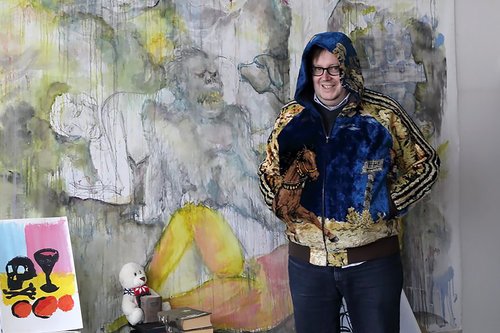
Evgeny Muzalevsky. Auto-epitaph. 2025. The Wrath and Strays of Paris. Courtesy of Alina Pinsky Gallery
The Western market for Russian artists under 40 is not absent, but fragmented: shaped by selective gallery representation, opaque pricing, geopolitical caution and the growing importance of alternative platforms. A younger generation is navigating a divided terrain, between domestic momentum, international displacement and the difficult task of being seen not only as Russian artists, but as part of the wider global contemporary art market.
The market for Russian artists under the age of 40 in the West is defined less by expansion than by selective visibility. While a small number of artists have secured stable gallery representation in London and Europe, the broader landscape remains exceptionally fragmented, shaped by complex geopolitics, institutional caution and shifting patterns of cultural exchange. What has been emerging in the West over the past few decades is not a disappearance, but a reconfiguration - one that rewards agility, networks and curatorial advocacy over traditional market structures.

At a global level, the market for artists under 40 has become highly systematised since the millennium. It is no longer an informal ‘emerging’ field, but a structured pipeline dominated by galleries, curators and international fairs. Primary markets lead price formation, institutional validation precedes resale liquidity, and successful artists are rapidly positioned within a global, rather than national, discourse. The most effective practitioners are not framed as representatives of a country, but as participants in a broader contemporary language.
Against this model, the position of younger Russian artists, or artists closely connected with Russia, reveals a number of structural divergences. The most visible is the relative weakness of a sustained Western gallery infrastructure. While artists such as Taus Makhacheva (b. 1983), Evgeny Antufiev (b. 1986), Aslan Goisum (Gaisumov) (b. 1991) and the award-winning artist duo Recycle Group (Andrey Blokhin (b. 1987) and Georgy Kuznetsov (b. 1985) have established positions within galleries in London and Europe, this level of integration remains the exception. For a broader generation of young Russian artists, exposure is more intermittent, often tied to specific exhibitions, residencies or curatorial projects rather than long-term commercial representation.

This structural imbalance is reflected clearly in pricing. Public auction data, where available, suggests that most of these artists remain within relatively modest bands by international standards. Works by artists such as Evgeny Antufiev and Aslan Goisum have appeared at auction in the range of approximately $5,000 to $20,000, while Recycle Group has achieved results and gallery listings broadly within a similar bracket. For others, including Evgeny Granilshchikov (b. 1985) or Alisa Yoffe (b. 1987), publicly visible results are sparse, and pricing is more often determined privately through studios or project galleries.
For Evgeny Antufiev, who turns 40 this year, gallery pricing suggests a more developed primary market than the limited auction record alone would indicate. Emalin Gallery’s Michaela Zuge-Bruton notes that, “In terms of collector demographics, his audience today is very international and not limited to a specific region … collectors tend to be those engaged with contemporary sculpture, spanning a wide range of ages, and backgrounds.” This is reflected in the gallery’s current price structure: smaller-scale sculptures by Antufiev are offered from approximately £7,500, while larger bronzes are priced around £35,000, and mosaics can achieve prices in the region of £25,000. This is notably higher than his strongest Western auction result to date – a small-scale sculpture sold at Phillips, London, in 2016 for $17,473 – which, while now a decade old, highlights both how early his secondary market remains and how significantly his primary-market pricing has developed since. This places Antufiev among the more commercially mature artists in this group, with a collector base that appears meaningfully international rather than narrowly Russian or post-Soviet.


It is also worth noting that the apparent absence of auction data for some artists is not necessarily indicative of a lack of market activity. For leading figures of their generation such as Alisa Yoffe and Alisa Gorshenina (b. 1994), both of whom left Russia after the tragic events of 2022, earlier auction appearances can become difficult to trace over time, as databases are updated, results reclassified or selectively removed. This reflects a broader structural characteristic of the ultra-contemporary market: where secondary-market activity is thin, inconsistently recorded, and often deliberately limited, pricing remains largely anchored in the primary gallery system rather than publicly visible auction benchmarks.
For Alisa Gorshenina, currently based in Paris, her auction record is exceptionally limited but nonetheless illustrative. One of the few clearly traceable results is a large-scale sculptural work sold at Vladey in Moscow in 2021 for $7,241. This aligns with a broader pattern in her market: works have tended to appear sporadically at auction, often in Moscow-based sales, with estimates for comparable pieces in the low-to-mid thousands of euros. The result reinforces the point that, despite strong visual identity and some institutional interest, her pricing remains relatively modest and unevenly documented, with primary-market and direct sales channels playing a more significant role than the secondary market.

Her recent market position has also been shaped by politics and displacement. Within Russia, galleries have largely shunned Gorshenina because of her outspoken opposition to the current political climate, which contributed to her emigration abroad. This has pushed her further towards a peripheral, self-directed and international-facing market structure. Pricing at her recent Dubai exhibition, ‘Tender Ruins of My Body’, ranged from approximately €687 for small sculptures to €2,500 for larger sculptural works, suggesting a market that remains accessible, direct and comparatively underdeveloped despite the strength and recognisability of her practice.
In a recent conversation in Paris, Gorshenina spoke candidly about the challenge not only of building a collector base abroad, especially in a crowded marketplace such as Paris, but also of making work outside her natural environment, especially for an artist for whom local lore and landscape of her native Nizhny Tagil in the Urals region of Russia was an essential part of her artistic practice and identity. Yet she remains undeterred and visibly committed to the task, even while facing the uncertainty of when, or whether, she will be able to return to her homeland.


Looking at Russian artists under 40 living and working in the West, it is important to distinguish between two very different trajectories within this generation: those artists who established their practices abroad prior to 2022, and those who have found themselves in a position of more recent, often forced, emigration. The former, artists such as Aslan Goisum or Taus Makhacheva, have had the time to build networks, secure gallery representation and develop collector bases within Western systems. Their integration, while not without challenges, has been gradual and structurally supported. Recycle Group who is today based in Paris was first represented back in 2013 by Gazelli Art House in London, who still works with them today, managing commissions and offering their work to collectors based in Europe, with prices ranging from the affordable £5–10,000 range up to £100,000 for a major work.
By contrast artists like Alisa Gorshenina, have been required to rebuild their careers from scratch since 2022 often under conditions of uncertainty and displacement. This process has coincided with a moment in which Russian cultural production is, in many contexts, viewed with caution or even outright resistance. The result is a markedly different starting point: one in which artists must simultaneously establish new studio practices, navigate unfamiliar markets, and overcome a degree of geopolitical stigma. In market terms, this translates into slower development, greater reliance on informal or alternative channels, and a more fragile collector base, even where artistic visibility remains strong.

Within this shifting landscape is the emergence of a few new gallery structures outside Russia specifically oriented towards Russian and post-Soviet artists. A notable example is the Alina Pinsky Gallery, which against all odds has recently established a space in the Marais. The gallery positions itself as a bridge between Russia and Western Europe, bringing together both established figures and a younger generation of artists within a single programme. Its exhibitions juxtapose historical and contemporary practices, placing artists such as Evgeny Muzalevsky alongside more established names like Igor Shelkovsky (b. 1937), creating a dialogue across generations. Currently on view is a solo selling exhibition ‘Evgeny Muzalevsky: Les Spectres et les Égarés de Paris, comprising the artist’s typical bright, expressive paintings, the gallery’s asking prices range from Euros 2,000 to Euros 50,000.
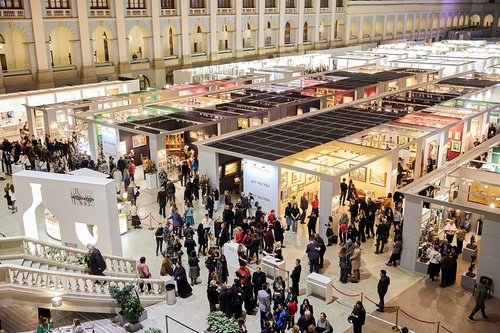
And there is another significant divide: there exist two distinctive markets for Russian contemporary art, one domestic in Russia and the other in the West, running on parallel lines with little crossover in terms of collector base or pricing. In Russia, the domestic contemporary art scene has seen a boost in recent years, with crowded fairs, active collectors and a buoyant commercial environment. In the West, however, young Russian artists face a much tougher reality: weaker gallery infrastructure, greater political caution, lower public price visibility and far less overlap with the collector base that supports them at home.


Alongside these structural distinctions, there is a parallel and more agile form of infrastructure-building in Italy through an initiative led by Emeliyan Zakharov. Zakharov has created a platform for Russian artists operating outside traditional gallery systems. In December 2025, he presented ‘Infinite Touch’, a solo exhibition by Alisa Yoffe curated by Maria Abramenko. The exhibition reflects a model that is increasingly visible: flexible, project-based and geographically mobile, rather than anchored in a single commercial gallery. Yoffe’s large scale black and white acrylic paintings can fetch up to Euros 25,000.
Pricing within these project-based initiatives remains largely opaque. In the case of exhibitions such as ‘Infinite Touch’, no formal price lists are publicly available, and transactions – where they occur – are typically handled privately. This reflects a broader characteristic of such platforms: they operate less as structured market-makers and more as flexible curatorial environments, where visibility and continuity of practice take precedence over price transparency and market consolidation. For artists such as Alisa Yoffe, this can offer an important form of exposure, but it also reinforces the broader pattern of a market that remains fragmented, informal and only partially integrated into Western commercial systems.

Taus Makhacheva. ASMR Spa, 2019. Photo by Oleksandr Kutuvyi, Taus Makhacheva. Courtesy of the artist
Alongside these developments, direct-to-collector sales via social media have become increasingly significant. Gorshenina regularly uses Instagram to present new works and invite collectors to purchase them directly from her. This approach bypasses the traditional gallery system, offering immediacy and autonomy, particularly for artists without stable Western representation.
Direct selling, while not absent, is rarely central to the market struture at higher levels in the West. By contrast, in more fragmented or peripheral contexts, social media can become a primary mechanism of exchange – even established Russian sculptor and painter Aidan Salakhova (b. 1964) uses this medium to bypass agents and sell to her followers on Facebook. It allows artists to reach international audiences, establish direct relationships with collectors and generate revenue without institutional mediation. Yet this model also has limitations. Without the anchoring effect of galleries, pricing can remain volatile, and long-term market consolidation is more difficult to achieve.

The broader conclusion is that the Western market for younger Russian artists is neither closed nor fully formed. A very small number of artists have achieved genuine international integration, supported by galleries and increasingly collected beyond Russian-speaking networks. A wider group remains in transition, moving between institutional visibility and fragmented commercial exposure. Beyond them lies a field of artists whose relevance is recognised, but whose market position is still emerging.
For collectors and advisors, this landscape requires a more active and discerning approach. The most significant opportunities lie not in following established trajectories, but in identifying where those trajectories have yet to be defined. The question is not simply which artists are visible today, but which can be positioned – curatorially and commercially – as international figures tomorrow.
In this sense, the current moment resembles earlier phases of market formation. Without the density of representation seen in other geographies, the field remains open. Pricing is relatively low, competition is limited, and the role of mediation – whether by galleries, advisors or institutions – remains decisive. Rather than signalling a marginal market, the position of Russian artists under 40 in the West points to a space of potential: one in which visibility, context and market structure have yet to fully align.
Evgeny Muzalevsky. The Wrath and Strays of Paris
Paris, France
23 April – 25 June 2026